1
Architecture poses the question of space, and that is: an integrated and comprehensive structure that at once embraces and organises all the issues of the project, and at the same time, gives shape to the thought of the present time.
Bringing order to the issues of the project and answering to needs concerns the external aspect of architecture, important in its own right. But the very nature of architecture is fundamentally bound up with the second part of the definition: the creation of the space of the present time, which is the internal aspect of architecture. Which mode of thinking, and what dimensions of the space-question, defer or even make impossible its resolution in the present? Can the nature of a work be identified and presented only through a comprehensive examination of form and space? The quality of form and space depends to some extent on the development of new technology and means, but is fundamentally bound to the course of architectural thought and the course of architectural theory. The taking-shape of architectural thought from one period to the next entails a kind of necessary delay, but allows one to take a contemporary, serious position in design and criticism. Otherwise, the product of our work is only the addition of a meaningless work to other meaningless works. Architecture is not timeless; it carries the distillation of the thoughts and capacities of its own time.
Therefore the architect's grasp of the space of the present time determines for him the internal conditions of architecture at the moment of starting design. But the matter is not limited to the moment of beginning; it is the process of moving the work forward and controlling it, which arises from working on an initial idea and adapting it to external conditions.
Judgement of a work is also a judgement of the architect's success — both in the choice of the initial position and in the process of carrying it forward, in adapting to external conditions. To this end, the judge himself must possess systematic and theorised thinking. Judgement is meaningful only when systematic minds meet. Hence, whenever one of these parties does not have a systematic gaze, the positions of the parties become opaque and unintelligible to one another.
Judgement on architectural work lies between purely philosophical-theoretical discussions, which are the work of philosophers, and purely spatial results, which are the external outcome of architects' actions — namely, an architectural conception of form and space, or 'internal' discussions. Architectural-theory discussion is of the kind that is abstract and conceptual, and one stage prior to the scientific and physical discussion of architecture. Such discussions cannot be confirmed or refuted on the basis of architecture's external matters — those concerned with the reality of the surrounding world and everyday life: the brief, the environment, capital, the client, and so on.
Western architecture, over these five hundred years and especially since the second half of the twentieth century, has been bent on thinking, reflecting, and offering views in this domain — of which we in the East have been heedless. The result is that during these 150 years of contact, and especially during the recent 50 years of academic Iranian architecture, our architects have always taken the external reflection of these matters and worked with that, and since our external situation and theirs differ, in environment and in programme, the possibility of pursuing a particular architectural problem — one that opens the way to internal architectural thought — has been less available. The root of these confusions and misunderstandings lies in the architectural schools of Iran and the limitation of architectural instruction only to the physical issues of the building, both in the past and at present. The result is the use of the tools and language of measuring physical, everyday architectural matters in place of the theoretical tools and language of form and space; and since these two languages do not necessarily coincide, the theoretical view has been excised.
2
As an example, the proceedings of the critique session on the Yokohama Port Terminal — held with architects such as Alizadeh, Mirmiran, Shirdel, Afshar Naderi, and Hashemi the editor of Memar (Memar 18, Autumn 1381) — contain points worth noting, illuminating the way of thought of the architects in question. I refer to a few. Mirmiran says that he holds two aspects for architecture; one is theoretical philosophy 'which has nothing to do with architecture and is wholly out of reach. In his words, we can talk about it without insisting on judging it, since there is no need.' Elsewhere he also says: 'There is, however, no great need to prove the rightness or wrongness of these theoretical philosophies; we have nothing to do with their good or bad.' Well, if that is so, why does he raise it at all as one of the two aspects of architectural discussion? He continues, having dismissed one of the two aspects he himself thinks effective, to invoke skill as the chief criterion of valuing an architectural work. The fact is that skill operates only in the external domain and physical quality of architecture, and cannot penetrate the internal layers. This is the minimum required, but skill in design does not necessarily guarantee the workings of the internal domain of architecture or the displacement of the relations of its elements and its mechanisms.
The next misunderstanding concerns the definition of volume and its dimensions in the general reality of the surrounding world, and likewise its definition in conceptual discussions, and treating these two as one. The result is that we call every volumetric phenomenon three-dimensional, which is a popular treatment of architecture. By three-dimensional architecture is meant the constancy of cross-sections along the length of the volume; when we manipulate cross-sections and change them, we encounter more than three dimensions. This is not something strange or a magic trick. It is enough to glance at the discussions of fractal mathematics to become acquainted with dimensions of 2.2, 2.3 and 3.4. These are conventions on the basis of which one can create specialist branches for working and thinking about space — just as in perspective two parallel lines meet at infinity, and on this basis a great mental apparatus could, for 500 years, be the source of theoretical thought about space, while we know that, in reality, in principle no two lines are parallel and so on.
Alizadeh's problem is of the same kind. He says: 'In principle I have no sensitivity towards theories. For me, the results matter.' Once again we cling to the external reflection and are wholly indifferent to the internal questions. The result is that we mock Le Corbusier — the most important architect of the twentieth century — as an old man at the end of his life talking nonsense about denying gravity in the internal discussions of architecture, and worse still, Einstein who listened to his nonsense. Alizadeh concludes that Le Corbusier was confused. In my view, the same misunderstanding between dimensions 3 and 3.4 has occurred here for Alizadeh.
Shirdel's discussion on the negation of taste and on 'the architecture of architecture' — which Libeskind raised on the basis of quotations and documents that survive from the views of the 16th-century Italian architect Giulio Camillo — and the discussion of the negation of choice by Eisenman, find their meaning within the framework of the internal discussions of architecture.
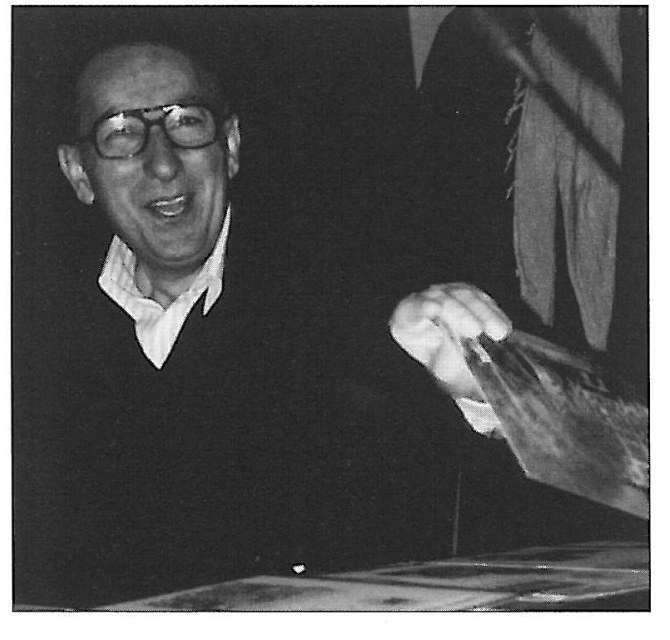
The matter is the bringing into being of a comprehensive system from which various architectural projects are extracted. Hence taste, choice and decision become bound to the form-generating capacity of that whole system, which Libeskind calls the architecture machine. This discussion, which is fundamentally conceptual, has only one weak point: in the first move, which is the choice and start-up and the application of view or taste to bring the machine, or the principal system, into being. After this stage, architectural works are born from the logic of the machine, and the application of taste and choice in it is reduced to the minimum. Its external reflection is that the project is not sketched out, no idea is needed; everything has been determined in advance and is only adjusted by the new policy or rule. So the application of taste or choice is theoretically negated. But since the presence of choice or taste in the first stage cannot be avoided, this machine becomes time-bound, and its reach becomes dependent on changes in taste and the architect's domain of choice — which lie in the external matters.
Its merit is the release from the wavering and dilettantism that comes with early neo-classical post-modernism. Its problem is that, if it does not change with time, after a while it becomes uniform, abstract, and irrelevant to the constantly changing and active outside world; if it tries to change, it brings the question of choice and the application of view and taste back to the field. Even Mirmiran, in his recent Berlin lecture, returns to the idea and reminds us of its importance — that is, the idea at its highest level. His pointing to the importance of the idea negates the matter of indecision to which Shirdel refers. The idea needs decision. But the matter itself — the architecture of architecture which Libeskind raised, by virtue of bringing into being a conceptual space and a distanced view of the workings of architecture, and putting forward a comprehensive question for architects, namely the design of the architecture machine before tackling the design of architectural projects — is admirable and worth deep reflection (see Libeskind, Three Lessons in Architecture: The Machines, 1985).
Footnote
1. Three Lessons in Architecture: The Machines (1985), Daniel Libeskind.



