Contemporary Architecture

Bagh Mashhad, Isfahan

Hamaan Studio, Behrouz Shahbazi·Photos: Como Studio, Mohammad Soroush Jooshesh·Memar 154 — 25th Memar Award
Bagh Mashhad, Isfahan
Location: Bagh Mashhad Street, Isfahan · Clients: Aghaei, Bagheri Nejad, Tavakol, Zandifar & Other · Project Managers: Masih Moshgforoush, Kimia Mohammadi · Design Team: Sharareh Pooladsaz, Zahra Shokrollahi, Faraz Tahmasbi, Ahmad Mousavian, Fahimeh Mohammadi · Graphic & Presentation: Faezeh Alavi · Construction: Hamed Aghaei, Mohammad Moghadam · Structure: Khosravi · Mechanical: Safaei · Electrical: Kaffash · Supervision: HAMAAN Studio · Photo: Como Studio, Mohammad Soroush Jooshesh · Area: 450 m² · Built area: 2,420 m²
Architecture, whether in its details or in a more holistic view, is nothing other than a continual rethinking of how limbs and spaces connect.

The Bagh Mashhad project came to the studio in 1399 [2020]. On a street leading to the river. The project’s clients were five related partners who wanted five identical units on five floors above the ground level. Creating spatial variety through changing unit typologies across floors was therefore not possible for the designer.

The design intervention focused on a single concentrated change: rearranging the connection of open and semi-open spaces and the hierarchy of access in the conventional apartment typology, with a glance at the history of the house in this geography. The design question was this: how can these limbs be joined so that the forgotten possibilities of the home are revived? Can a role resembling the inner and outer courtyards of the past be bestowed upon today’s balcony?
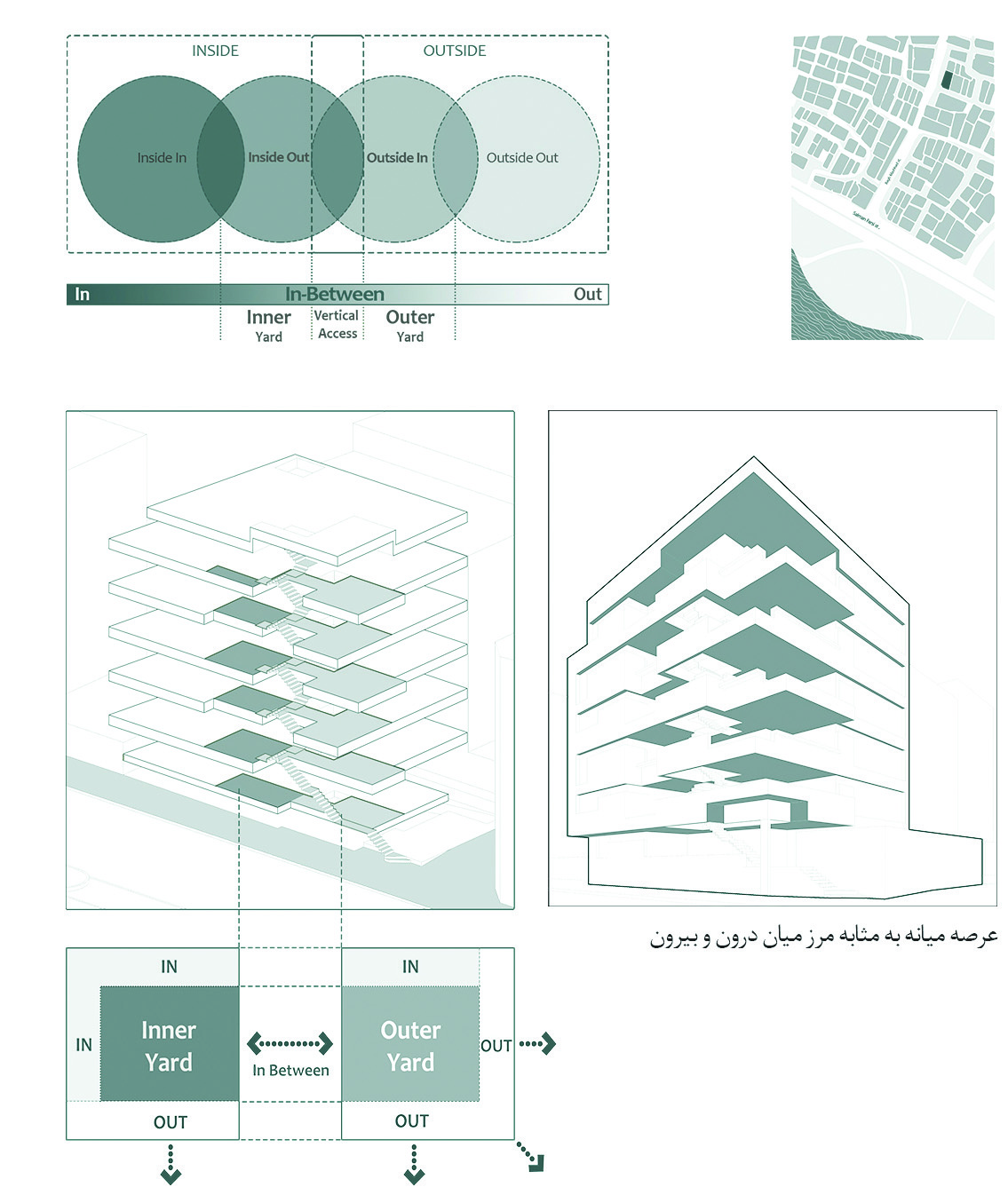
Concept diagrams showing the inside-outside duality, inner yard and outer yard configuration, site plan, and the transformation of boundary into threshold
Concept diagrams — transforming the boundary between inside and outside into a spectrum-like threshold

Rethinking the connection between vertical access and the balcony created the possibility of a fresh spatial order — one that re-establishes a spectrum from private to public within the apartment.

♦ ♦ ♦

The In-Between Realm

One of the possibilities that rethinking connections offers is how to transform the border between a duality into a spectrum-like realm. If we view the threshold between the duality of inside and outside as a mere boundary, no space remains for being in-between. But if this sharp line is transformed into a realm — a threshold — something emerges in the middle that adds new qualities to life.

In this project, the two inner and outer courtyards both play the role of these added intermediate spaces and serve as the backbone for shaping all other spaces of the house, redefining and blurring their boundaries. This geometry is the basis of the overall plan, and all spaces of the home find their place in relation to the skeletal structure of these courtyards. The courtyards are places where outside and inside encounter one another.
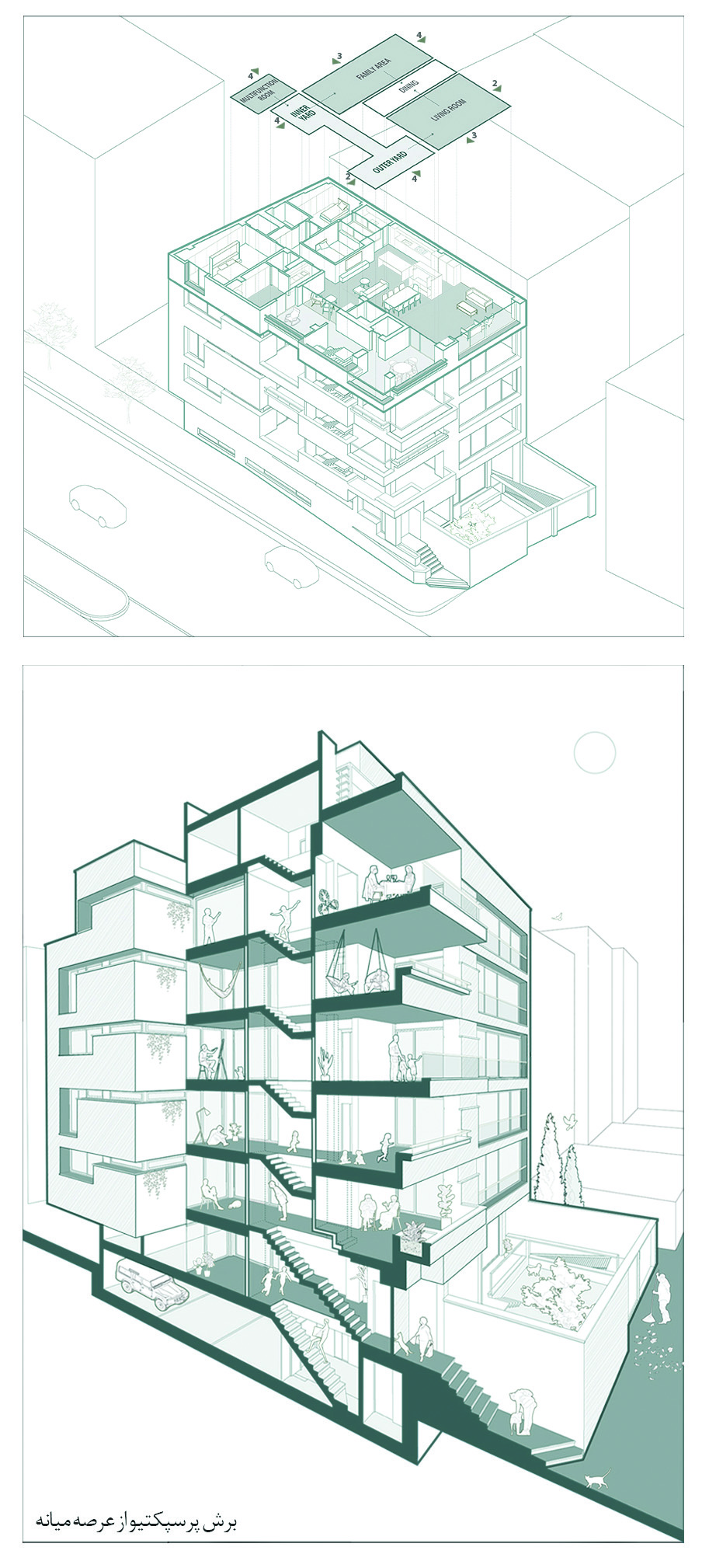
Isometric cutaway drawing and perspective section showing the multi-storey apartment building with inner and outer courtyards, vertical access core, and the middle realm between them
Perspective section through the middle realm — the inner and outer courtyards articulating the building’s spatial order
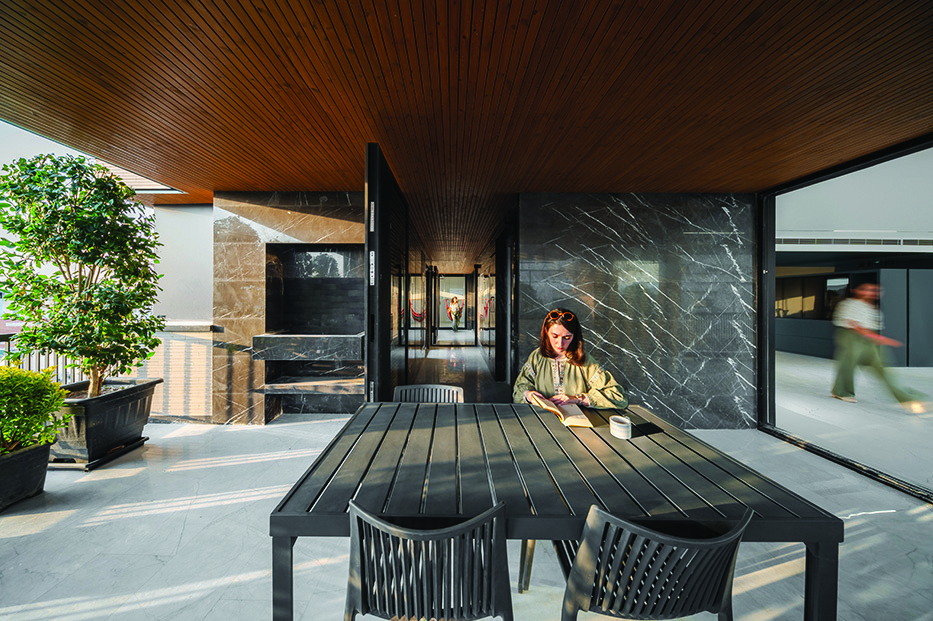
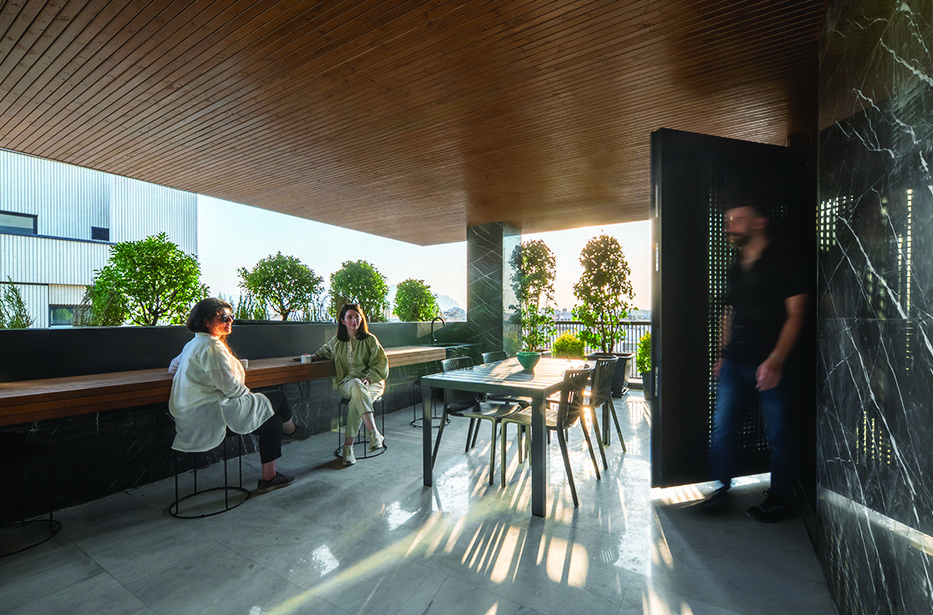
The outer yard terrace with dark marble walls, wood-panelled ceiling, a woman seated at a dining table reading, and a corridor leading into the interior
The outer yard — marble, wood ceiling, and a dining terrace open to the sky
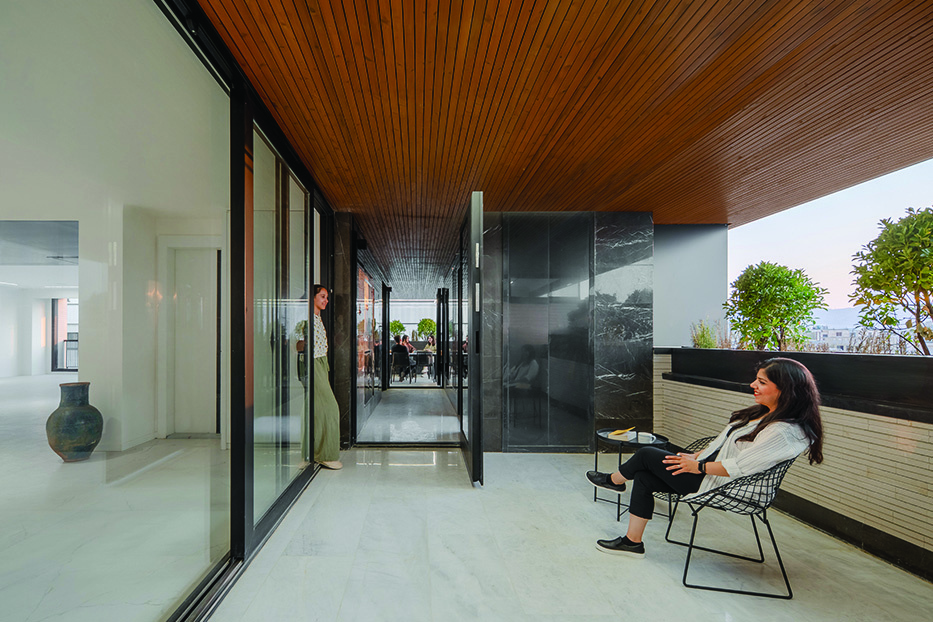
Terrace with a woman standing at a glass sliding door and another seated in a wire chair, wood ceiling overhead, greenery along the parapet
Terrace threshold — glass doors dissolve the boundary between inside and outside

The two-courtyard diagram has yielded different possibilities in the spatial order of the entire home — possibilities that can even extend to the major spatial divisions of contemporary life. First, it provides separate access to a space that, while working with the house, can also function independently with the outside: a space that can serve as a guest room, offering new possibilities for cohabitation; or be a home office in a house that alters the spatial division of life in contemporary times — a life that had taken bodily form in the separation of workplace from home, and many contemporary crises, such as the pandemic, reminded us of the necessity of thinking in other forms. Likewise, it can be a supplementary space for the relative independence of the family’s children, who, as a result of the housing crisis, have not yet been able to separate from the family.
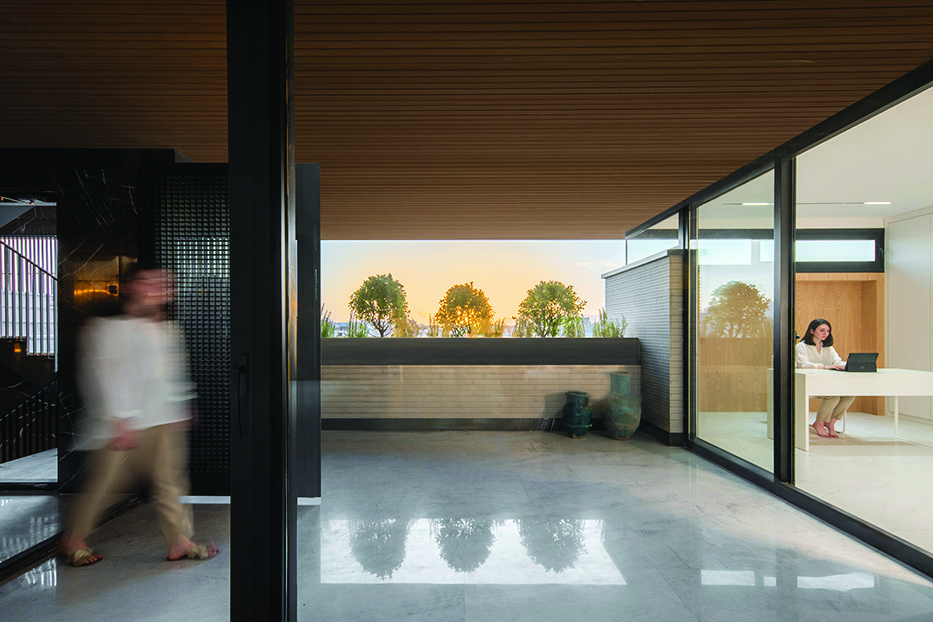
Corridor and terrace at sunset, a blurred figure walking past dark marble walls, a woman working at a desk visible through a large glass window, trees along the parapet catching golden light
The sunset corridor — where indoor workspace meets the open-air terrace at golden hour
♦ ♦ ♦

The Sunset Nook

Among the architectural possibilities of this diagram is a different use of light and the sunset vista. The western frontage of the plot is the longest, and the placement of the courtyards on the western face means that one need not follow the perennial rule that western light is undesirable. The courtyards are hinges that filter the western light, and the space adjacent to them becomes a cozy nook facing the framed sunset — a space we have named the “sunset nook” in this project.
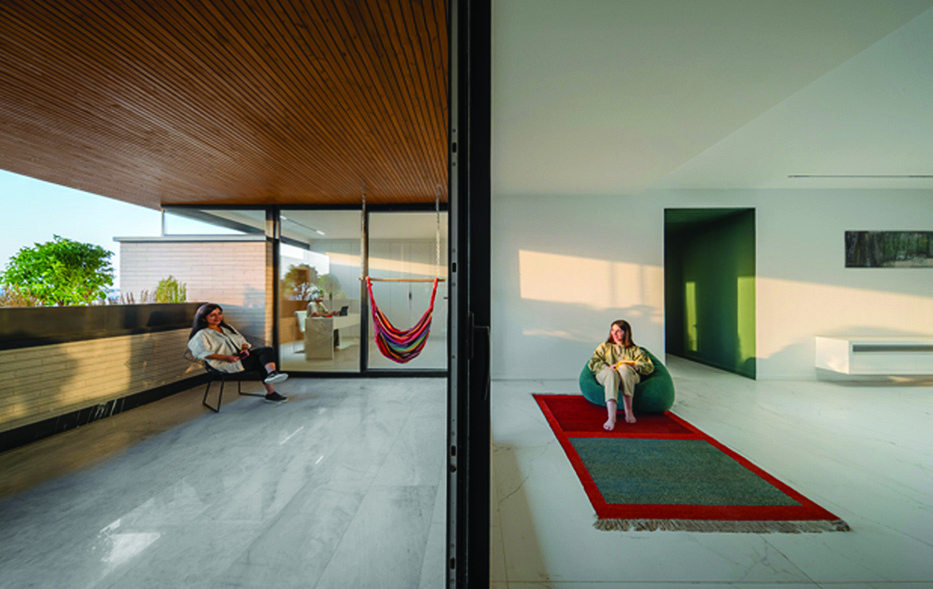
View from the terrace into the living space: a woman seated on the balcony, another lounging on a green beanbag on a red rug inside, a colourful hammock hung between, sunlight streaming in
The threshold between terrace and living space — hammock, beanbag, and afternoon light
The outer yard at sunset with three people gathered around a table, lush potted trees along the parapet, dark marble walls, warm golden light filtering through the greenery
The outer yard at sunset — gathering under the wood ceiling as golden light filters through the greenery
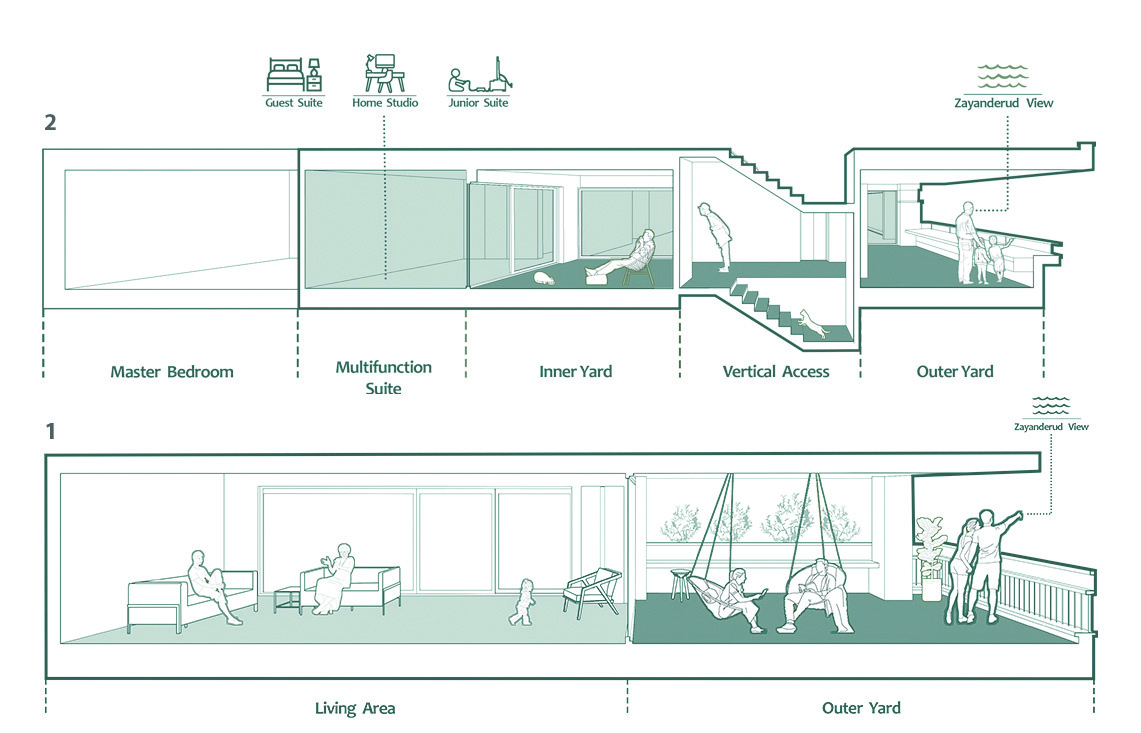
Section diagrams of floors 1 and 2 showing the living area, outer yard, master bedroom, multifunction suite, inner yard, vertical access, and Zayanderud view
Section — floors 1 and 2, showing the inner yard, outer yard, and vertical access core
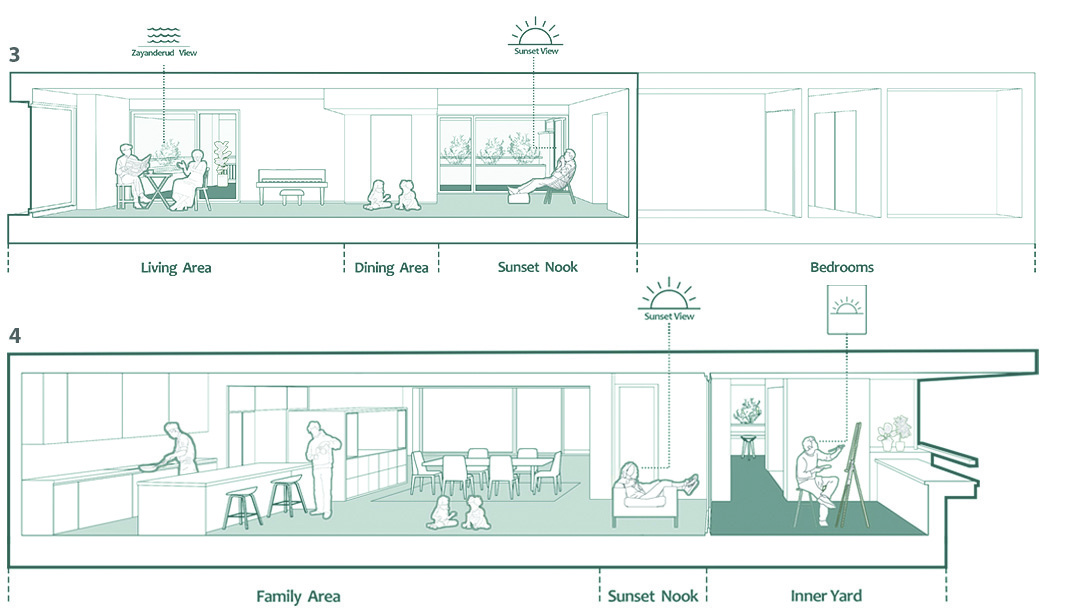
Section diagrams of floors 3 and 4 showing the living area, dining area, sunset nook, bedrooms, family area, and inner yard
Section — floors 3 and 4, with the sunset nook, family area, and inner yard
♦ ♦ ♦

Interior Spaces

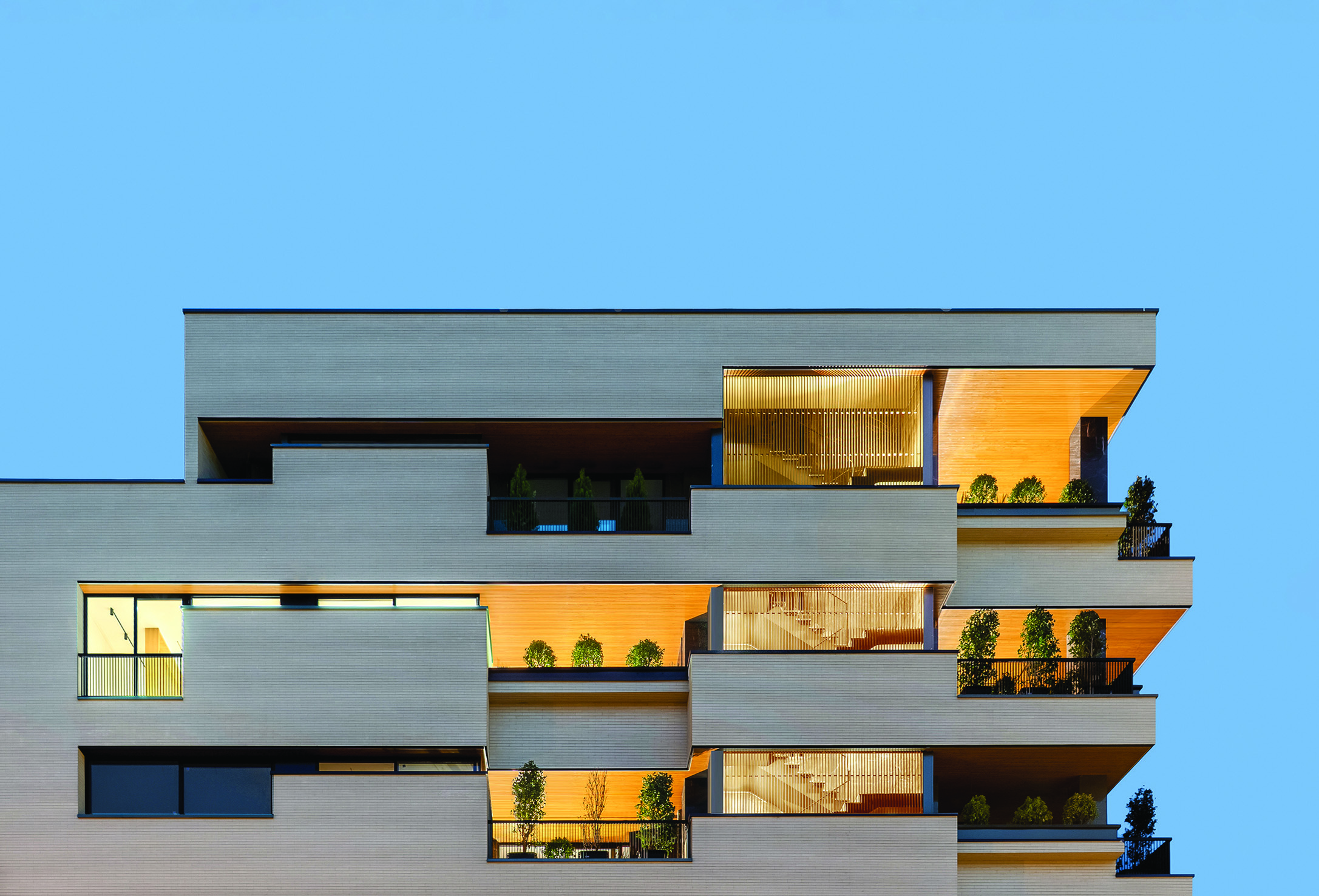
The fracture in form, volume, and structure at the building’s midsection has shaped better interior spaces: units with different configurations — two duplex units, one triplex unit, and three units with a split-level structure. On the southern side, terraces have been designed that, through their elongated depth, both preserve privacy and provide horizontal views toward the southern mountains and Bagh-e Malek Abad to the north.

The terraces, as semi-open spaces, are a response to the growing need of contemporary users for connection with the outdoors, natural ventilation, and a more liveable experience within urban density. The fracture in the building’s form and volume has also brought about an effective separation of public and private spaces. Residents can live in peace in the private section, and only when needed, join guests in the public space.
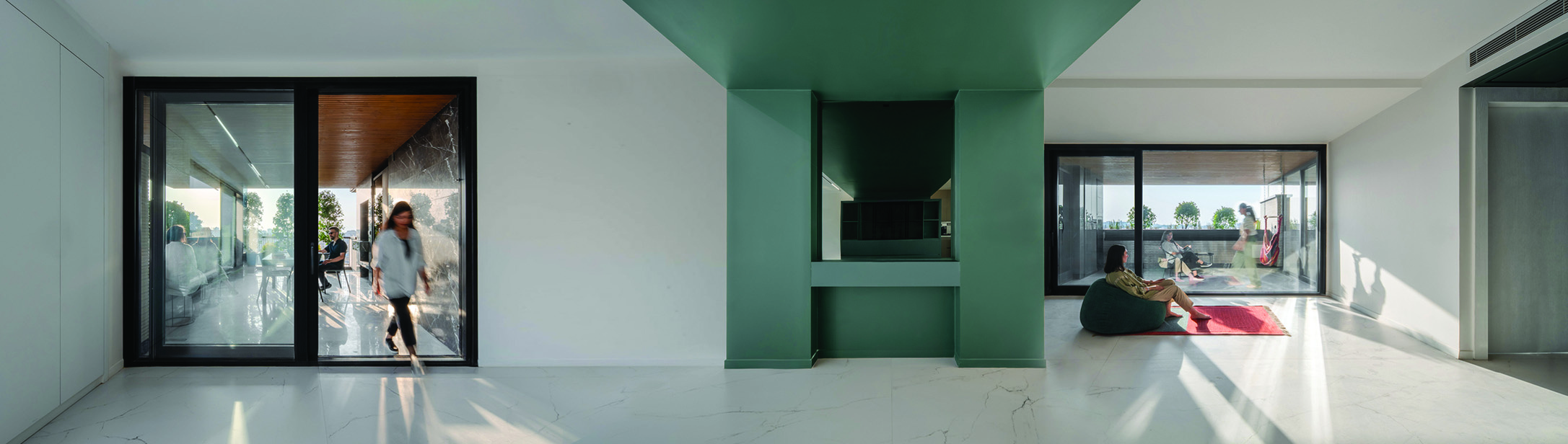
Wide panoramic view of the interior: a woman entering from the terrace through a large glass door on the left, a green-painted volume housing the kitchen and storage in the centre, another woman lounging on a beanbag on a red rug to the right, with a second terrace visible beyond
Panoramic interior — the green volume anchors the open plan between two courtyards

This design thinks not only of the comfort and privacy of residents, but also of reducing energy consumption, preventing waste in unnecessary spaces. In the building’s facade, attention to the third dimension has created a separating boundary between the duplex, triplex, and other units; this differentiation is expressed three-dimensionally, separating the volume from flat surfaces.
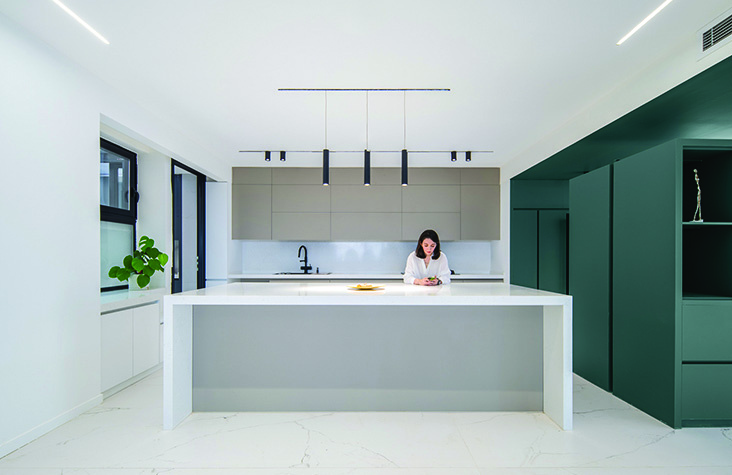
A minimalist kitchen with a white island counter, pendant lights, and a dark green cabinetry wall, a woman seated at the island, a potted plant by the corner window
The kitchen — white island and green cabinetry wall, light from the corner window
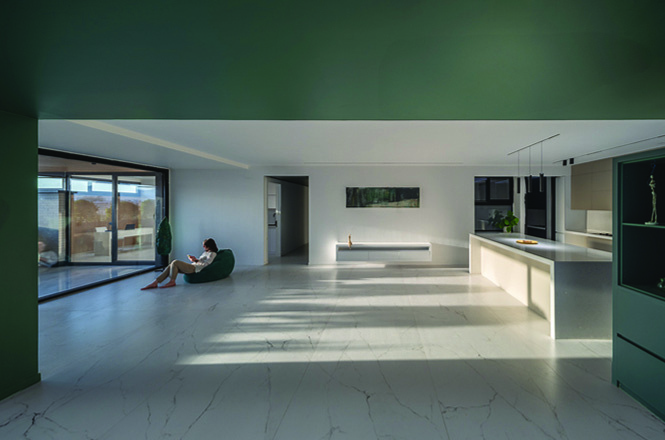
Living room with a green-painted ceiling continuing from the kitchen volume, a woman reading on a green beanbag by the glass door, the kitchen island visible in the background
Living space — the green ceiling extends the kitchen volume into the communal area
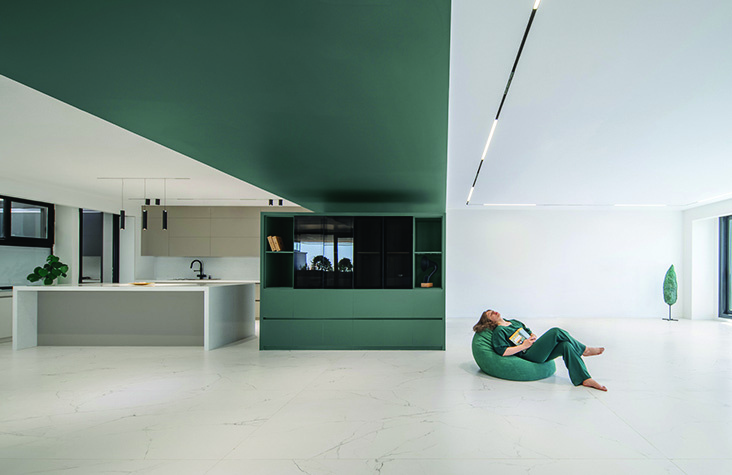
Wide view of the open-plan living and kitchen area with the green volume running across the ceiling, a woman in green clothing lounging on a beanbag on the floor, track lighting overhead, the kitchen island visible to the left
The green volume unifies kitchen and living space under a continuous painted ceiling
Floor plans for all levels: ground floor with parking and yard, floors 1 and 3 with inner yard and outer yard, floors 2 and 4 with inner yard and outer yard, and the penthouse floor 5 with expanded yard
Floor plans — ground level through penthouse, showing the inner and outer yard configuration on every floor
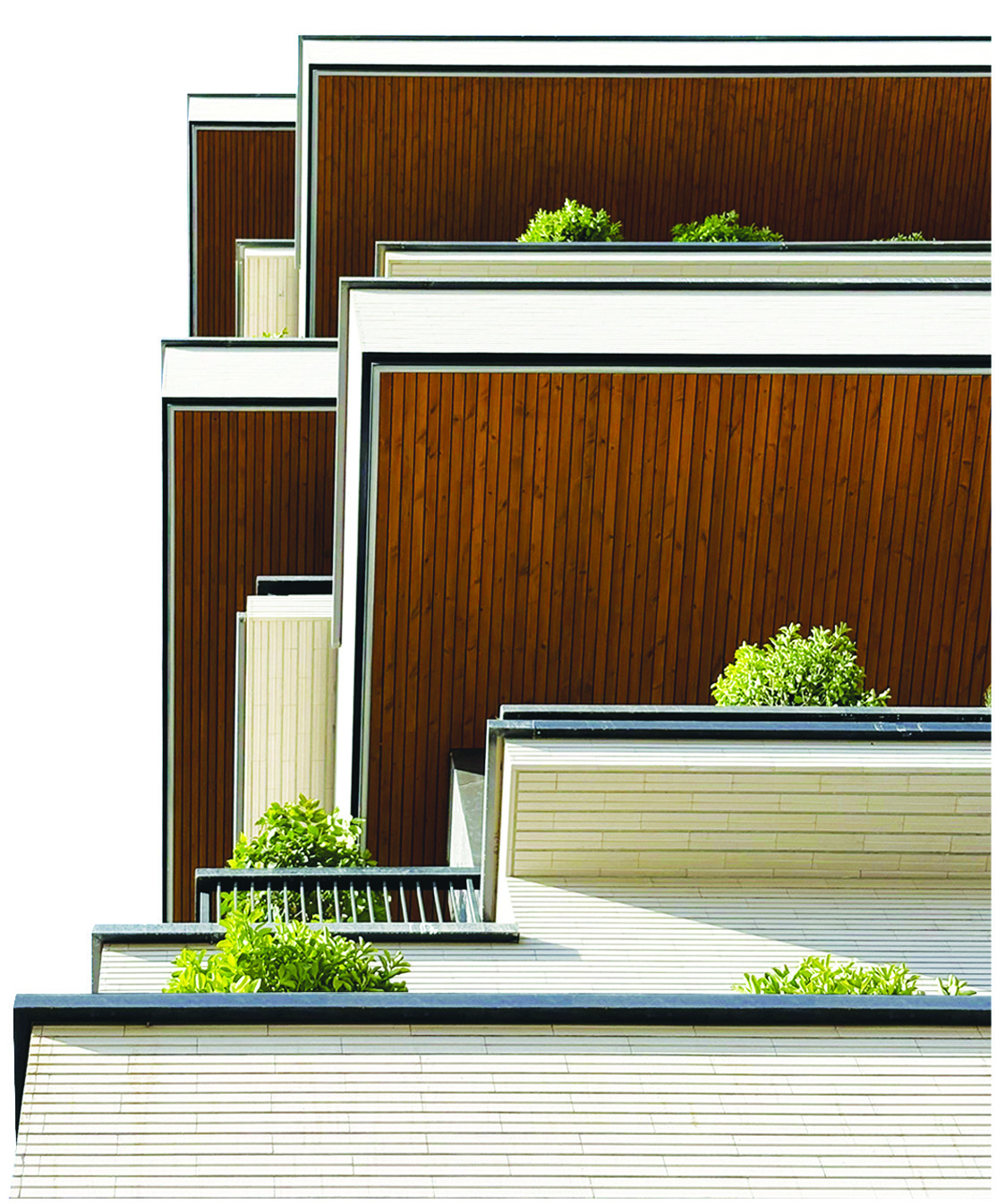
Close-up detail of the building facade showing horizontal concrete slabs with warm wood cladding and green planters on staggered balconies
Facade detail — staggered concrete volumes with warm wood lining and integrated planters
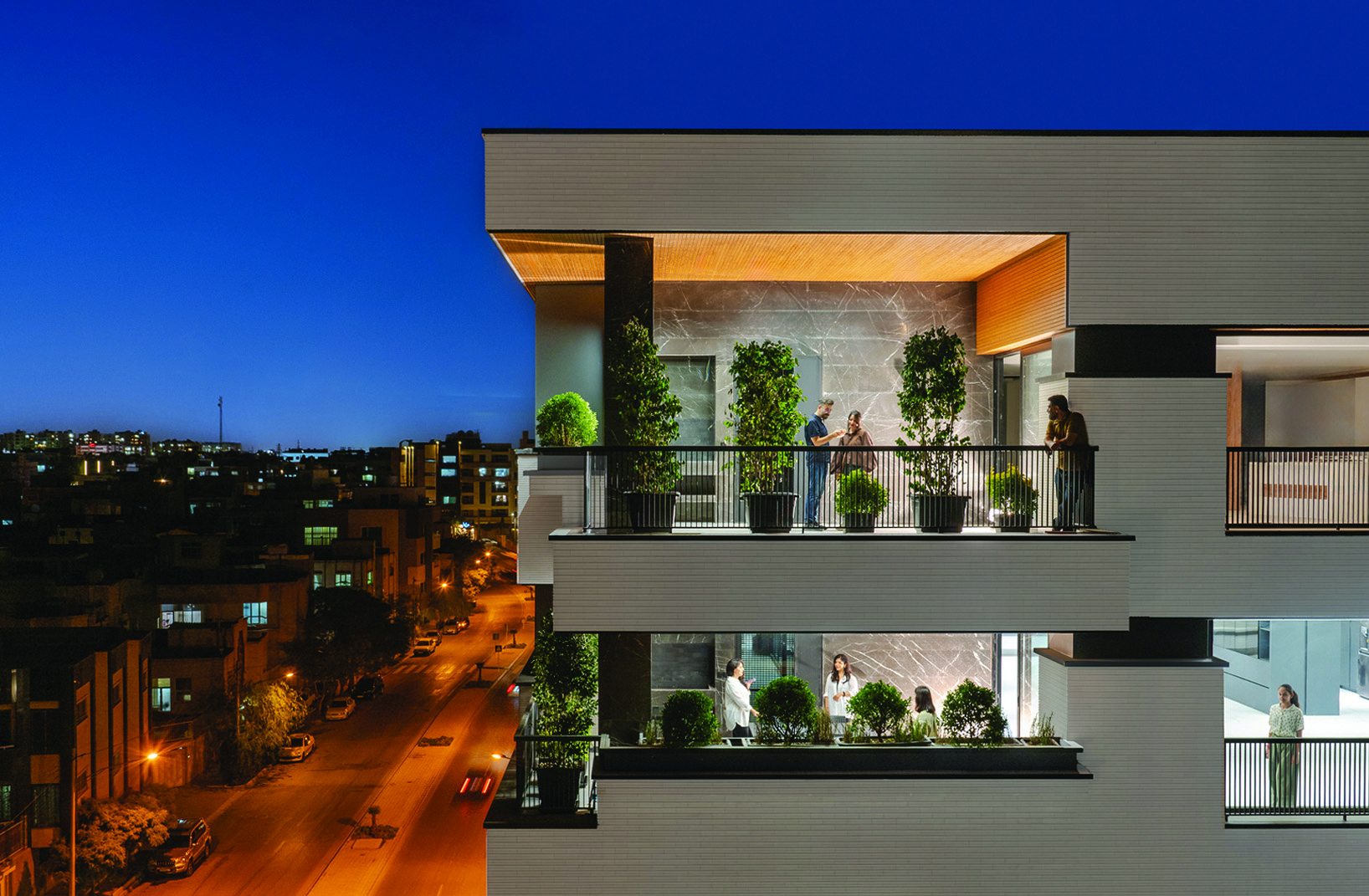
Upper floors of Bagh Mashhad at blue hour, people gathering on two levels of balconies with potted plants, the illuminated street and city skyline visible below
Balconies at blue hour — residents gather on the terraces as the city lights up below
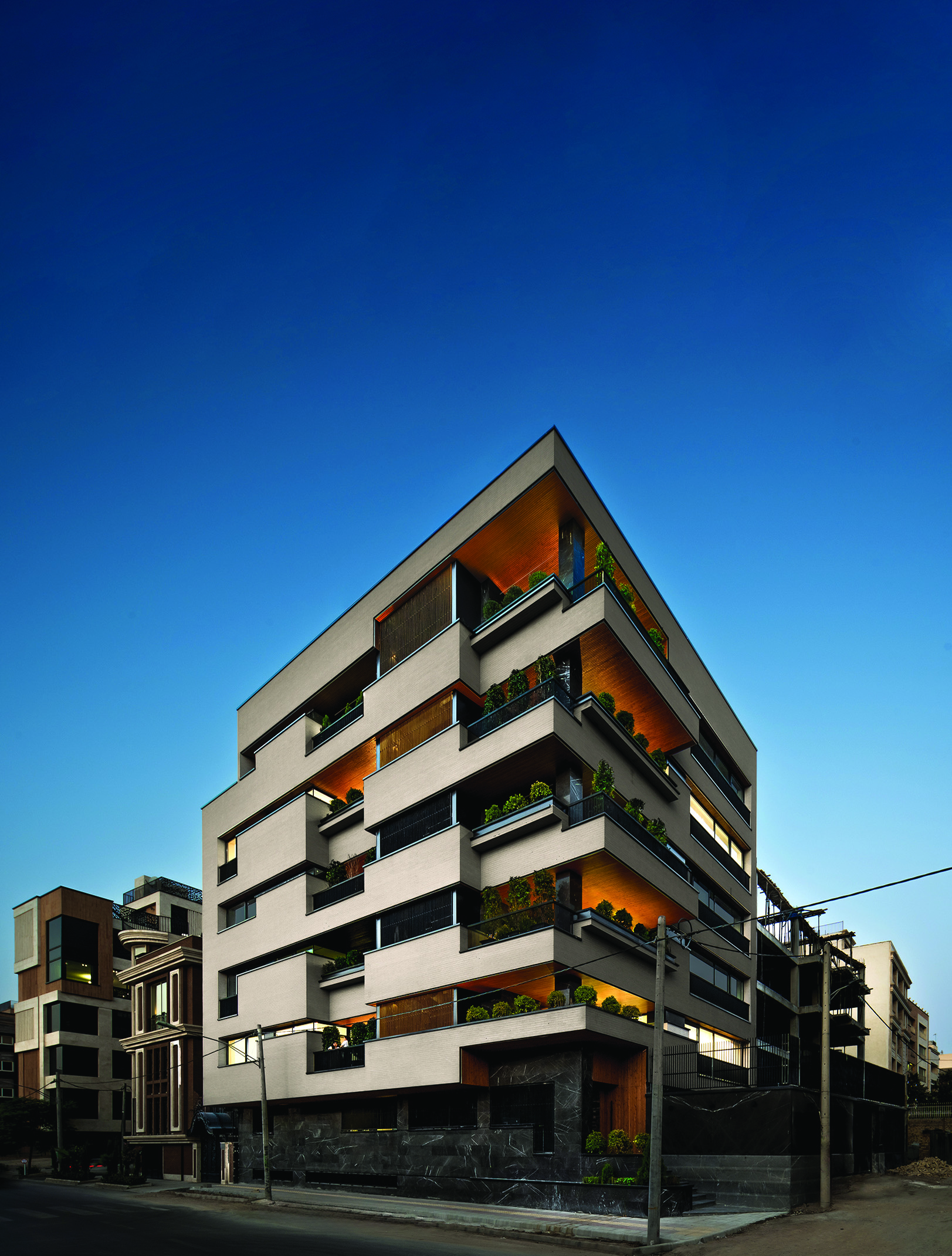
Full corner view of Bagh Mashhad at dusk, the multi-storey apartment building with staggered balconies illuminated in warm light, against a deep blue sky, neighbouring buildings visible
Bagh Mashhad at dusk — the staggered balconies glow warmly against the evening sky

Related in Architecture Database