See how they have fed the people ten doses of diazepam. / See how they have made a fashion of the cleric's hypocrisy. / See how, in place of glass, they break the plexiglass. / See how we pay for oil, water and electricity. / See how number has besieged the people's thought.
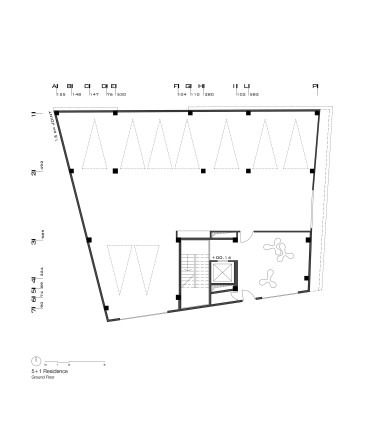
One of the most ordinary and most frequent non-infrastructural building types in our endlessly expanding cities is the five-storey-over-pilotis residential block — the "co-developed infill" — which is shaped by market logic alone, on the basis of trust between owners and a developer. Architects normally have no place in these unending constructions! "Five Plus One" was a project of exactly that kind: five owners holding sixty percent of the share, and one developer holding the other forty, plus a strict materials list! Beyond the prevailing municipal codes (site coverage, permitted footprint, permitted density, position of the stair core in line with fire regulations, and so on), and beyond the capital-driven logic of the real-estate and economic markets, the partnership contract was the inescapable engine of this routine urban project! By contract, the floors had been divided into eastern and western units with a sharp boundary, down to the square decimetre, matching each party's share. The eastern units would be occupied by their owner-residents in turn by floor; the western units belonged to the developer.
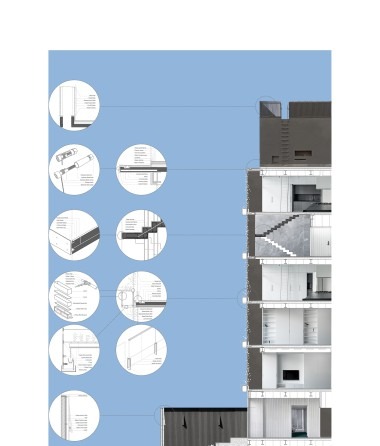
This time, as architects, we tried to raise the quality of architecture — too often forgotten in such projects under the assumption that it would shrink the developer's margin — without imposing additional cost. It was an attempt to bring the architect's role into the busy transactions of many owners and developers! We tried to push past the materials (which were fixed) and past the variety of plan partitions (set by share-numbers and the owners' personal rivalries), with strategies that were architectonic, experimental and industrial in the creation and experience of space on one hand, and with self-built detailing in place of imported technologies and materials on the other — and so to raise the quality of the lived spaces.
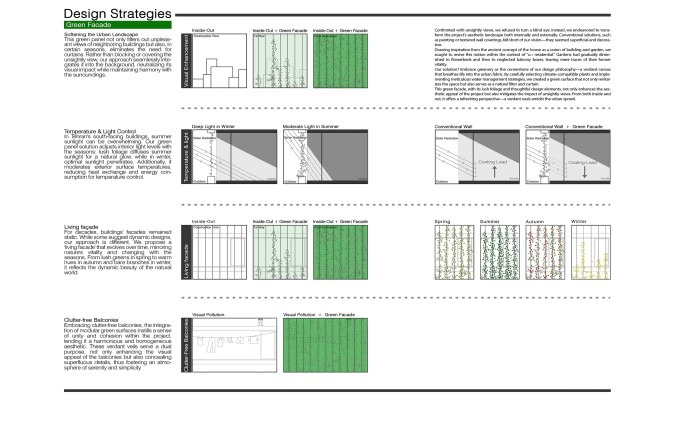
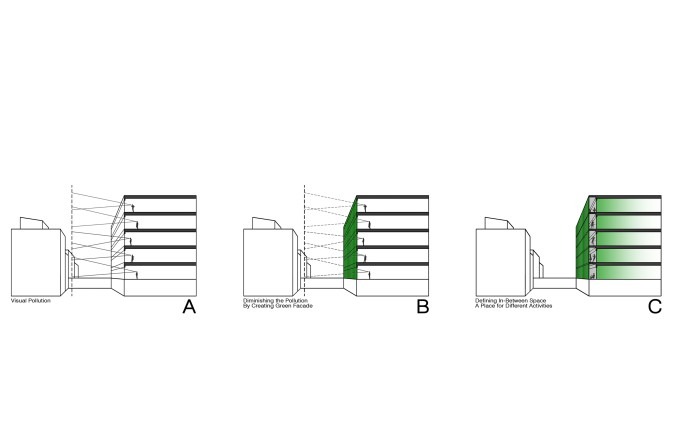
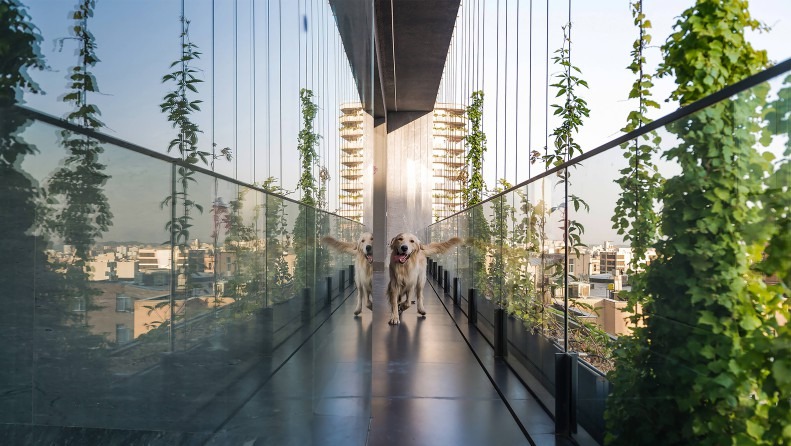
The project site is bounded on the south by nine heterogeneous, ungrooved and waqf-held lots, three to four metres wide, with varying storey counts. Our central question was: what should be seen from outside and what from inside? We decided to create a view for a project that had no view of its own — both from within and without! In its older meaning, the house was a composition of building and garden — gardens that gradually gave way to small courtyard beds, and then to planters on terraces that, neglected and irregularly watered, soon dried up and were left as packets of soil occupying space. We thought: to revive this distant idea and reinforce that feeling at home, we would make the use of green growth the pretext and the principal subject of "Five Plus One." We defined a green surface that would restore the outlook from both inside and outside, and that would place the disagreeable southern view out of focus, blurred in the background.