
What follows is the text of a conversation between Kamran Afshar Naderi and Reza Daneshmir, members of Memar's editorial board, and Mehrdad Iravanian, held in the summer of 1382 SH (2003), about his designs for the Iran Gas Company Building and Sadra Park in Shiraz.
Editorial Abstract
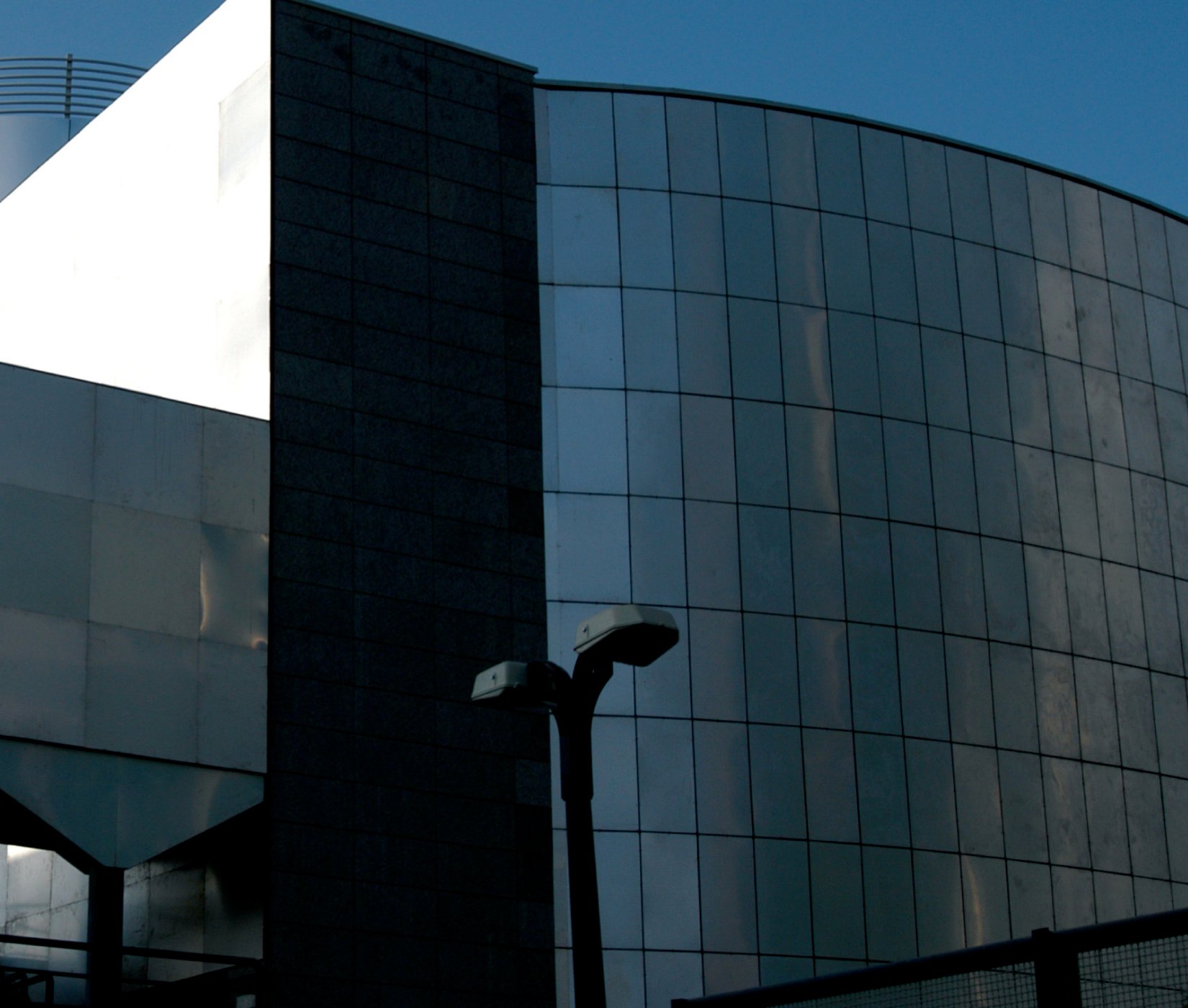
Mehrdad Iravanian, designer of Iran Gas Company Building and Sadra Park in Shiraz, has responded to the critiques made on his project by Kamran Afshar Naderi and Reza Daneshmir, members of Memar magazine editorial staff. Afshar and Daneshmir believe that the plan lacks a general concept harmonising the different parts. To their eyes, although the elements of this project are skilfully designed and executed and despite the fact that the project includes some dramatic scenes, it has turned out to be a collection of irrelevant, delicate elements and beauties. In this collection, the details are dealt with in the same level as programming, aesthetic and architectural issues.
Mehrdad Iravanian responds to their critiques by criticising the accepted viewpoints on the relationship between the plan and the space arrangement. He goes on by insisting on negative space in architecture and the beauty of collage, as method, in which all elements could be juxtaposed without complying with the customary value judgment hierarchy.
The Gas Company Building — Opening Critique
AFSHAR: When I saw the images of your recent work, it struck me that work like this is rarely executed in Iran, which makes it very interesting. The details are also very well designed and built. But there were issues we wanted to raise with you.
I have written about your work before — that it is narrative in nature. It is not in search of a single overarching idea that harmonises all the parts. Or if such an idea exists, it is at the philosophical level, not in the architectural form, which is entirely heterogeneous. In Persian, "heterogeneous" has been translated as naahamgun (non-homogeneous), but that carries a negative weight, whereas in English it simply means a phenomenon whose parts have no obvious relation with one another. This narrative quality has produced a work that discovers and advances through stories that are not necessarily related in a homogeneous way. But in architecture we are used to feeling a relation between the components of a whole. Here, the perception is visual. About this project specifically: it seemed to me that it has many attractive elements, well-executed, that build good spaces. But when I look at it as a whole, certain issues come up.
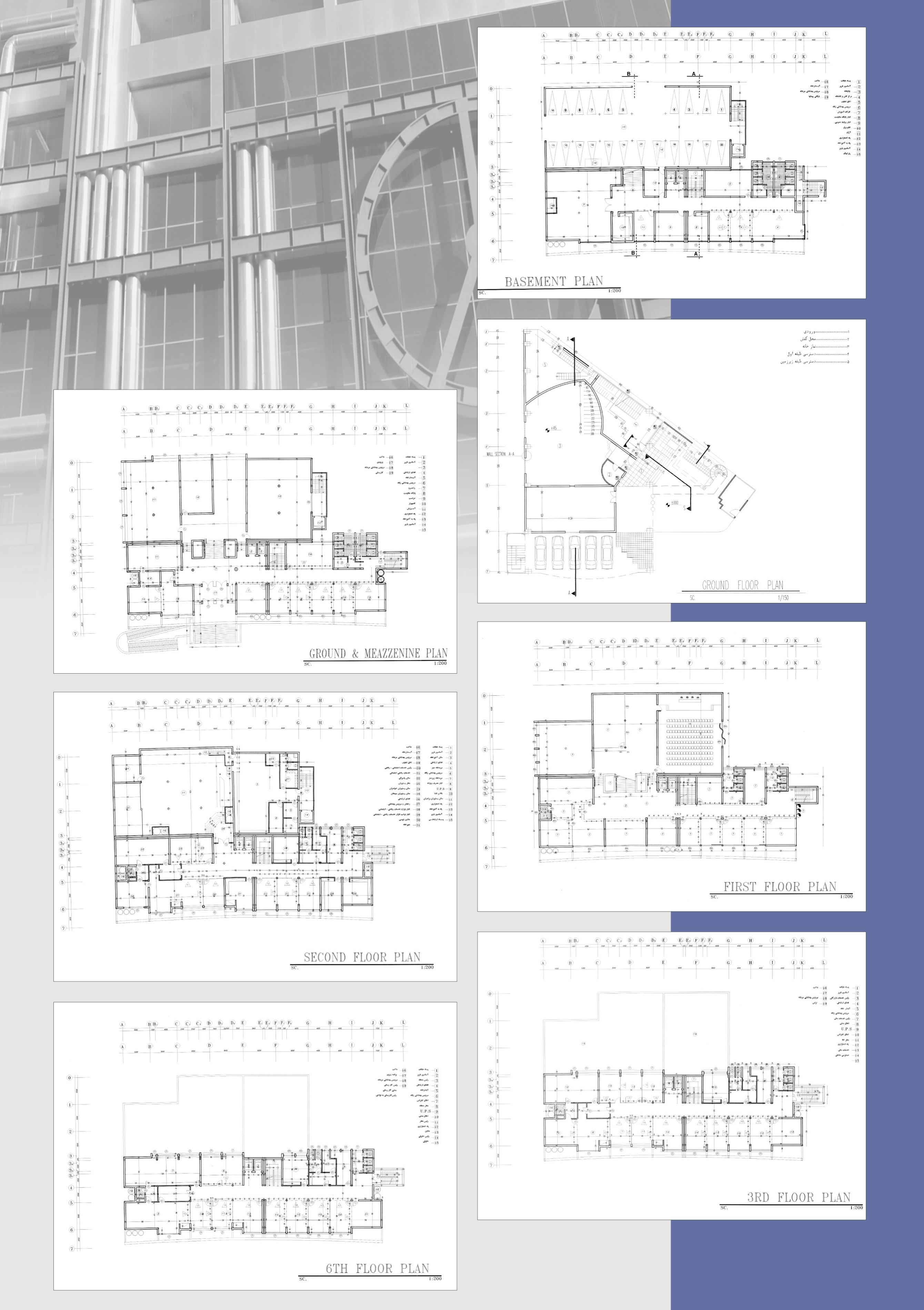
One of these issues is the plan, which seems out of step. The same goes for the facade — the skill visible in the details is not visible there. I have met other architects who present an attractive small project, but as the project grows larger the contrast in their work can become so strong that legibility drops, and the contrasts begin to fight one another.
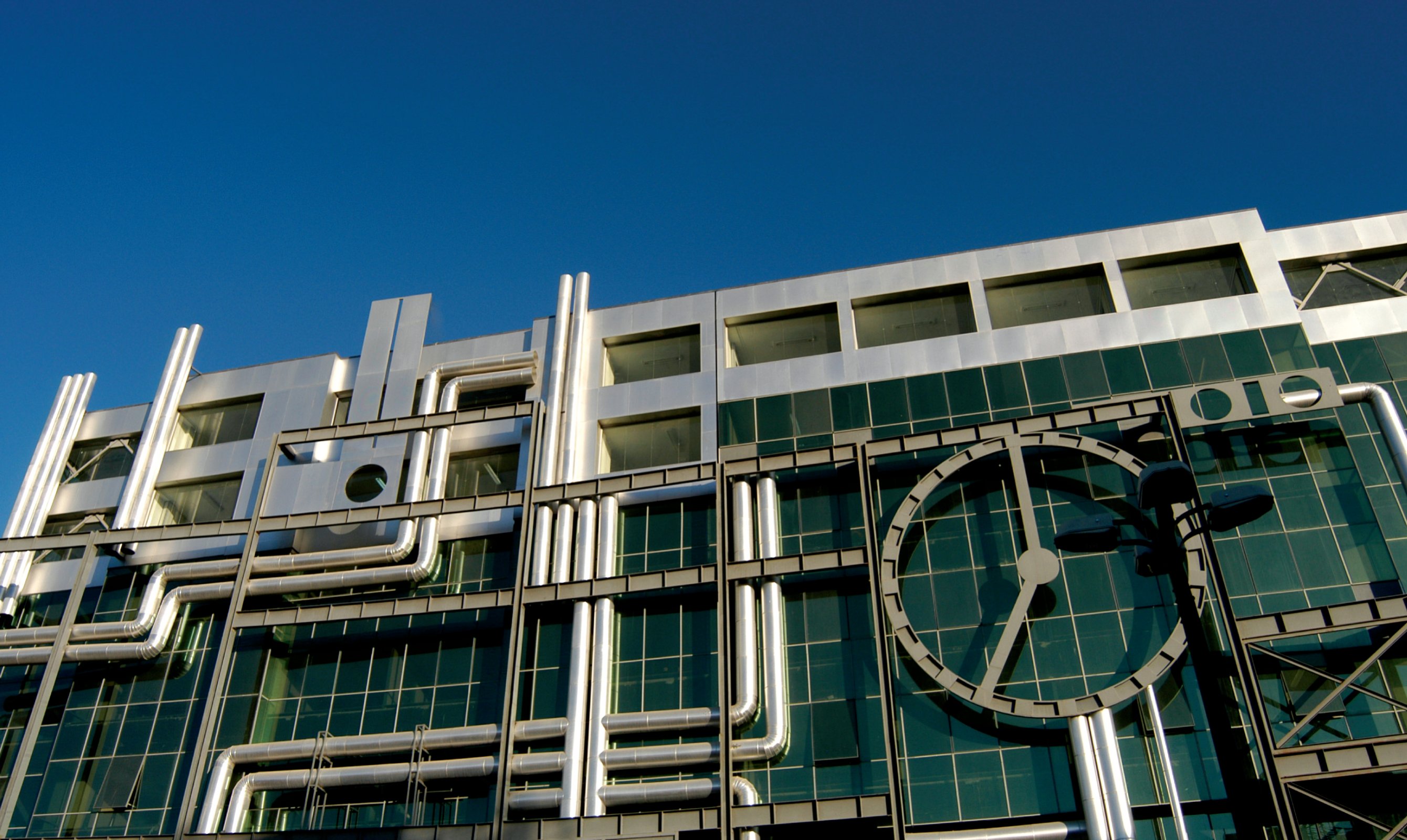
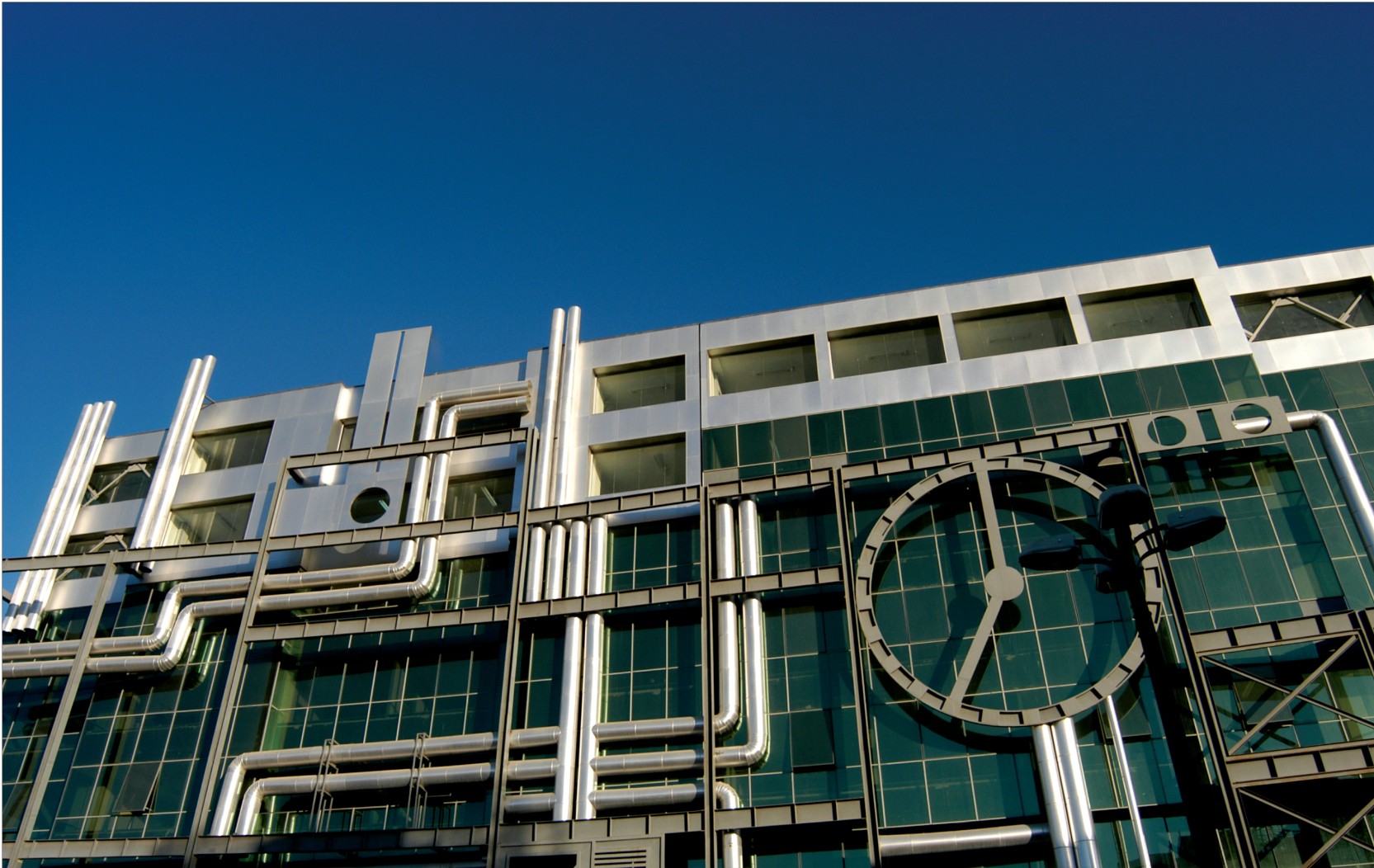
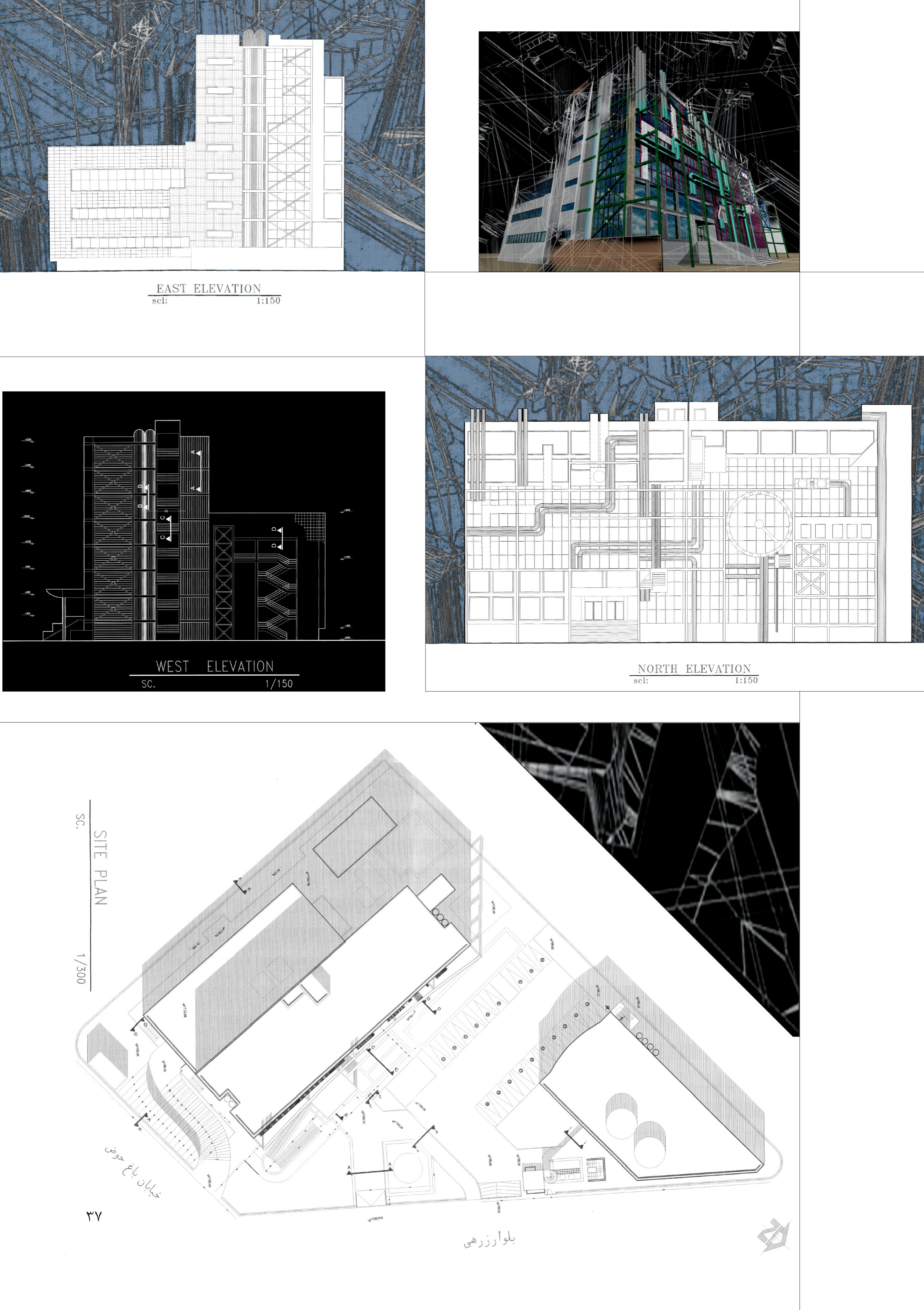
A positive note: the project has high construction precision, with only a few exceptions you will surely improve in later projects — for instance the bracing, which feels neglected, and that hurts the work. When the facade of a project as a whole gives an impression of stage-set artifice unconnected to the building's content, questions arise about whether, for example, the ducts shown are real. To understand, I studied the drawings very carefully, but those things get lost in everything else done for the sake of an overall impression.
Beyond that, in the spatial composition of the corridors we have one architectural language; in the hall, another language; in one place a "Sudic" tone, in another a cold English high-tech tone. As if a set of different characters that weaken each other.
Another positive: in the interior spaces, the floor, ceiling and wall dissolve into one another. The way the four surfaces of a corridor or interior space are treated lets the four sides feel as one. There is no clear definition of ceiling, wall, floor. This is the strength of your artistic work, but this strength does not align with architectural strength.
DANESHMIR: I too have written about your work before, and I have followed it through the magazine. The first thing is that you appear, over these few years, to have undergone changes that interest me. You were not what one might call a "clean" architect, but now you are, or you try to be. I am not saying that is better or not — my point is that your character is changing. For that reason, at first sight, this did not look like your work to me.
You have a figurative bent that links together in a chain. This gives you the power of image-making — you are an exceptional image-maker. In Chamran Park, where you had freedom of action, this ability is very well presented. There you have narrated easily. The question is not whether someone likes it or not; the point is that the work has been suitably and rightly presented. But in architectural work, I think the question of narrative or image comes up in the final stages. Image is the last stage we meet in an architectural project. In architecture, the important issue is spatial organisation. But it seems to me that in your projects you want to pass through this question very quickly, as if spatial organisation is not your work. Perhaps I am mistaken, but both in House No. 3 and the Gas Company project it seems you have rushed past spatial organisation to arrive at the narrative-and-image stage you want. The visitor does not see the spatial organisation; only sees the image. This creates a kind of duality in the whole project. A project cannot have ordinary spatial organisation but unusual imagery. When these two do not fit, the project becomes false — a kind of stage-setting that has no real relation to the work's essence.
Iravanian Replies: The Astronaut, the Plan, and the Negatorium
IRAVANIAN: I myself do not understand certain things. For example, the separation you draw between spatial organisation and other categories. Let me tell you a few episodes. Imagine an astronaut with a white parachute suspended in a completely dark void without dimension. We cannot tell his orientation or his relation to the ground — whether gravity acts on him. Now I come to you and ask: can you draw a plan for this astronaut, in this state? For the astronaut to acquire spatial meaning, take away his parachute. Because he is suspended in air — in what I call the "negatorium" — for now meaning is suspended. Then you want to give him state by planometry, so you draw a circle around him. Now put yourself in the astronaut's place: standing on your feet, lifting your hand above your head. The meaning the plan has is transferred to the volume above the head. The shape has not changed much — geometrically it is the same as the plan beneath the feet. But because it is up in space above the head, its meaning is entirely different. Here, due to his being in a wilderness and darkness, he feels he belongs nowhere. In the case of the plan, that need not be so.
In a third episode, consider ourselves. One metre above the ground, say from the knees, draw a plan of ourselves. Every section we take of ourselves at different heights yields a different plan. And when volume takes shape, it has no resemblance at all to what is in the human plan. Therefore, in my view, there is no readability between the planometric subject we observe and the multi-dimensional phenomenon. These doctrines are widespread in universities. The view that the plan must contain the same spatial relationships and organisation is, in my view, very elementary. Consider cars: you can draw the plans of ten different cars and ask which is which — all have a three-seat and two-seat arrangement with an engine in front. What distinguishes them is the development of the third dimension. You can have a highly exciting, well-organised plan with all good cross-sections, but when it becomes volume, something mediocre comes out. In the very building we are discussing, if there were no roof, the plan would be entirely classical — entrance, vestibule, stairs, corridor, rooms on two sides, a meeting room at the end, like 1940s–50s Iranian buildings and the International Style.
So, in my view, what we do in three-dimensional architectural form-giving and what we do in the plan can be separate. Just as the plan of a cylinder and a sphere can be identical, you can draw the plan of a silo that is a composition of various cylinders, but when you assemble them and lift them upward, something else emerges. Why do we always work on plans this way? Why don't we, say, design vertically instead of horizontally? Because it is harder.
So I feel that a later stage is needed for it to become architecture. The plan may be necessary, but it is not sufficient. I consider architecture the final stage. The best forms can turn out trivial, and the most ordinary geometric events, when they grow, become other things. Many times planar designs are interesting, but when we reach material — concrete, a material — it becomes difficult (referring to Zaha Hadid's designs). I love the kind of plans you describe, on condition that they can reach the same agility they have in their suspended state. But many times this is not possible — a plan is one thing and the ceiling design is something else entirely (referring to the ceiling design of an office by Himmelblau).
Plan, Heterogeneity, and Foster's Inheritance
AFSHAR: Yes, I accept there are projects where the facade or the plan are not the issue, because they are seen as space-form. But your project IS a project where the plan and the elevation are important — from the standpoint of design it is completely on the lines of the usual approach. It is not like Greg Lynn or Frank Gehry or Himmelblau projects. That is why we paid attention to the plan. Greg Lynn, for example, has a book in which he discusses the Statue of Liberty in a very interesting way, comparing the disconnect between its plans and its external form. But that observation applies to those architectures that are sculpture-like. There, the relation between ceiling, floor and walls is lost, and orientation in space, like the astronaut you mentioned, is also lost. The outer form has no plan-element; the facade has many motifs to the point of being somewhat decorative. At the same time, it has elements that bring up the Eisenman/Himmelblau argument of trying to set aside known architecture and its typology and create a space where all meanings can be reviewed from scratch — that argument does not apply here. Your project is among architectures where the plan IS a question.
About negative space, which you also mentioned, I think it would have been very interesting if in this project we felt no separation between inside and outside, between the building's volume and the surrounding area. But your building sits on the ground in the conventional way. It is not like some projects where one feels a whole has been woven together and interlaced, with spaces penetrating one another. I theoretically accept what you say, but it is not the subject of your project.
IRAVANIAN: I do not accept Afshar's point about the architecture of those whose names you mentioned — that their work is "without plan" and reaches a non-classical sense of space. They still present plans, and the moment they do, they enter the same horizontal-attitude approach to space. They follow the classical compositions of elements (a reference to the conference table in an office designed by Himmelblau). They do not start from zero to weave and interlace and reach shapes — they follow structure. In their work too the structure has the potential of the Bilbao Museum galleries — it can be sectioned and translated to plan; we can read the relationships and extract the geometry of the plans and sections, and recognise that the relation between the first and last floors is a repeating one and growth is pyramidal — meaning repetition by levels both meaningfully and diagrammatically. Maybe if it were an apartment or museum we could differentiate between the floors. But we cannot expect such things from a building of this kind.
DANESHMIR: Excuse me, but there IS such a difference. I am not saying heterogeneous architecture is better than homogeneous, or Gehry better than Herzog. We are discussing that when a project signifies space, this meaning must be unified and integral, and meaning can matter when it places itself in a historical text and enters into conversation with what came before, and explains what it did with what it inherited. In Foster's case, we must see what he inherited. The inheritance is a central core and peripheral spaces multiplied over several floors. It hardly matters whether on top those floors take strange shapes or simple ones. Foster's inheritance was this. What he has done is to push the core to the side and free up the centre. This is his main work. By doing this, he has critiqued the structure of the tower. My question is: what critique of the conventional 5–6-storey office building have you made with your work? Our view is that you have not made such a critique. You worked with a simple plan — there is nothing wrong with that — but this differs from Foster's work.
AFSHAR: You said we should not expect Himmelblau-like works, but it was you who created this expectation for us. We raised the question of spatial organisation and said that there does not appear to be a system organising the parts of the building. It would be very good if you addressed this point.
IRAVANIAN: Look, here we are dealing with the specific discipline of the gas company. In terms of how spaces are arranged, the distances between them, the kind of planometry in which they feel at ease. If it were an artists' building, the approach would be different from one that is a kind of factory. For a factory the spatial organisation is dictated by an orderly production line — usually a simple linear plan. The production path of factories hasn't changed much in twenty years. Here you can ask: what do you do for the spatial organisation of this work that distinguishes it from Peter Behrens's spatial organisation? Why can't you take it to space and rotate it? I feel we are subject to the ergonomics of certain phenomena that the objects, people or their organisation impose on us.
People, Duchamp, and the Defence of Simple Plans
IRAVANIAN: The more advanced part of this work is that essentially I have reached the conclusion that, for example, a plan can have a very simple shape but the people who occupy it can make it complex. All our views about whether the plan is simple, or the organisation is simple, are because we ignore a part and do not draw it in our plans — and that part is the people. Those who fill part of the architecture. This is an important point we neglect in architectural criticism. For instance, if everyone wore red and moved through this environment, you must place the change they bring on the account of architecture and spatial organisation. Or, suppose a few of us sitting here have created a negative space — if one moves, someone else takes their place. So the principle is negative space.
You asked what is added to this plan; I say it is the attitude. Like Duchamp's works that, with a small gesture toward a daily object and a change of name, change its meaning. A hundred-year-old idea, daily and trivial, becomes valuable and acquires the meaning of an artistic object.
So I am not afraid of having a very simple geometry here. Not that I do nothing in the plan — in many places I make strange and unusual uses of the plan's lines and compositions. But I am not afraid that if a normal shape were given to me with instructions to "build this, turn it three-dimensional," I would say "no, this is very normal — why should I do this; let me turn it a little so it doesn't look like a Louis Kahn work." I say in the three-dimensional realm you can change meaning. So if you have discipline in one part, in another part you can do this. Therefore one can keep the plan and yet develop within it. As in many works you have mentioned. For example, in Zaha Hadid's works you see that first there is three-dimensionality, a kind of painting, and gradually she is forced to translate them into plans and draw shapes to make them three-dimensional. It is by no means the case that these are projects for which the shape is drawn first and the plan reaches somewhere from it.
I accept that in park-design the application of this kind of intervention is possible — almost as you can write a scenario and execute it. But in architecture, as for a sculpture you want to build, a thousand-and-one hands intervene. So you cannot come out very pure. In parks it is not so. There, in fact, you are dealing with the architectural surface, and that is why the negatorium does not bother you. But in architecture there must be a programme that works in totality. Some of your considerations are correct.
AFSHAR: The argument you made about the factory is correct in some cases. Anyway, in the factory the machine is used instrumentally — it has no thought, eyes or ears. But humans are different. Architecture comes about through the human eye. For instance, the importance of Wright's Guggenheim is not that its architectural form is different, but that the way people move in that space and discover the space has changed. A cube cannot be called something simple. If we place a door in the centre of one of its faces at ground level and enter from there, the space is simple. But if we enter from one upper corner and exit from one lower corner of the cube, then the space becomes special. In my view, if in a project the kind of impact that, for example, has happened in Himmelblau's work occurs, and the architecture's negative space is very special or even strong, that is enough.
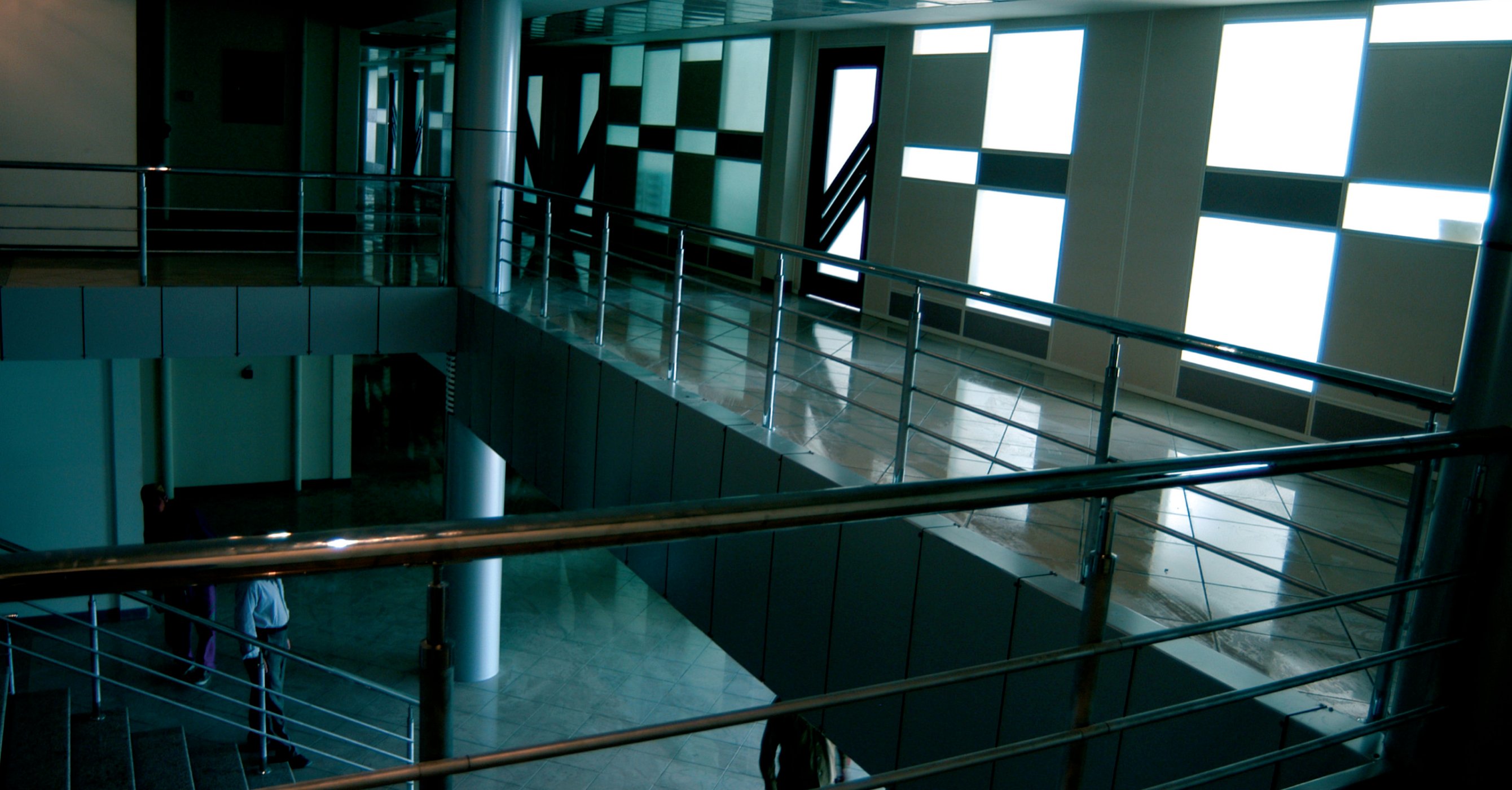
DANESHMIR: I want to add just one point to what Mr Afshar said. In Himmelblau or Zaha Hadid projects, if you remove the ceiling, the project falls apart, because the interior and exterior are tied together. But in your project it is not so. Also, I would like to raise a question — perhaps it would have been better to start our discussion from this: how did you design this building? Your answer can help us understand.
IRAVANIAN: You spoke of cube and door. I say put the door in the same place, but with other things — non-architectural things — change the way people move. For example, swapping people's shoes.
AFSHAR: If architecture cannot change the door's place, can it change people's shoes?
IRAVANIAN: Yes — I do this in the park, because I write the scenario myself. For example, the lamps that light the path: I change the negative space, not the positive parts. Also you spoke about scenes in my work; in my view architecture is nothing other than this. Architecture is scene and accident. I have shown this in Sadra Park. But scene and accident are different for each person. When we design a fixed shape somewhere and place it, we cannot claim everyone sees the same thing. In fact, architecture is perhaps the result that happens afterwards, not in the moment when an encounter or accident takes place. So architecture is scene, and advanced architecture begins not from a plan but from scenes that we build for whoever enters. I do not see architecture in the realm of horizontal systems. Architecture is an encounter.
AFSHAR: You raised several different topics: discovering spaces as a sequence of scenes; architecture in weightless suspended space where the plan is meaningless; architecture under constraints, regulations and economic and architectural matters; and architecture of negative space. Are all four present in your work, or...
IRAVANIAN: All four are present.
AFSHAR: This is exactly our critique of your project. Look at good architectural projects — they have answered all constraints. Not that they ignored them, or killed the client, or ignored negative space. Our point is that architecture, generally, at least until now, has been organised around one or a few main ideas. Whether the Eiffel Tower at the start of the last century or Gehry at the start of this century, architecture has eventually had to adopt a method, present an idea, and gradually that idea, in its development, has resolved all peripheral matters along the way. After all, architecture has to install a plug on the wall too. But if you start simultaneously from a discussion of plug and philosophy and put them all on one level, architecture does not emerge from that. In fact, architectures that can turn constraints into value are very successful. In my view, an architect is not someone who fights constraints and tries with tricks to weaken or soften them. Architecture can convert constraints into value, and at that point architectural ideas are discovered and extracted. For example, Koolhaas in the Grand Palais project in Lille has turned the fire stairs — which many do not know where to put — into a valuable subject. A project is always a discovery. The project cannot be an idea imposed on the building. It is a discovery that comes from within the work, from within the site. Generally, good architectural projects start from the most general spatial ideas and arrive at details. If in a project details are raised at the same level as programmatic or aesthetic issues, architecture becomes flat and depth diminishes.
IRAVANIAN: You contradicted yourself in a few sentences. On one hand you say architecture is based on one or a few main ideas; on the other you say a project cannot be an idea imposed on the building. In any case, the discussion that we can put an element such as a plug on the same level as philosophy, and that we can change the value-hierarchy of these things, in my view, is attractive — architecture does not become flat. Each becomes a phenomenon worth discussing. Just as the plug that Oldenburg made very large becomes a heading for a worldview in which things considered trivial may matter as much as overarching ideas like ideology or worldview.
Oldenburg, Heterogeneity, Collage
IRAVANIAN: In Oldenburg's case, he makes the plug big, or the saw big and plunges it into the ground. In his work there is an idea. But if he sank the saw into the ground, then painted it, then put clothes and shoes on it, the situation and idea would fall apart. In his work there is a defined and very strong idea: to give value to a daily object through a change of scale. He has even turned this idea into a style. A second point is the relation of heterogeneous elements with one another. Imagine a person coming out of a house wearing a Napoleonic hat, work pants and a Pharaoh's costume — we all think they came from a masquerade. So in some cases heterogeneity can work. In a space made of homogeneous, same-family elements, if we introduce elements very different from the text, between these completely different elements a relation forms, because they are compared with the surrounding text. The same goes for the exception that proves the rule.
With all this, I still do not find the realisations of these arguments in the work. For example, this pressure-gauge of yours is a pressure-gauge. If, in Oldenburg fashion, it became the facade of the building, the same Oldenburg argument would apply. Or if all of these were exotic elements, no problem. If there was a rule with a series of exceptions, the same. But it seems that all three of these are working together. From what is said, this is how one can infer it. No one can tell you what attitude to take with your work; this choice belongs to the architect. The critic must also critique, however, and discover the different ways of approaching architecture. My argument is that in a story you can have different episodes whose scenes and even tones differ. But for a collage you must have a general idea, otherwise it remains a collage. In your work I feel that, instead of being a single work with a particular language, it has become a collection of skills, finesses and beauties unrelated to each other — a kind of polyphony in which several aesthetics and several spatial arrangements stand side by side without being able to become something fully original.
IRAVANIAN: You raised the question of collage well. In my view architecture in essence is collage. We think collage from the moment we come into the world. As Hamid Mosaddegh puts it, "under the blue dome there was nothing new." I do not strongly believe that we must write a novel where all its parts link to one another. To me, that is not reasonable. You can write a 5-part novel, not link the parts, but with one word — a name you give it — suddenly tie them together and bring their meanings close. You are still in normal-critique territory, and this is why you say the generalities must first be drawn and then we get to the details. The meaning of collage is the opposite. In collage a big plug and philosophy stand side by side, with no relation, and you think this philosophy, which is so vast, may be so far away that it has become the size of the plug — and so they are placed at the same level of value. Look at many famous buildings — in them the plan has no importance. To them, architecture is so much the volume and the three-dimensional sensation that the plans were unimportant. For example, the plan of the Pompidou Centre. I think they too look at the building from the standpoint of a volumetric, image-built object. For this reason I do not accept that the plan is the final word and that the development on it is unimportant. I think the plan can be the same, but you can change the entire meaning of the architecture through development. I favour this approach and pursue it.
AFSHAR NADERI: It seems our discussion is starting to repeat itself, and we have reached its end. Even the last part of what I said was a repetition and can be cut.
Transition: From Gas Company to Sadra Park
IRAVANIAN: A point I will make to close the discussion of the Gas Company can be a preamble to Sadra Park. We usually [pause]... at some moment an event occurs to an object and its programme changes. We call this change of programme — because it is not our desire — an "accident." We say it has had an accident. Whereas it may have very good function and use for some other purpose, and serve many other things, but not us — because it was not in the original programme. So, now, after this accident the programme of the thing changes. I have paid attention to this issue in architecture, and for this reason I have called this method "crash architecture", and I believe I have succeeded in it.
As for the Sadra plan, I should say that it is designed for a site of about 25 hectares. This park may be the abstraction of a city. Why do we usually go to a street? Why do we find a street attractive? In this work I tried to show the encounters and accidents — in fact the phenomenological encounters that we have with architecture and surfaces.
In the discussion of the Gas Company you spoke of narrative. To me the kind of phenomenology that comes from epic-storytelling is the way of imagining narrative in this architecture. Imagine various kinds of encounters with a place in which there are many cars carrying out architectural placement every day. If you set a camera to show this area and capture frame by frame, you would see the cars change. The parking spot is fixed, but the colours and models...
Sadra Park
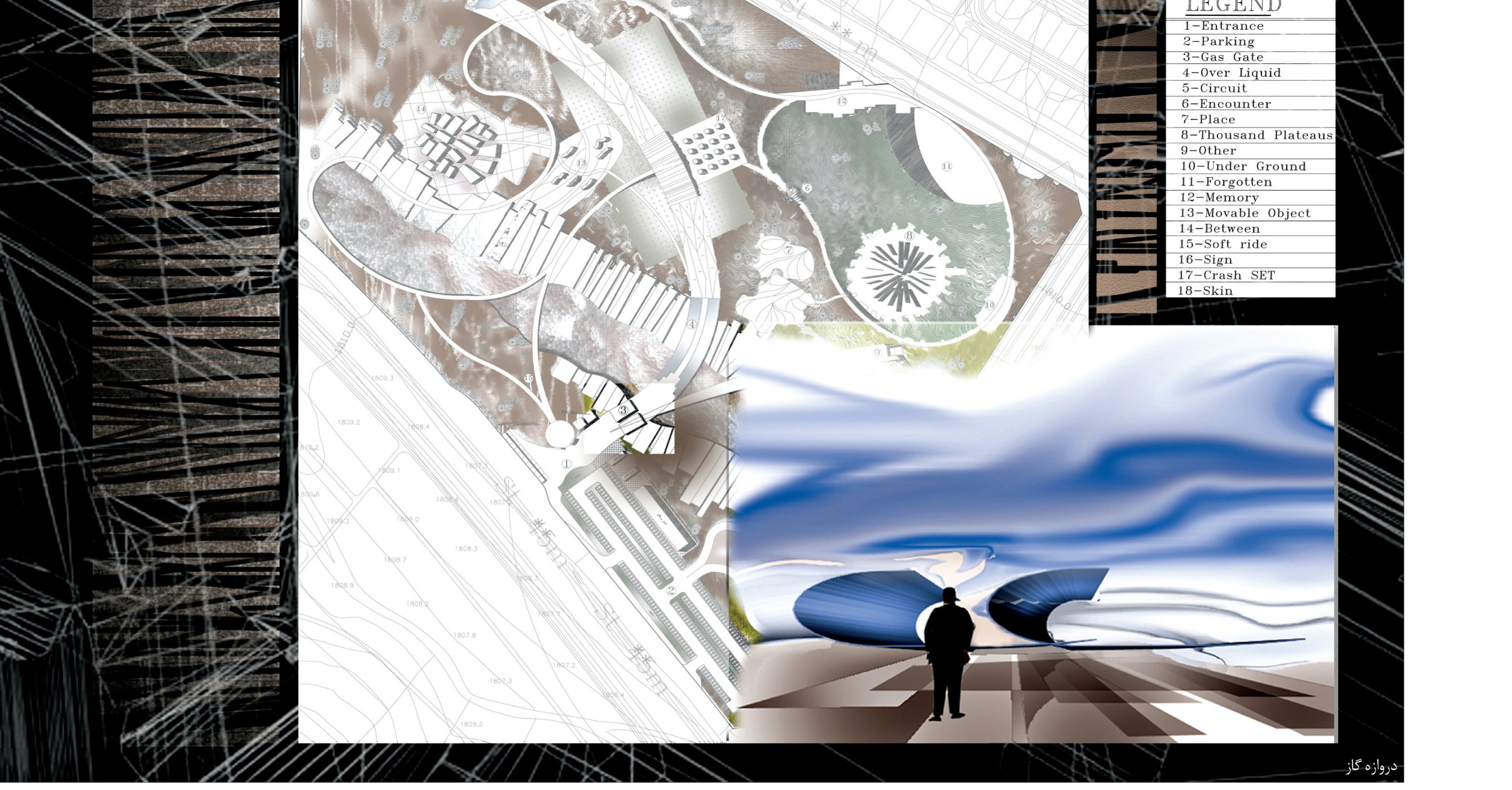
IRAVANIAN: So parking is not just for parking cars — you can also design it for seeing this striking event. We can even design a platform in the parking for people to sit. We have critiqued the view that parking is only for parking cars. If we look at it only from this angle, we may not notice these changes. But if we look at it as an architectural object and an event, then perhaps its meaning changes. From my view the plan of this parking is nothing but a series of lines on the ground in which the cars are to be placed. The architectural volumes are the cars that sit among these lines and form a shape that changes from moment to moment. If you watched from morning to night in a single day, here a kind of encounter occurs that the cars produce.
In the Gas Company building, the background and subject — of gas in liquid, solid and the related issues — was a good text for me. Gas pipelines pass through one-third of the site. The first time we entered the area, while we were discussing space and solid, liquid and gas, we noticed that the pipelines had defined their own zone of respect. That is why we defined the first entrance of the building in this form. The platform you see is a "meaningful platform" that defines both a kind of overall spatial organisation and engages closely with the issues of the text. Our first entrance is the entrance to the "gas gate". At this gate we define presence and absence. In fact, absence. If you look at the image, you see a closed ring in which half is missing. The missing half is the gas. We wanted the movement from the gaseous to the liquid and solid state to be implicit. A kind of planometry that is very simple, with a path called "destiny" — a single fate that is very common, that we all recognise, going to a place. But in that path you have a kind of wavy motion and the surface on which you move is not flat; in fact, you have various heights — not length but height-conflict.
In Sadra Park, with this view, I tried to remove the horizontality of the landscape, because of the experience we have in urban space. Before any encounter, we try to make collision happen. We have embedded the meaning of inside and outside in the landscape itself, so that anyone can be intensely and closely influenced by it.
The big meaning we always seek is the meaning of place. "Place" is something I call jaa, and its opposite bijaa (no-place). I have called something jaa that has no property and gives nothing architecturally; only by an indication is it a place. Not because of spatial features such as three-dimensionality or the effect of elements. Exactly next to it, there is something called bijaa. When you arrive at jaa, the adjacent area is bijaa, and when you go to bijaa, the adjacent area is jaa. Your change of location changes the meaning of jaa and bijaa — that is, it changes space.
AFSHAR: But there is a question here. In this very specific discussion, place generally — without any sign, simply through meaning — acquires placeness. Imagine like a piece of desert that may be a holy place because it is supposed that, say, 50 years ago an event happened there. The very existence of that image suffices to turn it into a place. But one of the properties of place is its fixedness. Unlike space, which can change with a light or a scent. So I do not think this jaa and bijaa, which is only a piece of land, can so easily turn into a place. The meanings that turn a piece of land into a place come from deep human, social and historical meanings.
IRAVANIAN: The view we have on jaa and bijaa is romantic. We talk about belonging to a city, or to a street, or saying "my place is here." In this work I try to take this feeling far enough that we can do without it — removing the semiotic attachments normally placed on the environment. The argument you make about the holy place contains a sign. Whereas here I am trying to be without that sign, to the extent that with your movement the meaning entirely changes.
IRAVANIAN: This park is in fact like a museum. Like a museum, it has a guide that guides you scientifically. For example, there is a series of blocks placed and they tell you that if you walk on it, it will not give way because its arch is in this form. We essentially designed this park so that, for example, a 30-centimetre arc gives you the experience of space.
AFSHAR: In the case of the park you raise specific ideas that can be very attractive topics. But the issue is, I doubt that much of these discussions reaches from the programmatic level — in your mind — to the level where it makes contact with the audience. Your architecture is meaningful and very intellectual. I am not saying architecture must be popular, and I accept that with your artistic works you want to go beyond the programme that is usually sold to the client. But in practice what is felt in the work is the programme. If we look at the parking, it does not differ from other car parks. The space you call jaa and bijaa may exist in 5,000 other parks. With explanation we cannot show jaa and bijaa, the path to heaven or the destiny path. We are looking for properties of your work that can be seen in the work. We are not looking for what is described in words. Because words are not our tool. We must see how what you say is actually realised and how it relates with the audience.
IRAVANIAN: I say now we have reached a level of architecture, and even in many architecture schools the most ugly attention is paid to this topic. About the words you mentioned, I believe that we should now change tools. Just as the media have started doing this. For example, I explained that in the parking we can build a platform on which people can sit and watch — even a platform changes the meaning of the parking, to a greater or lesser extent.
AFSHAR: I doubt that if you put up a platform, people will agree to sit and watch the cars move.
IRAVANIAN: Look, perhaps our naming for Sadra Park is bad. You come to it for experiencing and learning and have a guide. As in the physics park where physical phenomena are explained. You by yourself do not arrive at discovering an adventure. In this park you have an architecture tour. Many events are explained to you. For example, with the platform in this parking and the cars that come and go and the fixed cars that are there in other colours, the meaning of parking changes and objects there become architectural objects. There a guide explains. Here, about what you will see, a programme is given to you — like the leaflet at a painting exhibition, in which there are explanations about the works, even those without title. By taking someone to a place and saying "this is jaa and that is bijaa," rich architectural meanings can be explained.
Structure, Decay, and the Closing Argument
IRAVANIAN: This work is not very verbal and there is no need to plant a flag or sign. When your foot grasps it, you understand it. In this programme you have a point from which you can dominate everything, and a slight shift takes that view away, and you fall into a vicious circle of obstacles where the smallest movement causes a strange event. But all these are made of very simple elements. You have walls that all shoot toward the horizon, and through them you can see everywhere — but a moment of inattention, and that view disappears. This is not a labyrinth. On the contrary, it is well exposed. But with a slight slip you find yourself in a strange position.
I have done this with a "landscape" that eliminates the horizon. But the wall is not made by lifting up the surface — a wall like sand dunes appears that draws the line of the horizon. Yet it has slopes that you cannot see. The whole thing is a slope, and the slope draws the horizon. This bowl-form shape erases the meaning of "outside."
I want to erase the meaning of signs. Here you are placed in a surface without sign, where the end is itself. But sign is sometimes very important. In this park you also pass through a place with walls bearing very historical and contextual environmental signs that remind you of a village or a city. So we have two next to each other: one without sign, which refers to nothing; one fully sign-laden, which takes you through a special place along an alley.
In Sadra Park here we tried to bring objects into rotation and movement — not giant sculptures that move. This is the experience of change. We have positive things and we move in them. I have been very sensitive to this issue, careful that the park not turn into Disneyland. I have tried to make the park not sad but thoughtful, and have tried not to follow conventional park-making.
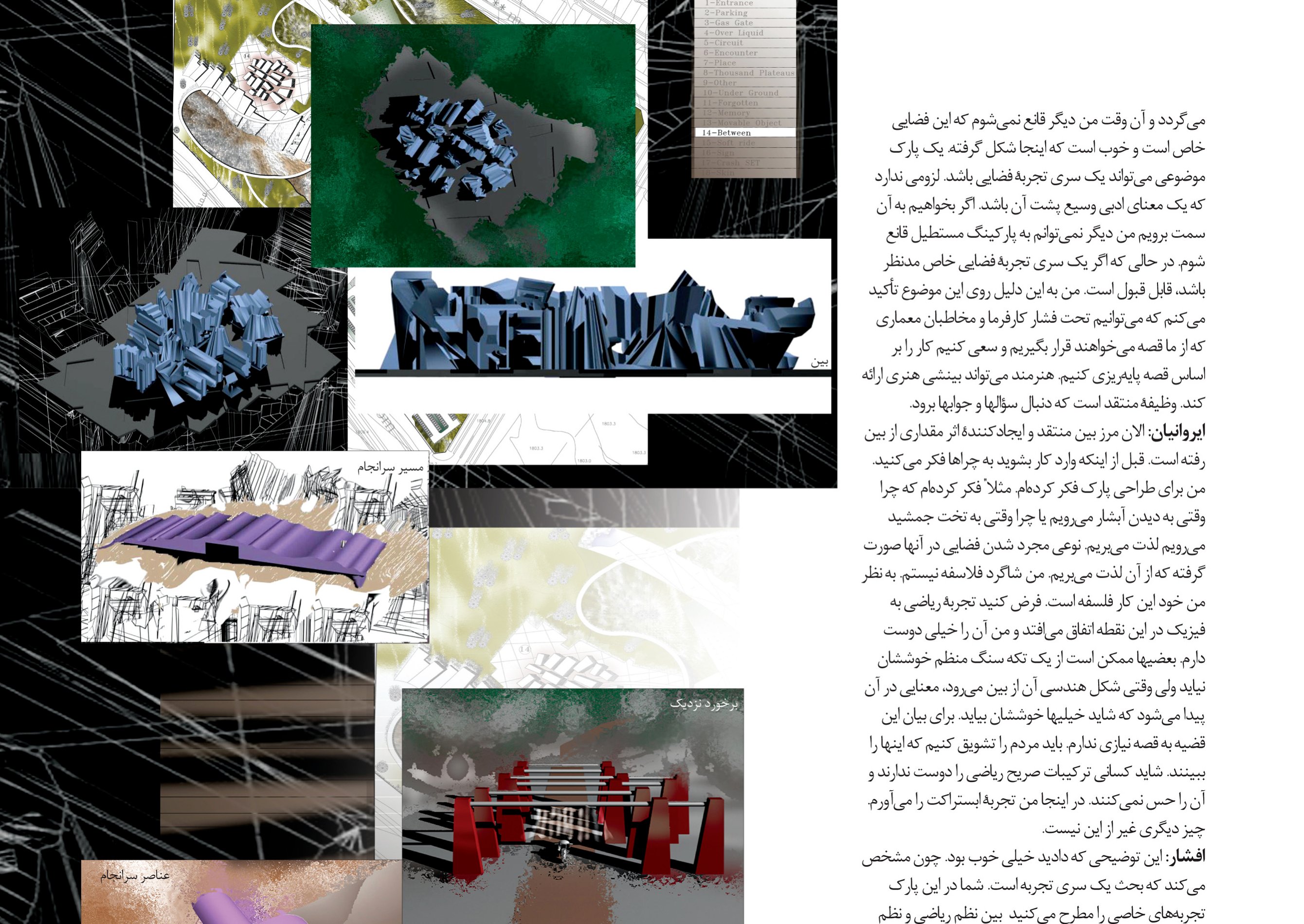
Here in fact the same earlier discussion about the Gas Company plan also applies. Here with a simple plan you reach unusual volumes. On this basis I say: the plan is very...
DANESHMIR: No — here you have a thousand-and-one wrinkles...
IRAVANIAN: True, on the primary surface, up to a height of about half a metre, you can have the simple plan, and afterwards this surface is not defined.
IRAVANIAN: In that case you would have to draw a hundred-thousand lines.
DANESHMIR: You cannot explain such a thing with a single plan.
IRAVANIAN: That is exactly my point. With one plan everything cannot be explained.
DANESHMIR: What interests me as an architect is how you design the structure of this park. This is one side of the matter — and perhaps we should look for a structure in this park. Why is this part here? Why can't it be elsewhere?
IRAVANIAN: I spoke about jaa and bijaa with this hypothesis — you can put anything anywhere. The accidental, in the sense that the experiences carried out in it can happen before or after. Of course many things have meaning only in their own scope. For example, what happens in the "decay" section. But some things can be elsewhere.
DANESHMIR: I want to know what structure we are examining. Well, this structure is not hierarchical — that is clear — but I want to know how we place it in the architectural text.
IRAVANIAN: Well, it has an overall framework. It has an unclear framework, intended so that we do not see the end of destiny. It has a separate-path framework that is "Other" and takes its way apart. The rest is a long cycle for the experience of subjects, up to reaching boundaries. In this cycle there are pieces whose beginning and end do not matter, because our experiences are not meant to be...
AFSHAR: I want to speak openly. Perhaps somewhat exaggeratedly and negatively — not because I have a negative view of this design. I want to say that what you describe does not match what we see. You have a strong narrative talent, and you put it on display at the heart of this park, which is attractive. But my perception of architecture is encounter, free from descriptive narratives. Here, varied and unrelated movements stack on top of each other, accidentally — and a complex composition is produced. The issue one can think about is: by what line are all these stories and narratives connected? Another issue is that you have designed a large number of volumes and placed them along the paths. This kind of work resembles image-making very much. It is also more or less artificial, because in life we don't encounter things with such intensity. Here, the boundary between artificial and natural is very thin.
IRAVANIAN: I do not fully accept what you say. These things put on top of each other have the property of being able to differ from one another and to create complexity. About what you said on artificial and natural, I want to say: pay attention to the prosthetic nature of architecture. Part of the naturalness of our lives is this prosthetic-ness. Well, when for a scene like parking we invite things for show and put up platforms, compared with what exists in the city and seems natural, it appears artificial. Yes, it is true that here we have brought the work to the level of abstraction, and you are right — all this is experience. Experience that other settings perhaps cannot give.
DANESHMIR: We see these experiments in Western architecture in the work of the SITE group. For example, for Best stores they made images so that the store would catch the eye more and sales would rise. This technique has a more limited lifespan and is a kind of time-bound graphic work.
IRAVANIAN: Yes, exactly: there the goal was sales, but here the goal is not sales, it is architecture. Maybe we have also used that technique. But I do not think this is like the Best store, where people watch the window and wait for the door to open so they can go in.
AFSHAR: After all the discussion I have arrived at a personal opinion. As I said, you have an artistic talent. Even the house you have built — both as a whole and each of its parts is a sculpture. The urban design for Chamran Boulevard exhibits exactly this character — like episodes someone has designed. In Chamran Boulevard, because of the linear character of the site that does not accept organisation, the individually-designed episodes have sat very well. At the same time you have meaning, thought and philosophy. So there is an overall programmatic and content-related vision in your work. But what could tie these two together — structural thinking and organisation — is absent.
IRAVANIAN: When you put this meaning forth, a heavy mass of information is added to it, and naturally one looks for connections, and at that point I am no longer convinced this is a special space — that it is good a topical park has come into being here. It can be a series of spatial experiences. There is no need for a broad literary meaning behind it. If we want to go in that direction, I can no longer be satisfied with the rectangular parking. Whereas if a series of special spatial experiences is the focus, it is acceptable. I emphasise this point because we can be put under pressure by clients and audiences who want stories from us, and try to base the work on story. The artist can present an artistic vision. The critic's role is to follow questions and answers.
IRAVANIAN: Right now the boundary between critic and creator of work has somewhat blurred. Before entering a work, you think about the "whys." I have thought about designing the park. For instance, I have thought about why, when we go to see a waterfall, or why when we go to Persepolis, we enjoy them. A kind of spatial abstraction has taken place in them that we enjoy. I am not a student of philosophers; in my view this work itself is philosophy. Imagine the experience of mathematics in physics happening at this point — I am very fond of it. Some people may not like a regular stone, but when its geometric form is broken, a meaning emerges that perhaps many people would like. To express this issue I do not need a story. We must encourage people to come and see these things directly.
AFSHAR: This explanation you just gave was very good — because it became clear. Physics, which is more complex... If we look from this viewpoint it is very interesting. More interesting than using the meanings of destiny and jaa and bijaa.
IRAVANIAN: [...continuing] When we look at the world, we want to discover many things; we want to reach the source — the source of relations. This is phenomenology.
AFSHAR: Well, we think the thread breaks here. I think part of the theories you put forward about this park damage its value. In any case, I think an overall idea about your work has reached the reader.