



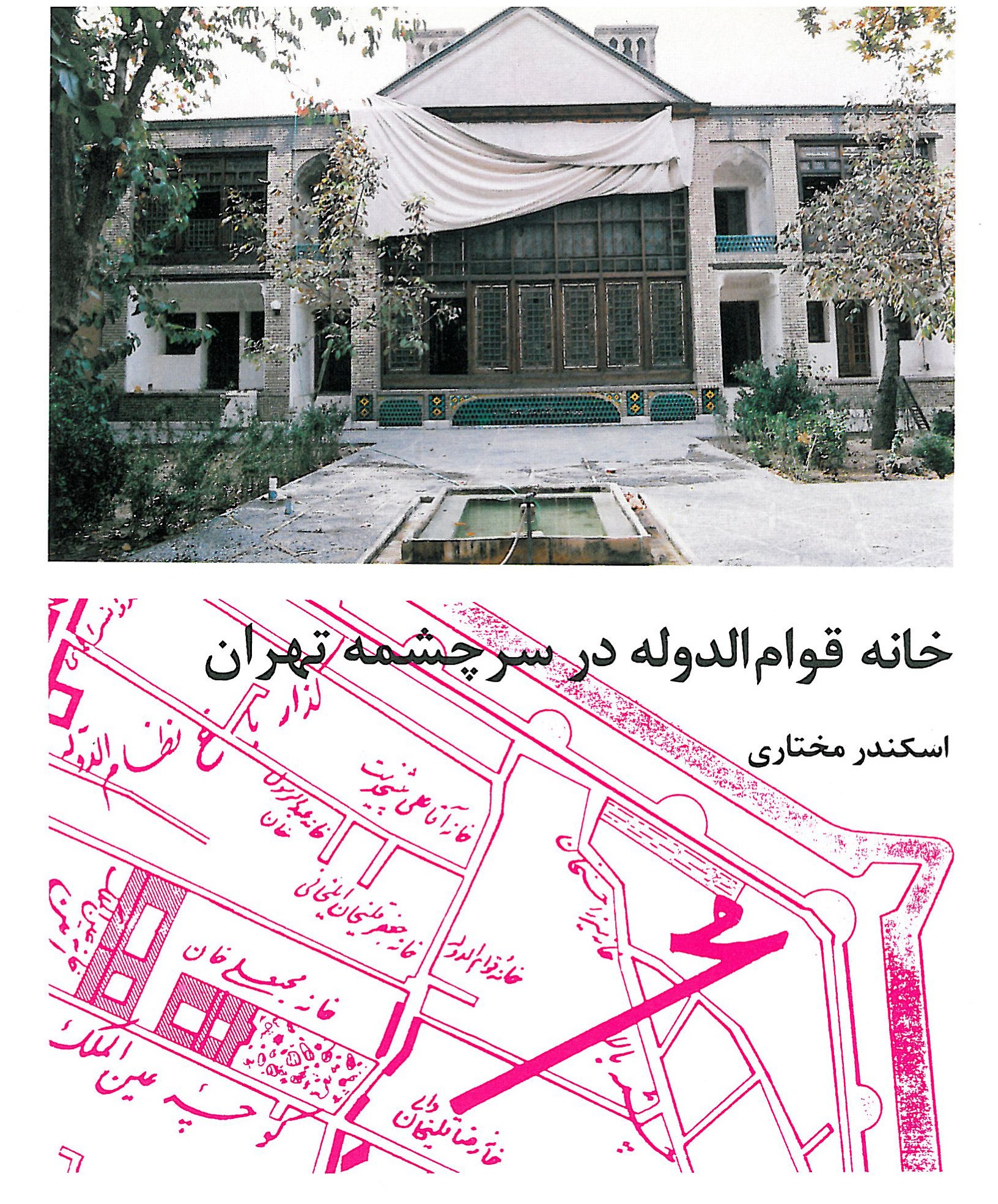
The face of Tehran's historic fabric has been drawn with many different inscriptions. The most authentic of them are to be found inside the line of the Safavid wall, an area that is gradually being erased; and although everyone acknowledges its value, in practice no one is willing to invest in preserving it. With this short preface, I wish to introduce here one of the precious grains of that fabric — a house in Tehran's Sarcheshmeh neighbourhood, known as the House of Ghavam-od-Doleh.
The house lies on Amir Kabir Street, in Mirza Mahmoud Vazir alley, in the northern part of the Oudlajan quarter and within the Sarcheshmeh neighbourhood. Its owner, Mirza Mohammad Mostofi Ghavam-od-Doleh — son of Mirza Mohammad-Taqi Ashtiani — was one of the notable figures of the Qajar era. He entered state office in 1265 AH and over his lifetime held the ministries of Azerbaijan and Khorasan, the pishkari of Isfahan and Fars, and the ministries of Customs and Accounts. Hassan Vosugh-od-Dowleh and Mirza Ahmad Qavam (Qavam-os-Saltaneh) were among his descendants.1
As shown on the 1275 AH map of Tehran (map 1), and confirmed by the evidence of the surrounding fabric, what remains of the Ghavam-od-Doleh house today is only a portion of the original — about one fifth of its original extent. The inner (andarun) quarters, the carriage-house, the stable, the bath, and the marriage hall (tālār-e 'aqd), which belonged to the house and was used by neighbours for wedding ceremonies, were gradually separated from it by Ghavam-od-Doleh's heirs, and mainly by the sons of Vosugh-od-Dowleh.2
Today a part of the inner quarters survives one lot away from the main building. The bath is still in use by the neighbourhood's residents, the carriage-house has been turned into a local park, and the remaining portions have been re-built.
The plan of the surviving mansion is one of the authentic and wholly common types of Iranian architecture (map 2). Two courtyards, north and south, flank the building. The two courtyards, separated by a level difference of about three steps, are linked by two corridors running on either side of the two halls. The water of the Haj 'Alireza qanat emerges in the north courtyard; after overflowing from the north pool it enters the house's underground howz-khaneh, and from there it appears a third time in the pool of the south courtyard.3
The main building is made of three parts: the two halls in the middle, two corridors on either side of the halls, and beyond them two ranges of rooms in two storeys, whose combined height equals the height of the halls. Besides the halls, the corridors connect the side rooms, the staircase and the two courtyards. Each hall has its own artistic character. The southern hall — which must be counted the most precious space in the Ghavam-od-Doleh house — is entirely covered in paintings and catches the sun. It opens onto the south courtyard through a seven-panel orsi sash window of fine and elaborate timber lattice-work.
The northern hall is entirely covered in mirror-work and stucco, and opens onto the painted hall through a shah-neshin. A seven-panel orsi on its northern side brings the north courtyard and its pool into view from within. When the orsi panels are raised, the halls turn into iwans and the north and south courtyards merge with the space of the halls. A joyous space of flowing water, green trees, and walls adorned with hundreds of patterns — the work of an architect who conceived a space attuned to the spirit and needs of the house's owner.
Between the two halls stands a most exquisite three-panel orsi that must be called the city's finest partition. Its wooden lattice-work is delicate and densely worked, and its glass is entirely covered with painted motifs; the combination of colour and pattern here reaches perfection.
The Hall of Paintings in the Ghavam-od-Doleh house must be counted among the historical treasures of the city. Every surface is covered with paint and pattern. The division of the surfaces into their parts has been carried out with the utmost mastery and displays the capacity of Iranian art in the ornament of surfaces. Flower-and-vine (gol-o-boteh), eslimi, khataei and gol-o-morgh motifs — the traditional elements of Iranian painting — are set alongside inventive landscape scenes and European flowers in such a way that the viewer, at any distance from the work, perceives a fresh grace note and tastes a new sweetness. Some of the landscapes of the hall — which number in the dozens — are no larger than fifteen square centimetres. This savoury art is from the hand of master Aqa Lotfali Khan Sooratgar of Shiraz, who has inscribed his signature in the hall with the words: “As the humblest of his attendants, Lotfali Shirazi has painted.”4
The northern hall has a dado of marble; the remaining wall and ceiling surfaces are entirely covered in mirror-work and stucco. Among its treasures are framed colour engravings printed on pastel paper. These engravings, brought from Europe to Iran, must be regarded as forerunners of the coloured photographs whose use became fashionable in Tehran's grand houses from the middle of the Qajar period.
The side rooms flanking the halls are in two low storeys. The north rooms have no fireplace and are intended for the hot seasons; the south rooms catch the sun and are used in the cold seasons. Their decoration is not elaborate.
The basement, or howz-khaneh, of the Ghavam mansion is only as large as the floor area of the halls above. It has two entrances and consists of a broad rectangular hall that, by a particular design, is given a pleasant atmosphere. Two storerooms on the north and two recessed alcoves attached to the entrance stairs on the south act as “earrings” that break the uniformity of the space. Two short longitudinal walls in the middle of the hall, besides solving the structural problem of roofing, enrich the spatial variety. The basement dado is covered with relief-patterned tiles that, in technique, are among the high points of traditional Iranian tile-making.5 The basement walls are plain and unornamented, and the ceiling is covered with shallow kalil arches whose slight rise, given the span of the hall, counts among the innovations of Qajar-era vaulting.6
The building was purchased in 1345 SH (1966) from master Mirkhani, its last owner, by the Ministry of Culture and Art; the late master Karim Pirnia and master-architect Mahmoudi carried out its essential repairs. From 1353 SH (1974) the building became the site of the technical office of the National Organisation for the Protection of Antiquities in Tehran, and its paintings were given a thorough three-year restoration. The Cultural Heritage Organisation has in recent years also undertaken various repairs in the building, the most important of which has been the restoration of the Hall of Paintings — a hall that had suffered greatly from the repeated filming of Persian-language movies there.
The Ghavam-od-Doleh house is a product of Iranian art, a space in which every art allied to architecture has found a worthy presence. This beautiful, lively environment is the work of an artist-architect whose name we do not know — but whose art we honour.
1. Sharh-e Hal-e Rejal-e Iran, Mehdi Bamdad, vol. 1.
2. As related by Dr Ghavami, of the descendants of the late Ghavam-od-Doleh Ashtiani.
3. “Ab-e Tehran,” in the Journal of Archaeology and History, Mohsen Mo’tamedi, 1369 (1990).
4. Ostad Lotfali Sooratgar Shirazi, Jasem Ghazban-pour and Aydin Aghdashlou, Cultural Heritage Organisation, 1376 (1997).
5. The technique of firing relief-patterned tile, once common before the Qajar era in the seventh and eighth centuries AH, can be seen in such well-known works as the mihrab of Emamzadeh Ja’far of Qom (now kept in the Iran Bastan Museum) and a wooden emamzadeh doorway from Kashan now in the Metropolitan Museum.
6. These arches normally have a hidden timber frame that absorbs the roof’s thrust. The weight-loads from the side vaults also form part of the set of forces that bring the structural net into balance.