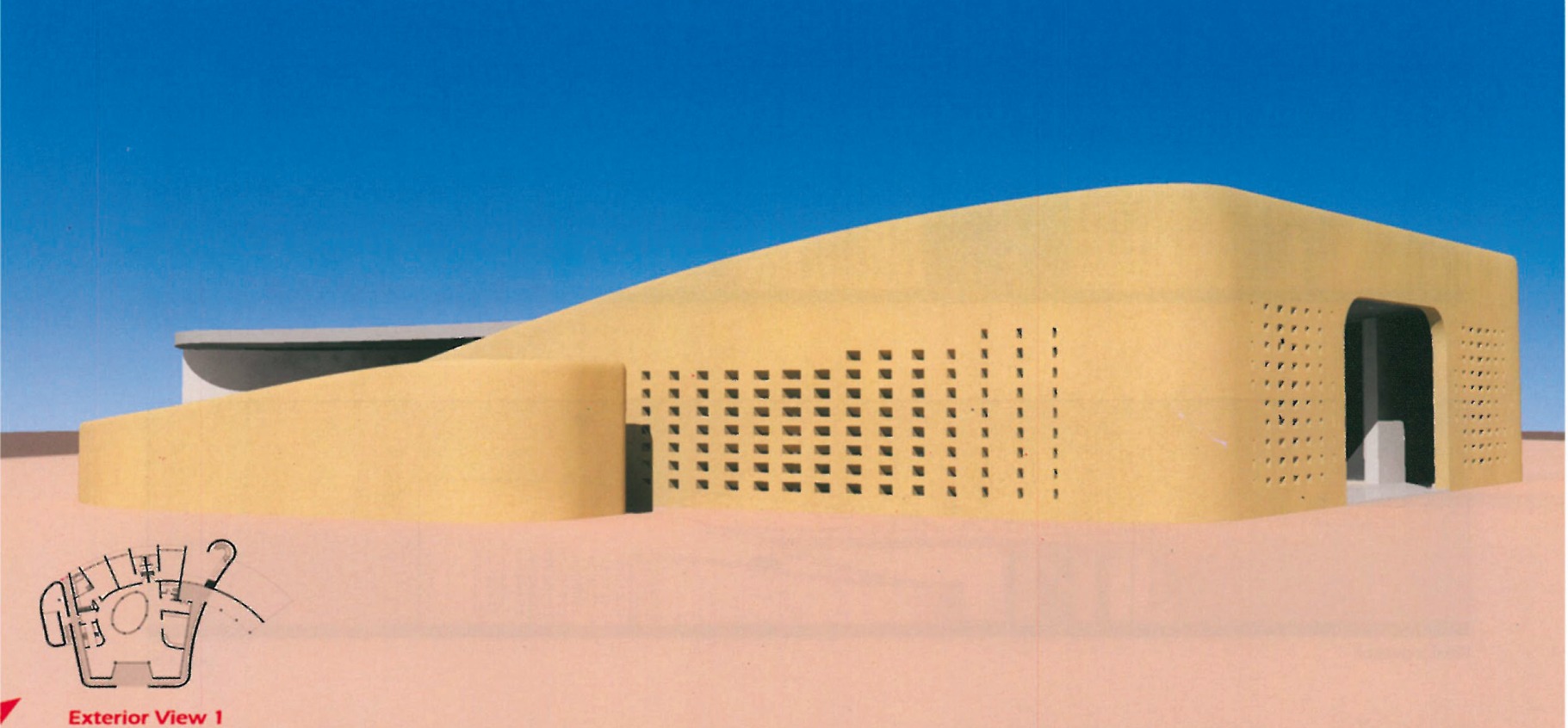
Desert House (Koubi House), 2003
Architecture designer: Firooz Firooz
Associate Architect: Ali Akbar Toraby
3D computer modeling & graphic: Ali Akbar Toraby
Area: 510 m²
What you see before you is one example from a series of designs for "climate-responsive houses" titled the Koubi House. The vastness of our land, the diversity of climatic conditions across different regions, and a range of experiments have compelled the architect to adapt the design of houses to the specific conditions of each location.
A brief survey of desert architecture in Iran, in cities such as Yazd, Kashan, and Kerman, reveals the simple and ancient responses of architecture to the harsh conditions of water and climate in these regions. These responses are sometimes embodied in architectural elements such as the dome, ivan, badgir (wind catcher), and other features. What is notable is that in Iranian architecture these elements, while remaining functional, have also acquired a unique aesthetic dimension in the service of spatial beauty, enriched by the creative spirit of architects who have always striven to achieve a synthesis of nature and architecture.
The Architecture of Sustainability
We cannot regard vernacular architecture as a movement or a particular trend among the various currents of architecture, but rather as a group that pays attention to fundamental principles of architecture. Evidently, this mode of understanding, particularly with respect to the principles and applicable rules in this domain, has not fully developed. Perhaps the absence of clearly formulated and operational principles and rules in this field is the very reason for the emergence of this mode of understanding.
The goal of this project is to present a sustainable design for a house in the hot and dry conditions of Iran's deserts. The house must be designed as a space that can harness the natural forces of the environment to serve its inhabitants. In the hot and dry climate of Iran's deserts, the most critical requirements are providing adequate humidity, maintaining a stable indoor temperature throughout the day and night, and minimizing direct solar radiation.
The Skin and the Roof
First, let us consider the exterior wall of the building. Animals living in the desert have thick skin with small pores, which causes less water to evaporate through their skin, preserving body moisture in the desert heat. Desert buildings too have followed this pattern: their outer walls are typically solid, without large windows or openings, thereby preventing direct sunlight from penetrating the interior spaces. The resulting pattern has generally tended toward introverted buildings.
In this project, an effort has been made to exploit the extroverted character of the small house, utilizing the distinctive properties of the exterior skin to regulate environmental conditions. For introverted patterns typically require large, empty, and expansive open spaces, which is not always feasible. The next step is determining the form of the skin and how it functions.
If we define a space with a floor, a skin, and a roof, then two elements—the skin and the roof—are always heated by direct sunlight, with the difference that during midday hours and in the hot seasons the roof absorbs the larger share of solar radiation. In the afternoon hours and during cooler seasons, however, more sunlight falls upon the exterior skin and the vertical elements of the building. Therefore, the roof must reflect thermal energy, while the skin—especially its western portions—must store it, so that the building's heat lost during the night can be compensated. For this purpose, the form of the house's skin has been defined through a calculation of the path of solar radiation.
Natural Climate Systems
Next, to add the humidity needed for the incoming air currents, attention has been paid to the building's air intake. Here, by creating an intermediate space between the exterior skin and the interior functional spaces, the natural moisture of water and plants can be harnessed in the path of airflow. Through the horizontal openings in the glass wall of the skin, air is drawn inside. In this manner, the openings that allow controlled sunlight into the interior also generate air currents.
Looking at the roof construction details, one can also trace the designer's thinking about finding natural solutions for energy conservation. By placing inverted clay flower pots on the roof, a large volume of air is trapped beneath them, acting as the most economical thermal insulation. This layer sits on a bed of sand and gravel and causes rainwater to flow over a thin waterproof membrane and drain into the intermediate space (the pool).
And finally, the ivan on the southern facade offers the finest vista to the observer within the house. The setback of the transparent inner wall at this point protects the interior from direct sunlight during the spring and autumn seasons.



