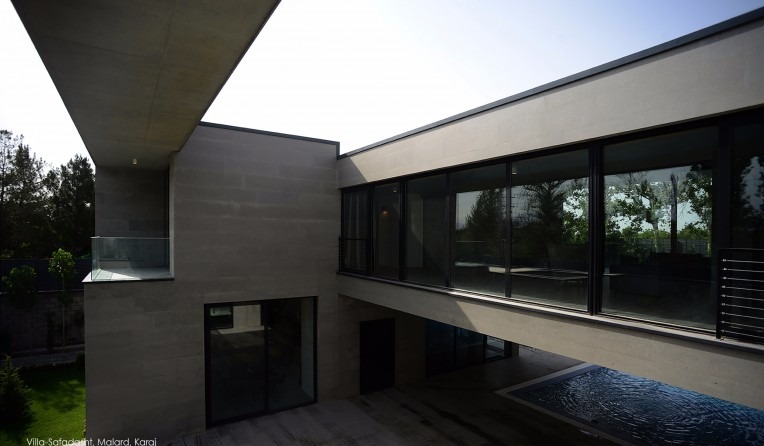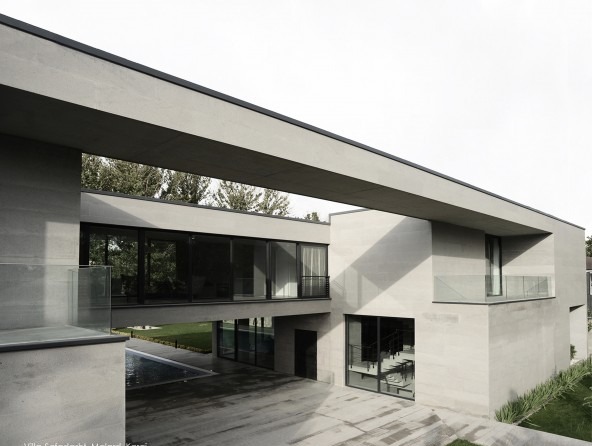
In this project, the architecture seeks to create a space in the middle ground between origin and destination, one that expresses its own condition within a brief interval. A distance that belongs to neither. The reconstruction of a passage-like space and its symbolic relationship with the concept of a bridge drives the architecture toward reproducing a physical form that places the subject (the viewer) in a state of suspension, akin to a borderline zero point. A place where hesitation and excitement during the crossing render the origin and destination secondary, and from here the relationship between subject (viewer) and object (architecture) is established.
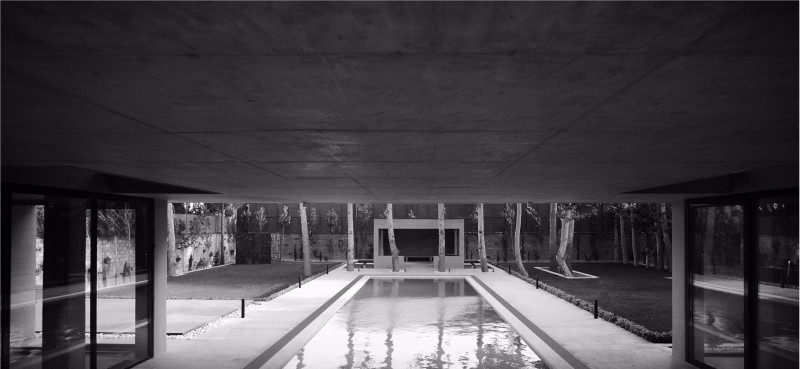
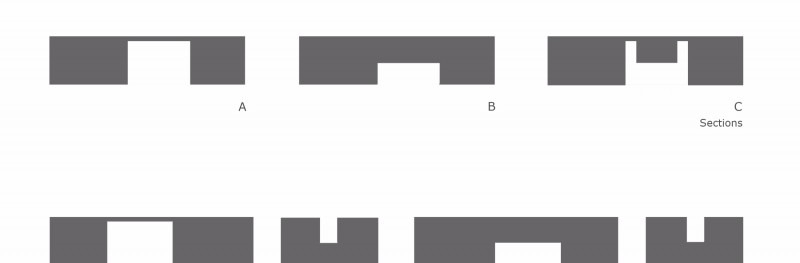
On the ground floor of this project, there is a public living space in the western section and a semi-private living space in the eastern section of the building, completely separated by an open space and connected on the first floor by a bridge that itself encompasses all the private spaces of the building. A passage space begins at the site entrance and passes through the building, under the main bridge, providing the main ground floor entrances on both sides and terminating at a gazebo at the end of the path.
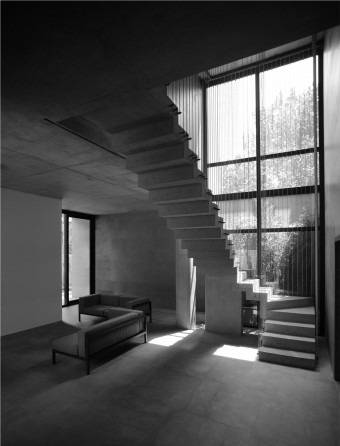
In the western part of the ground floor, the staircase, changing room, public restroom, kitchen, and dining area form the public living space with an area of 205 square meters. In the eastern part, the recreation space, pantry, jacuzzi, restroom, and connecting corridor from the yard to the interior create the semi-private living space with an area of 145 square meters.
The first floor, with an area of 307 square meters, contains four bedrooms, a TV room, and a staircase at the eastern end of the building. The gazebo, mechanical facilities, and entrance complex — which includes the pedestrian entrance, caretaker's quarters, and parking — are located in the peripheral areas of the site, totaling 380 square meters.
The structure was initially designed as concrete with slab ceilings, but after preliminary assessments revealed that the large spans would create unsuitable thicknesses and consequently a bulky building, the decision was made to use post-tensioned ceiling systems to reduce thicknesses.
For climate control, concealed floor-mounted fan coil units have been used throughout the building. Cooling is provided by a chiller and heating by a boiler and burner. Given the project's structure and the exposed concrete ceilings (without suspended ceilings), all electrical and mechanical piping has been routed over the structural ceiling.