Contemporary Architecture

A Scene for City Events, Sepiddasht, Lorestan

Ehsan Inanlou·Photos: Mohammad Hassan Ettefagh·Memar 142 — 23rd Memar Award
A Scene for City Events, Sepiddasht, Lorestan
Location: Sepiddasht, Imam Khomeini Street, opposite the Martyrs' Cemetery, Lorestan · Client: Sepiddasht Municipality · Architects: Reza Farashi, Maziar Ghaseminia · Architecture Collaborator: Ehsan Inanlou · Structural Engineer: Mohsen Varmaziar · Construction: Mohsen Fooladvand, Hossein Rajabi Eslami · Graphic Design: Shadi Bitaraf · Supervision: Reza Farashi, Maziar Ghaseminia · Photo: Mohammad Hassan Ettefagh · Built area: 84 m²

The subject of the project was the design of a martyrs' memorial with a very limited budget in the small town of Sepiddasht. The designated site had been situated in the old fabric of the town and had served as the town's cemetery for many years. The site's location was such that it occupied an opening in the urban fabric along the town's main axis.

The prevailing typology of memorial structures in both small and large cities across Iran takes the form of an object or statue — one that serves merely as a monument in the city — and the client's initial request, too, was the design of a memorial element for the martyrs.
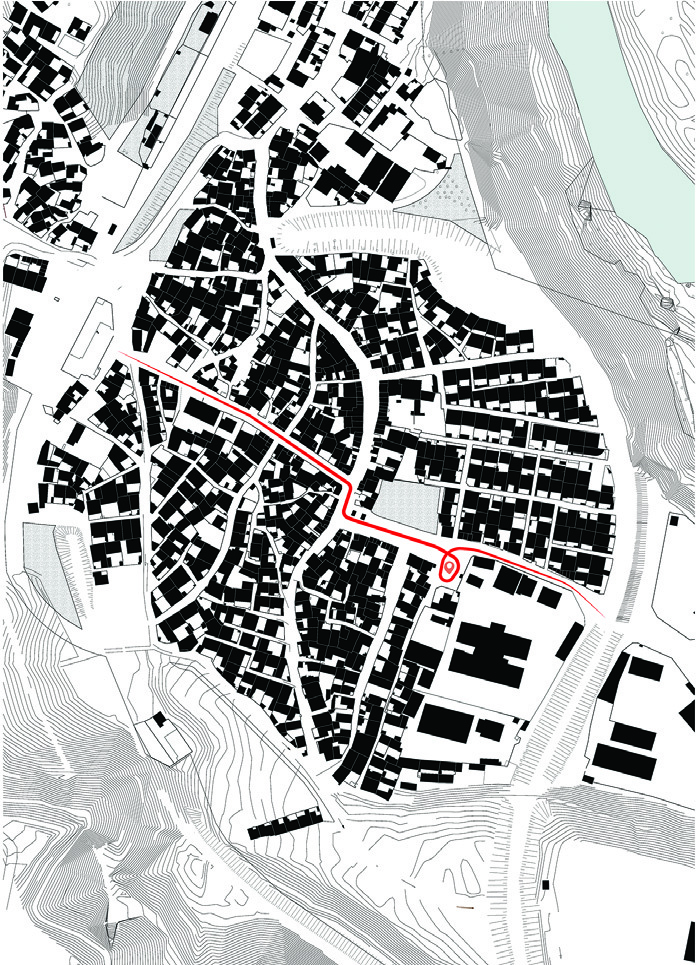
Figure-ground site plan of Sepiddasht showing the dense urban fabric with the project site marked in red along the main axis of the town
Site plan of Sepiddasht — the project site (marked in red) occupies an opening in the urban fabric along the town's main axis
◆ ◆ ◆
Beyond the Statue
Our question from the outset was: how can we, with the minimal budget and program allocated for the project's design and construction, make the greatest possible impact on the town?

In response, our strategy was to move beyond the cliche of building a statue or a solitary object as a memorial. We decided instead to create a stage for the performance of urban events — a space of high adaptability for the town that could assume different roles at different times — offering, in other words, far greater possibilities than a single statue could provide.
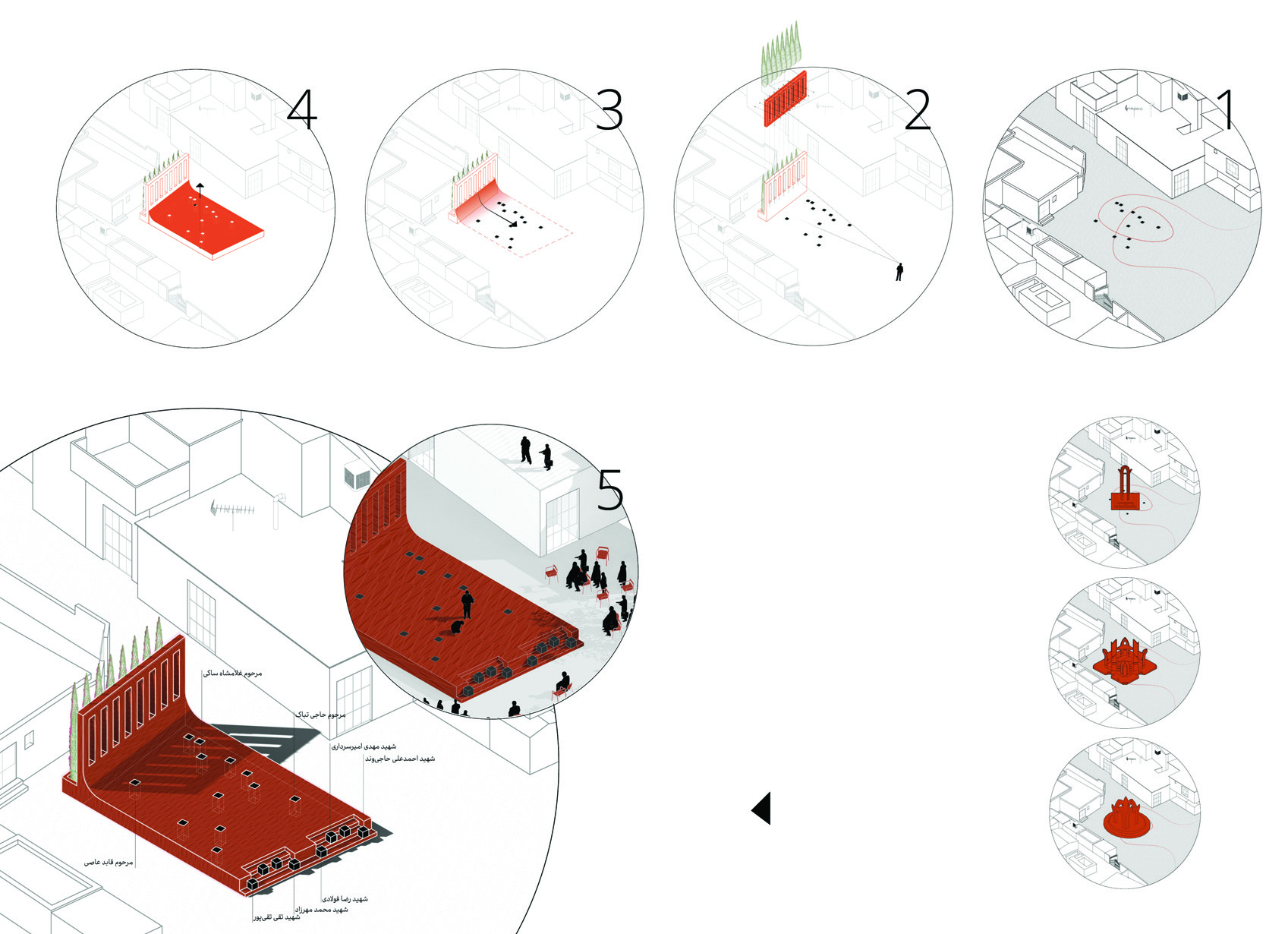
Design process diagram in five steps showing the evolution from the existing site with graves, through introducing the red plane, positioning grave markers, raising the vertical wall with openings and cypress trees, to the final integrated design with labeled graves
Design process — from the existing site with graves to a red stone stage with vertical wall, cypress trees, and integrated grave markers
◆ ◆ ◆
The Red Stone Stage

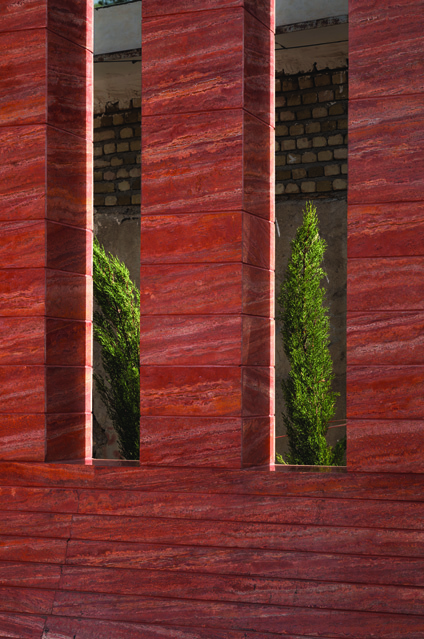
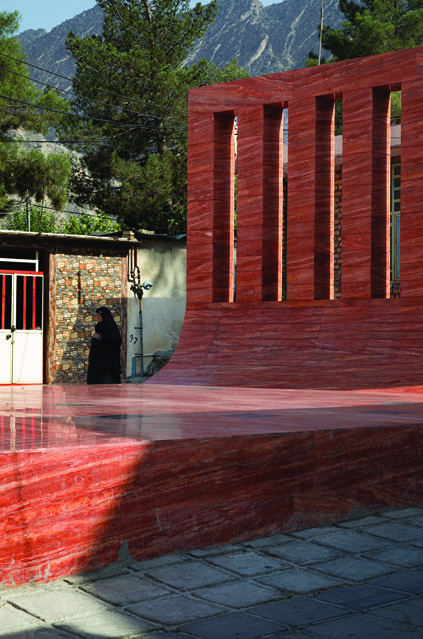
We employed a vertical plane that spreads wide across the ground, so that the upstanding portion of the plane preserves its symbolic role. To intensify this quality, we cut eight openings into it and planted an equal number of cypress trees behind each aperture.

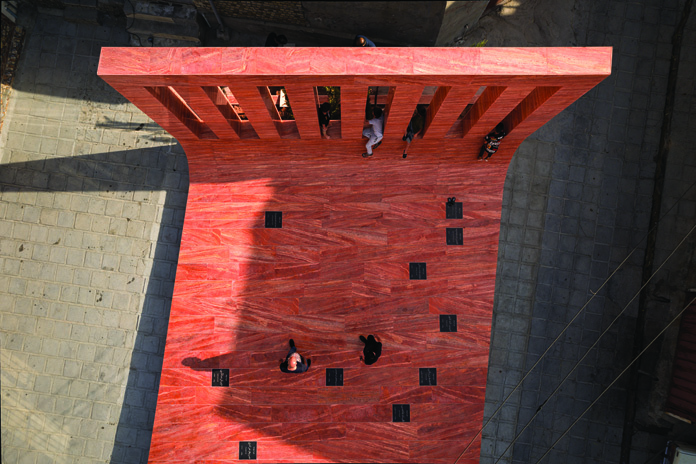
We used red stone from Azarshahr so that this "stage" would stand out prominently within the town's fabric. Meanwhile, the expanded, ground-hugging portion of the plane serves as a space for the performance of urban events. At the same time, we brought the locations of the existing graves onto this stage, and for each opening on the vertical body, we placed a black box along the edge.
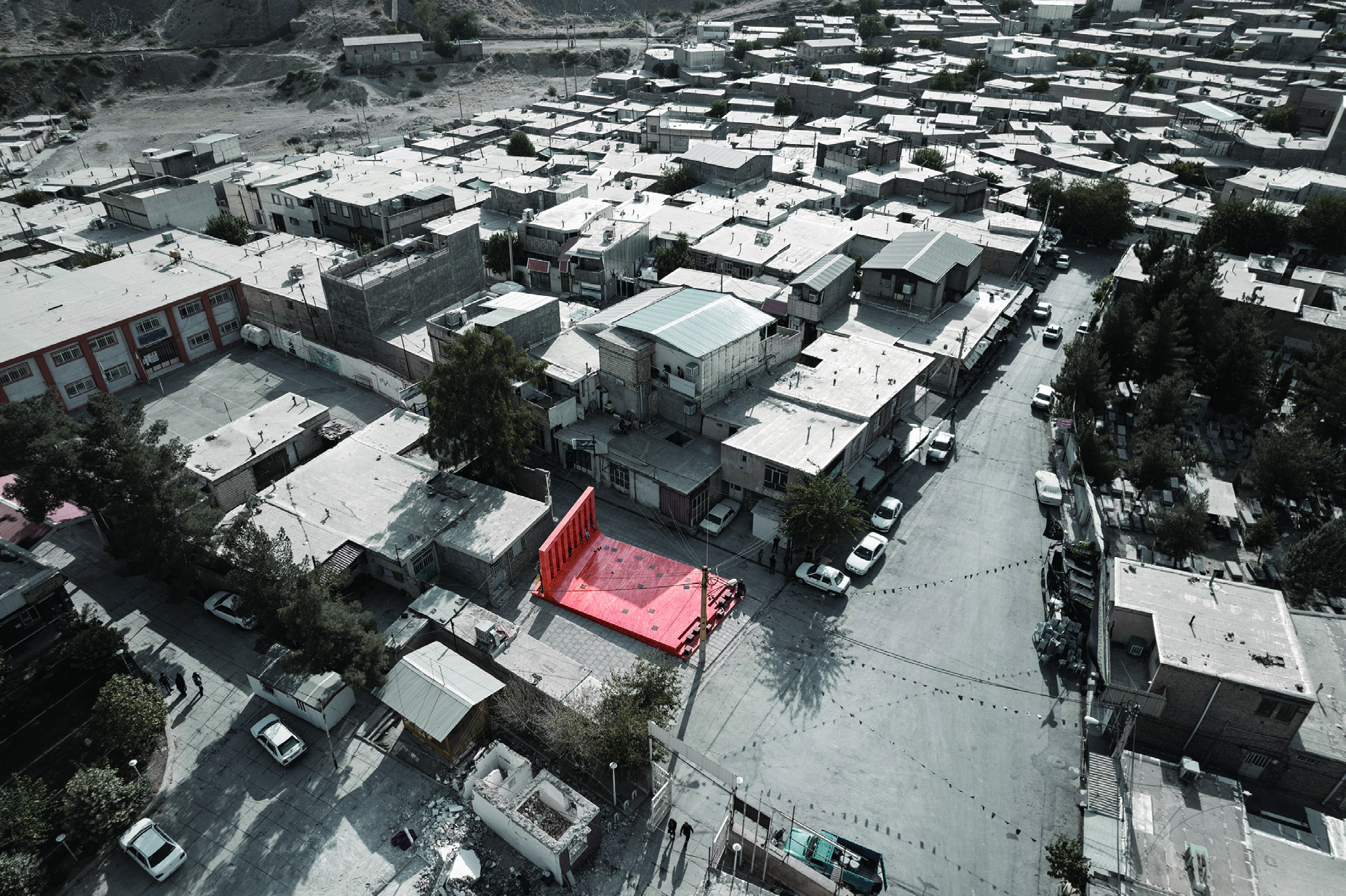
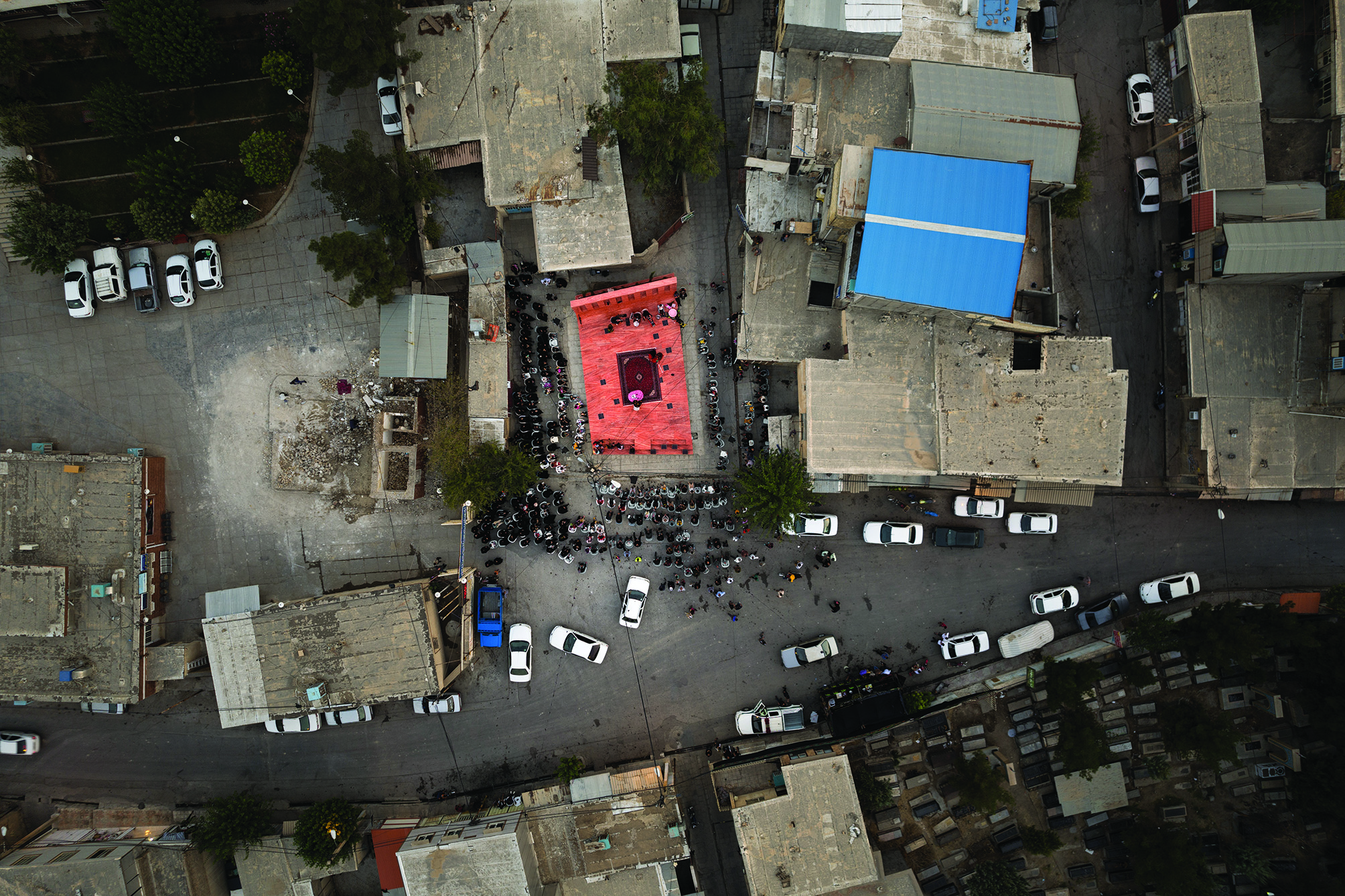
Aerial view of Sepiddasht with the red stone platform highlighted in color against the desaturated surrounding town fabric, showing how the project stands out in the urban landscape
Aerial view — the red stone platform stands out as a bold intervention in the fabric of Sepiddasht
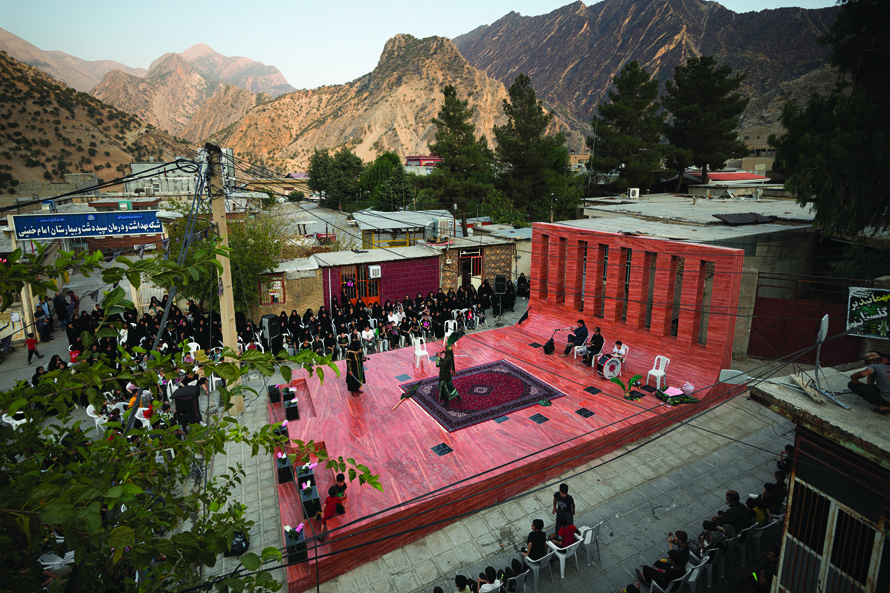
View of the vertical red stone wall with eight tall openings revealing cypress trees behind, the curved transition from wall to ground plane visible, mountains in the background
The vertical wall with eight openings and cypress trees — the symbolic face of the memorial
Close-up of two openings in the red stone wall showing cypress trees growing behind, the natural grain of the red Azarshahr stone clearly visible
Cypress trees visible through the openings in the red Azarshahr stone
Overhead aerial view of the red stone platform showing the vertical wall at the top with openings, the curving transition to the ground plane, black grave markers embedded in the surface, and a person sitting on the platform
Overhead view — the plane curves from vertical wall to ground-hugging stage, with black grave markers embedded in the surface
◆ ◆ ◆
A Space of Many Roles

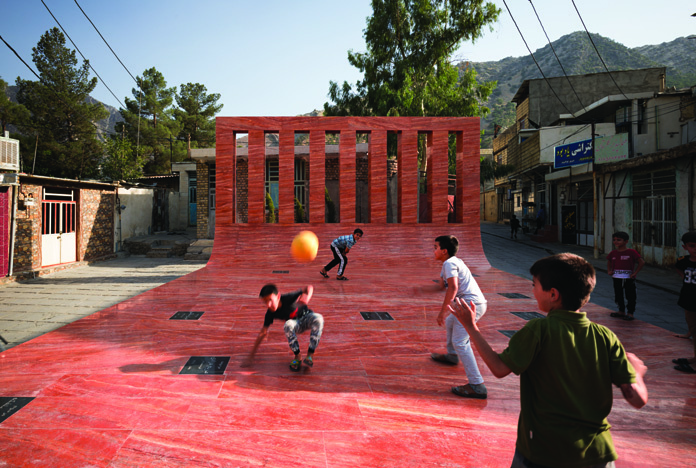
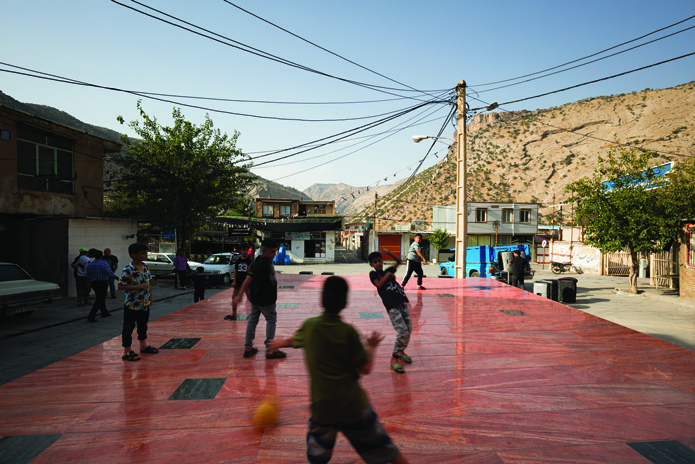
By activating the project as a flexible space — for the performance of religious and ritual ceremonies such as Taziyeh, as a playground for children, as a gathering place for the townspeople, as a venue for the residents' consultations, and simultaneously as a symbol and marker for Sepiddasht — we added new possibilities to it as a public space.

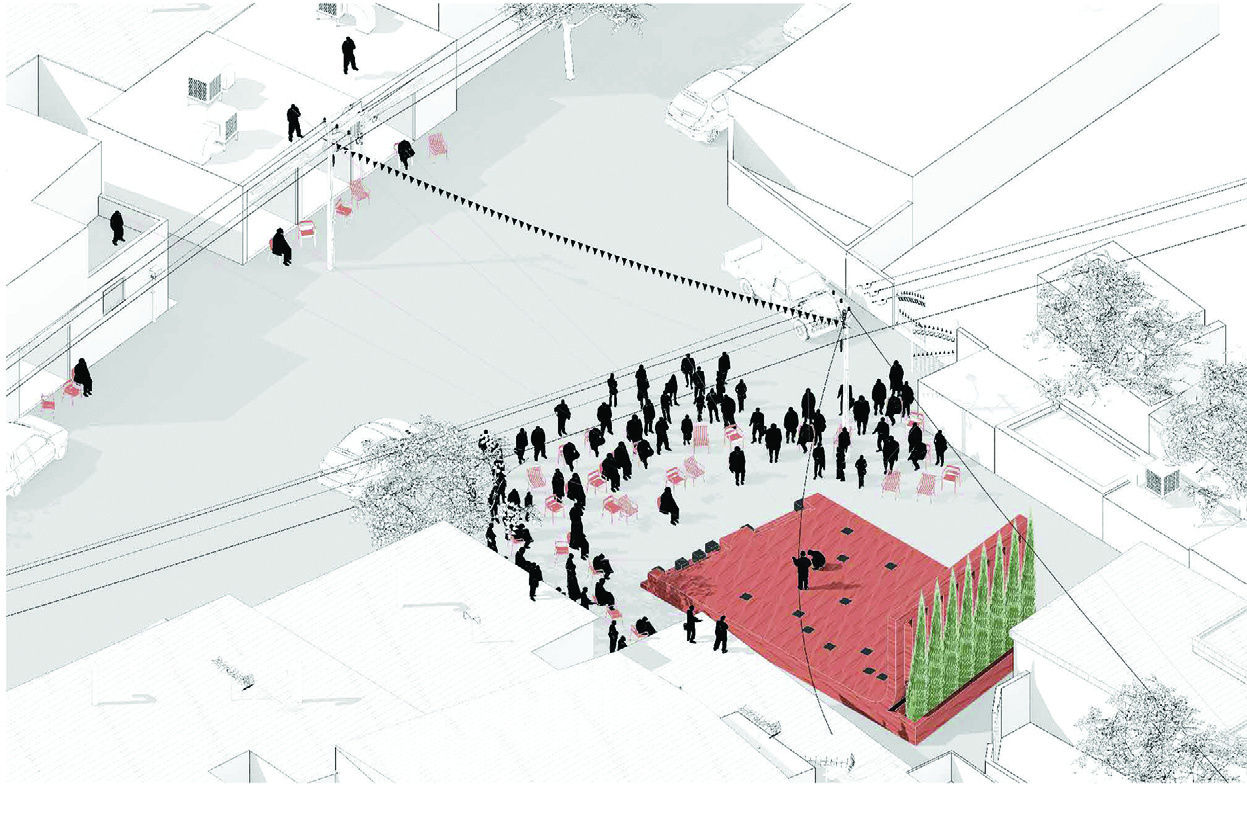
Five isometric diagrams showing different usage scenarios for the platform: Taziyeh ceremony, religious gathering, children's play, townspeople gathering, and a market event
Usage scenarios — the platform adapts to serve as a stage for Taziyeh, a gathering place, a playground, and a market
Isometric drawing showing an urban event on the red platform with crowds gathering around it, the vertical wall with cypress trees, and the surrounding town context
Isometric view of an urban event — the platform extends its role into the town's surrounding streets and alleys
Children playing ball on the red stone platform with the vertical wall and its openings as a backdrop, Zagros mountains behind, and surrounding town buildings visible
Children playing on the platform — the memorial becomes a playground
Children playing on the red platform with mountains visible in the background, power lines overhead, and the small-town fabric of Sepiddasht surrounding them
The platform as playground — new possibilities for Sepiddasht's youth
◆ ◆ ◆
Activating the Town

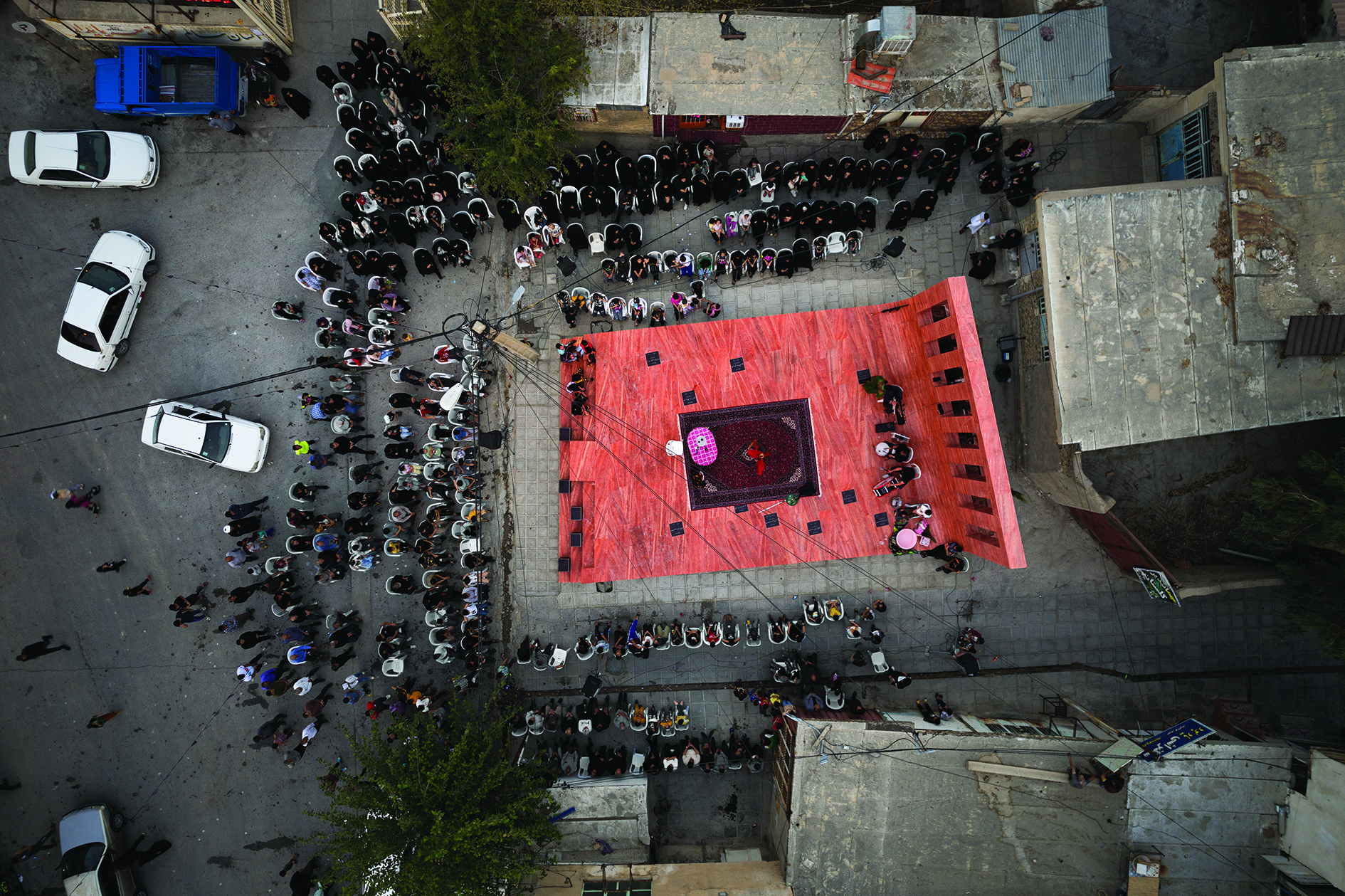
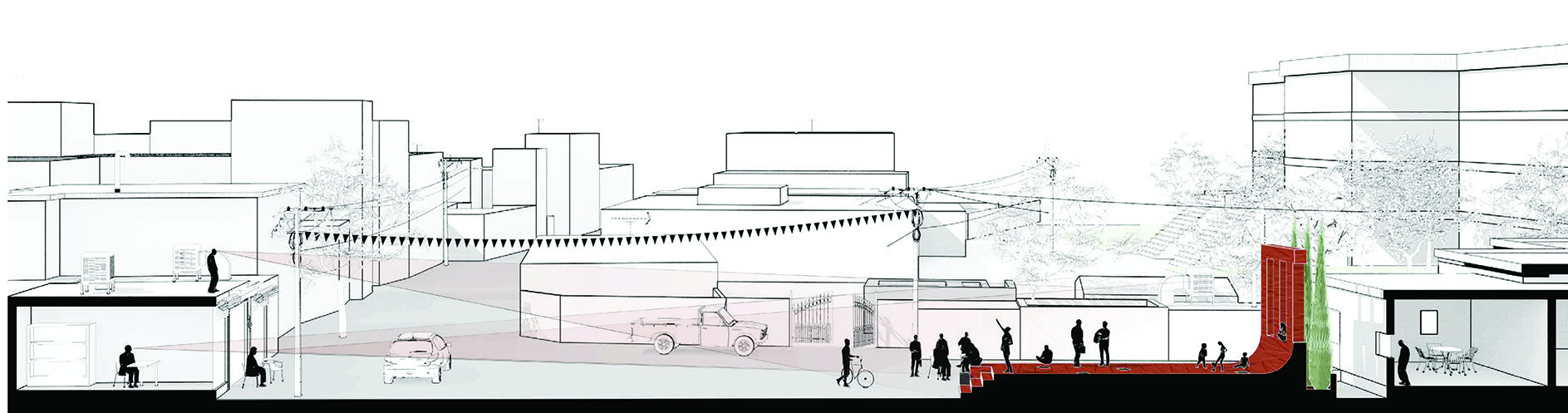
During various urban events, the different levels around this stage — the rooftops of surrounding buildings, terraces and balconies, streets and alleys, and even the surfaces inside adjacent shops — become activated as positions and vantage points for spectating, and this plane extends its role throughout the town.
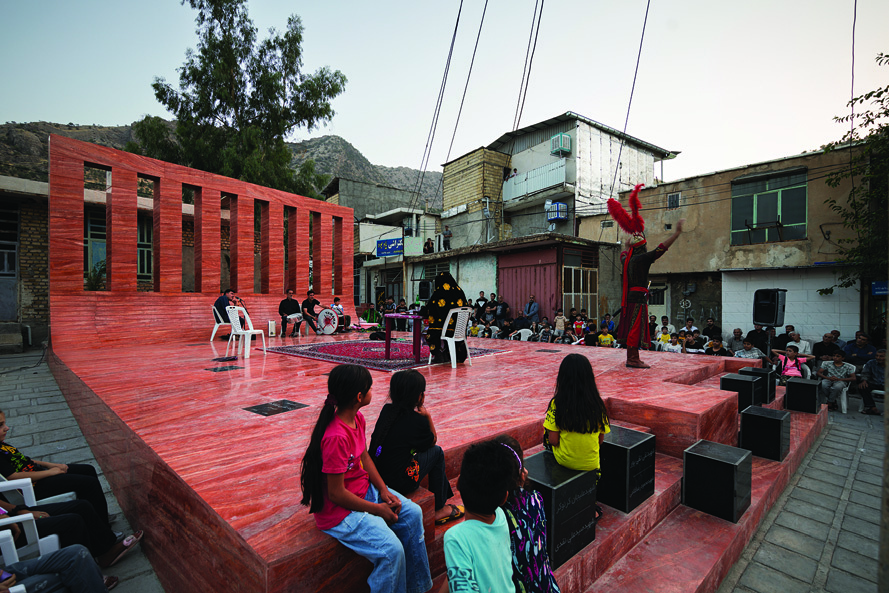
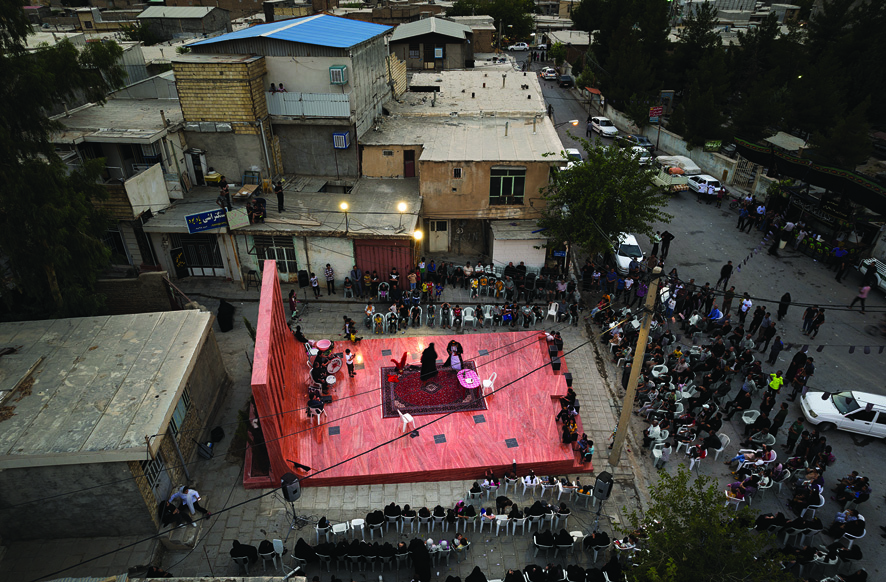
Ground-level view of a Taziyeh performance on the red platform at dusk, with children watching from the edge of the stage, musicians and performers on the platform, the red wall backdrop, and surrounding buildings visible
A Taziyeh performance on the stage — children watch from the edge as the platform comes alive at dusk
Aerial view of a cultural performance at dusk on the red platform, surrounded by the townspeople sitting in chairs and standing along the edges, with the town's buildings and rooftops serving as additional vantage points
Aerial view at dusk — surrounding rooftops, terraces, and streets become vantage points during a performance
Aerial view of a Taziyeh religious ceremony on the red platform with mourners gathered around, black-clad women on one side, men on the other, and the town's fabric visible around the edges
Aerial view of a Taziyeh ceremony — the platform as ritual space
Aerial view of the red platform during a gathering, showing its relationship to the town and how it fills the opening in the urban fabric
The platform fills the opening in Sepiddasht's urban fabric
Sectional drawing through the town showing the red platform and vertical wall in context with surrounding buildings, streets, pedestrians, vehicles, and the urban life of Sepiddasht
Section through the urban context — the red platform and vertical wall engage with the streets, shops, and daily life of Sepiddasht
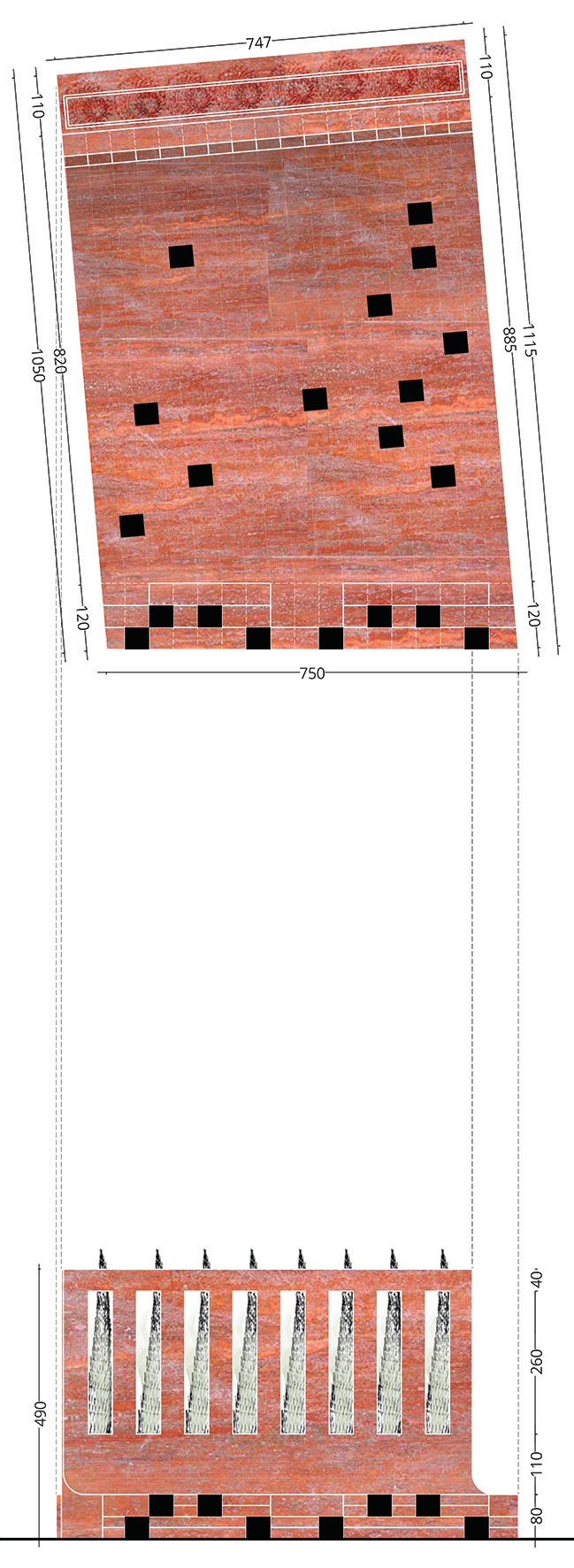
Technical elevation drawing of the red stone wall showing plan view, front elevation with openings, and side elevation with dimensions
Technical drawings — plan, front elevation, and side elevation of the red stone wall
Memar Magazine
Iranian Bimonthly on Architecture and Urban Design · Issue 142 · December 2023 – January 2024

Related in Architecture Database