Contemporary Architecture

Three Interviews

Partager
Three Interviews

In October, the Iranian Students News Agency (ISNA) website reported on the complete demolition of the remains of the Qajar-era Delgosha Caravanserai. "Last year on the second of Azar, the owner of this Qajar caravanserai, having obtained a decree for its removal from the National Heritage List, commenced the demolition and excavation of the site. By the time the demolition injunction reached the owner, everything except the building and the entrance portal of the caravanserai had been destroyed. At that time, the then Director General of the Cultural Heritage and Tourism Organization of Tehran Province deemed the remaining portions to be of even greater significance and emphasized the necessity of their preservation. Yet in early Ordibehesht of this year, the entrance to the Delgosha Caravanserai was covered with concrete so that the remaining sections could be demolished. A commercial complex is to be built in place of more than a century of identity and history in this part of Tehran."

"This historic caravanserai, which old Tehranis knew by the name 'Vazir-e Nezam Caravanserai,' was built at least 130 years ago on the southern side of 15 Khordad Street, opposite Arg Square. Given its age, it was registered on the National Heritage List in 1356 [1977] and was among the most complete examples of bazaar caravanserais.

The House of Dai Jan Napoleon Is Being Demolished

The house and garden of Dai Jan Napoleon, registered on the National Heritage List in 1383 [2004], now stands on the verge of being removed from that list so that a large commercial complex may be built in its place on Lalehzar Street. This old house became etched in public memory in the 1350s [1970s] with the broadcast of the television series "Dai Jan Napoleon," directed by Naser Taghvai. It is the last surviving fragment of the Lalehzar gardens and was originally the residence of Amin al-Soltan, the Grand Vizier of Naser al-Din Shah. Spanning nine thousand square meters on Lalehzar Street, in the Ettehadieh cul-de-sac, the property belongs to the Ettehadieh family and contains examples of Qajar and early Pahlavi-era houses. In the year 1261 SH [1882], when the great Lalehzar garden was subdivided and sold for the construction of a street bearing the same name, a portion was allocated to Mirza Ebrahim Khan, the father of Ali Asghar Khan Atabak (Amin al-Soltan). Upon Ebrahim Khan's death, his son purchased additional adjacent parcels and expanded the estate. In subsequent periods, the descendants of Amin al-Soltan subdivided and sold the ancestral land. Cinema Jahan, Cinema Shahrzad, a parking structure, and a commercial complex have been built on portions of these lands. Rahim Ettehadieh purchased this land from the heirs of Amin al-Soltan in 1295 SH [1916] and, dividing it into thirty shares, distributed it among his children.

Concurrent with the registration of this property on the National Heritage List in 1383 [2004], the Cultural Heritage Organization entered negotiations with the Ettehadieh family to purchase the house. Agreements were reached for the transfer of the garden to the government at a price of four billion tomans, but ultimately the transaction fell through. At present, a number of the owners have purchased the majority of the garden from the remaining heirs and wish to have it removed from the National Heritage List -- which would permit construction and alterations to the garden and buildings -- in order to make changes. It is said that following the demolition of the Dai Jan Napoleon house, a very large commercial complex is to be built on its site, in which case, given the tens of thousands of square meters of density of this complex, the last remnants of Lalehzar's historic fabric would also be destroyed.

The Flag Building Has Also Fallen

The historic Flag Building (Sakhteman-e Parcham), with its Art Deco architecture and colorful flags at Darvazeh Shemiran, was completely demolished to make way for a commercial complex -- despite the building being situated within the primary buffer zone of the historic Fakhrabad Mosque and having been slated for registration on the National Heritage List.

In the early 1320s [1940s], Amir Jalilavand, a police colonel and head of railway security, decided to build Iran's first apartment hotel in Western style on Darvazeh Shemiran Street. He commenced construction of the building but, having exhausted his budget, was forced to use railway rails instead of structural steel to complete it. After some time, he began renting out several of the hotel's finished rooms. The lands of the garden surrounding this apartment hotel belonged to Mirza Ali Khan Amin al-Dowleh, husband of Ashraf al-Molouk Fakhr al-Dowleh, daughter of Mozaffar al-Din Shah. Fakhr al-Dowleh was a devout and pious woman, yet she could not prevent the activities of this police colonel. Therefore, adjacent to his unfinished apartment hotel, she initiated the construction of a mosque in 1324 [1945], designed by Andre Godard, the renowned archaeologist and architect of the National Museum. After the construction of this mosque, which took four years, the apartment hotel's enterprise was dismantled. Later, due to the presence of a flag distribution workshop and the many flags installed on the building's roof that caught the attention of passersby, it became known as the Flag Building or Iran Screen. At one point, it was reported that the Cultural Heritage Organization intended to register this building on Iran's National Heritage List. However, delays in this process led the current owner to decide to purchase surrounding lands and build a large commercial complex in its place.

Tehran Bazaar, Delgosha Central Courtyard

Cinemas Being Turned into Commercial Arcades

Several cinemas on Lalehzar and Jomhouri streets are being demolished and converted into commercial arcades.

Cinema Eram (formerly Mayak) -- Cinema Mayak, at the intersection of Lalehzar and Jomhouri, was founded in the early twentieth century by Sakovar Lizreh, a Russian immigrant, and opened in 1312 [1933] with the screening of "The Lor Girl" (Dokhtar-e Lor), the first Persian talkie. After Cinema Iran, Cinema Mayak was the second cinema hall that families attended.

Cinema Laleh (formerly Rex) -- This cinema, on Lalehzar Street, belonged to Qodratollah and Seyfatollah Rashidian. It commenced operations in 1324 [1945] with the screening of the film "I Will Find You Somewhere." After the Revolution, following its confiscation, the cinema was renamed "Laleh." Its ownership later transferred from the Mostaz'afan Foundation to the Artistic Center, and it was ultimately shuttered at the end of 1372 [1994]. The owner has also submitted a request to convert it into a commercial arcade. Cinema Homa and Cinema Asia face similar circumstances.

We have now been urban planning consultants for District 12 for a decade. Despite having prepared twelve revitalization plans for historic Tehran and its neighborhoods, we have still been unable to prevent these demolitions, let alone restore and revive what remains of them. Our conviction regarding the imperatives of revitalizing this historic center has been as follows:

  • A historic city center carries the history and collective memories of its citizens, and its deterioration weakens the civic life of the city and its residents.
  • The distinction and identity of a city depend on the vitality and activity of its historic center; hence, the revitalization of this center is essential for leveraging "historical heritage" as "cultural wealth" and attracting activities to the city center.
  • The advantage of a historic city center lies in its cultural and historical attractions, mixed uses, public spaces, and tourism areas, which can create a vibrant and lively hub for the specific clientele of each activity located within it.
  • The relatively ready urban infrastructure in the historic center makes its revitalization as a multi-functional zone (governmental, cultural, commercial, and touristic) easier.
  • The valuable expanses, axes, and scattered buildings in the historic center facilitate the establishment of superior cultural, educational, touristic, and administrative-commercial activities that attract culturally minded individuals, tourists, citizens seeking leisure combined with shopping, and especially young people (the presence of these groups will guarantee the vitality of the historic city center).
  • Governmental and commercial zones at the national scale, along with the network of major public and cultural spaces and buildings, despite physical deterioration, remain concentrated in the historic city center and lend it the character of a national capital.
  • Neglecting the organization and revitalization of the "historic city center" will lead to the decline and destruction of "Tehran's historical identity." The historic center is the core nucleus and origin of the formation of Tehran as a city, which together with the historic nuclei of Tajrish and Rey -- now within Tehran's legal boundaries -- constitutes the city's historic fabric, and in conjunction and synergy with the modern center (the active areas of Districts 6 and 7), represents the principal center of Tehran.

Ettehadieh House in Tehran / Eram Cinema

Operational Strategies for Reviving Historic Tehran

  • Preservation and restoration of individual buildings, bazaarcheh (small bazaars), complexes, and valuable memory-bearing spaces, and their transformation into centers of culture and art;
  • Strengthening and developing an interconnected network of public spaces along historic axes and pedestrian walkways, with emphasis on valuable historic space and urban appearance;
  • Preserving the resilience of the fabric and valuable residential and non-residential buildings within the boundaries of the Tahmasbi and Naseri ramparts, and avoiding the common practice of road widening;
  • Creating vitality in the historic city center through the injection of mixed functions with emphasis on educational, cultural, and touristic activities, including the establishment of cultural and artistic centers, tourism facilities, and dispersed university faculties in historic buildings throughout the city center;
  • Creating nighttime vitality in the historic city center by defining various types of habitation (permanent residency for young people and culturally minded citizens, and temporary accommodation for domestic and international tourists);
  • Environmental calming, accessibility, pedestrianization, and development of non-polluting public transportation in the historic city center.

A successful plan must contain benefits for all stakeholders. The benefits of revitalizing historic Tehran for various sectors and groups are as follows:

Citizens

  • A better environment and services for shopping
  • Increased sense of belonging to the historic city center
  • Access to complementary activities alongside shopping (social, cultural, hospitality)
  • Attachment to historical monuments (preservation of architectural heritage and city history)
  • Opportunity to participate in the development of their own city

Property and Business Owners

  • Greater economic prosperity
  • Higher added value for properties
  • Greater business stability and credibility
  • Reduced disorder and environmental insecurity
  • Access to desirable infrastructure
  • Opportunity to participate in the development of the city

Urban Management

  • Ability to collect higher fees and revenues from more reputable activities and properties
  • Attracting tourists and conferring identity upon the city center
  • Increased employment and a more active urban economy
  • Ability to provide better services to citizens
  • Renovation and equipping of a portion of the valuable deteriorated fabric in the city center
  • Establishing a model of cooperation between the municipality and the private sector

* Shahrzad Mahdavi has been a continuous collaborator with the quarterly Abadi since 1370 [1991] and has published translations and articles in other specialized architecture and urban planning journals including Memar, Shahr, Haft Shahr, and Honar va Me'mari. She has been working with Bavand Consulting Engineers for the past fourteen years.

The demolished Flag Building

THREE INTERVIEWS

Interview with Mohammad Beheshti

The topic is Tehran's values, and you are well versed in it. Please share whatever you wish.

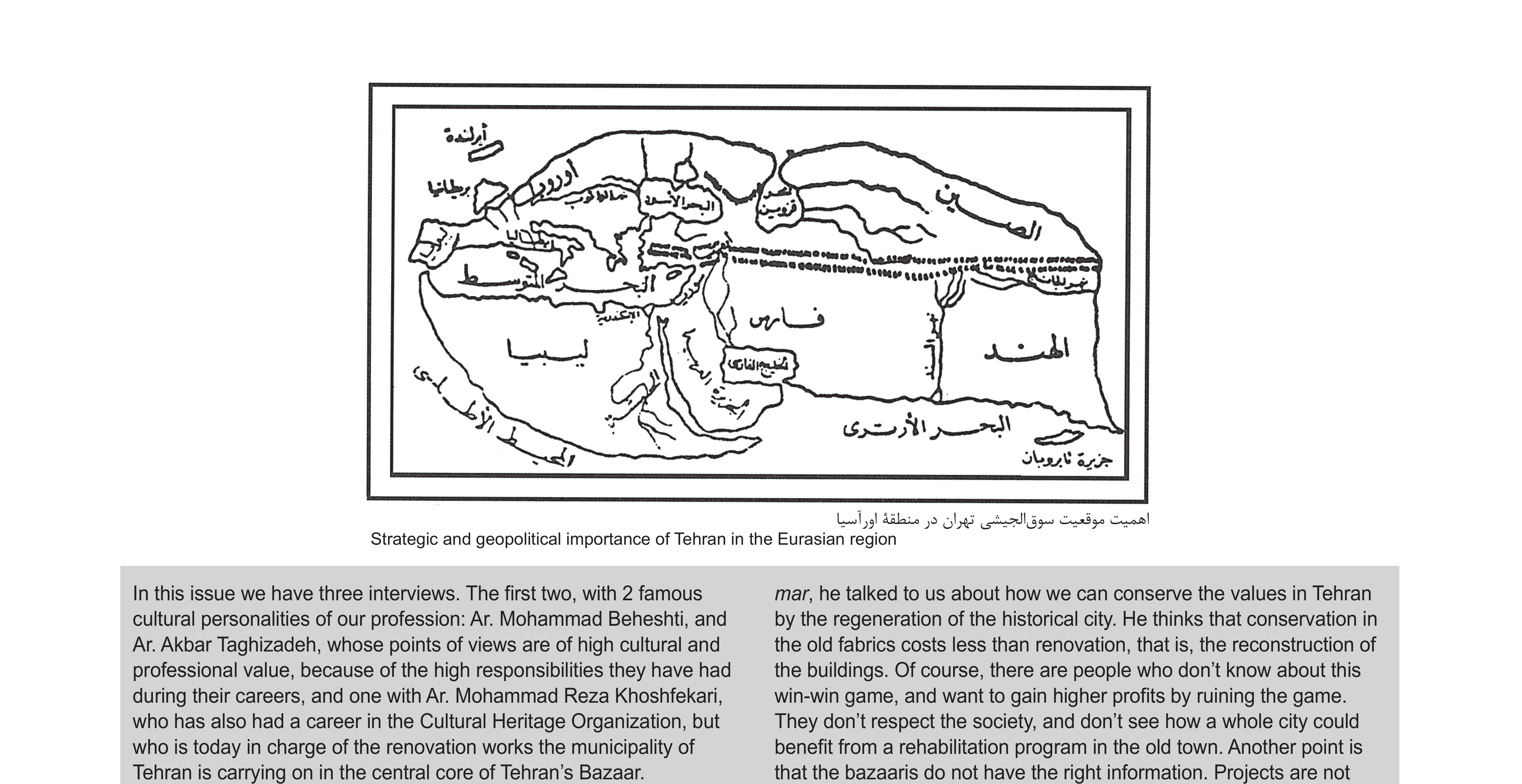
I have an article that I will provide to you, titled "The Narrative of Tehran." In it, I have discussed the unique geographical position of Tehran. A position that first caused the ancient city of Rey, and subsequently the village of Tehran, to experience very rapid growth. This is related not only to its location on the sole major route between East and West -- the Silk Road -- but also to specific geographical reasons such as Tehran's suitable distance from the north and south Tehran fault lines, a distance that provides access to groundwater sources, springs, and rivers associated with the faults on one hand, and relative remoteness from the faults themselves during earthquakes on the other. In that article, I also address the details of Tehran's unprecedented population growth over the past two hundred years, which has been related to migrations and historical events. In any case, Tehran has a long and considerable history that cannot be easily dismissed.

That is well established. But we want to hear your views on the principal issues of Tehran in your own words.

You see, in the modern era, we set out to build a city based on new urban planning knowledge -- comprehensive plans and city engineering using so-called modern scientific methods. Where does this city derive its authenticity? The Tehran plain possesses genuine values, identity, and characteristics, part of which trace back to the nature of this setting and the interaction that humans have had with this environment going back eight thousand years. That is, this city is not a place without standing; it has stature. But with the approach we have taken in the modern era, wanting to give this city a new stature, we have in fact entirely disregarded its meaning. First, stature is not something we can bestow upon a city through our designs; second, stature is the product of the historical interaction between humans and their environment. Our contemporary behavior testifies that we have treated Tehran and the Tehran plain as a blank sheet of paper, thereby disregarding everything that signifies stature -- and not just its nature.

With this kind of outlook, we are like someone who, wanting to water a flower as an act of devotion, tramples a hundred flowers underfoot and considers it a sign of love for that one flower. That is, it is we who need to be corrected, not our city. If we are set right as a professional community, if we are set right as urban management, our city will certainly be set right as well. If our city is disorderly and we find it disagreeable and uncomfortable and think it is a costly city, it is because what has been in the minds of Tehran's modern society, and the outcome of what they imagined, has taken shape and materialized in practice.

Yes, but some bear greater responsibility here and others act more passively. When the municipality, the Heritage Organization, or the Court of Administrative Justice, for whatever reason, remove valuable buildings from the list of protected structures and issue demolition orders, the tendency is that now it is the turn of the more identity-rich parts of the historic city to be demolished. Of course, it is not that all the gardens of District One in Shemiran were worthless when they were destroyed. Perhaps these behaviors could have been otherwise? Does the same body of urban planning knowledge that you speak of negate these actions? In Europe and America, where they themselves wrote this knowledge, their historic centers are intact, their rivers and ancient trees and hectares upon hectares of green space remain... So what is the story?

All of this, when the orientation is that something else is better, naturally people do not see what is right before their eyes. Our professional community is like a physician -- a physician whose diagnosis and prescription for the city are killing the patient. Well, it would be better if they did nothing at all. Perhaps if nothing were done, the city would heal itself!

But surely...

Look, right now in Tehran there are things that are desirable. Now you should investigate whether these are the result of the work and initiatives of the professional community and urban management, or whether they actually neglected these areas and the city simply corrected itself on its own. In Yusef Abad, you have an urban community. Was this the result of the professional community's work?

Well, the development of Yusef Abad originally, when Mostofi sold it, began with land sales and massive construction for the middle class.

Yes, but now it is beginning to thrive. Why? Because humans are civic by nature.

So what should we do so that everyone thrives? Both our professional community and our urban management --

They need to come down from their high horse of authority. They should not think that all the knowledge of the world resides with them. They must be confronted with the fact that they are inflicting damage upon this city. In this extraordinary natural setting of Tehran, they have committed irreparable mistakes! Has everything turned out well wherever their word has prevailed? Has the city improved?

Perhaps a large part of the problems stems from the fact that the decision-makers in Tehran's urban management are not Tehranis at all and do not know Tehran. When all the ancient trees of Darband were sawed down and Tehran's rivers -- the only resources for urban recreation and joy -- were converted by the Technical-Engineering Organization into ugly concrete channels, the mayor of Shemiran was from Isfahan, not Tehran. Otherwise, perhaps...

He would not have allowed it. In any case, their decisions were not based on any urban planning or aesthetic vision. They were not principled either. Even now, fifteen years later, not a single day has the walls of these enormous channels been wetted, even in the wettest season of the year. The Heritage Organization also did not allow the ungainly concrete channel to be extended into Sa'dabad Garden. In reality, the project was futile and only left a wound on the face of the city. Actually, if only that mayor had truly been Isfahani! Because at least there the Zayanderud existed!

Now the gates of the Zayanderud are opened and closed whenever the provincial governor pleases.

These are things that no one did for hundreds of years. Now some people think everything is under their control.

Yes, he regretted it too. But it was a case of the remedy coming after death! All the ancient trees on the other side of the river had already been chopped from the roots!

Individuals are compassionate one by one. But when they assume positions of authority, they commit a great deal of ineptitude...

Well... how do we instill this conviction in the hearts of Tehranis and officials?

Your problem is that you are in a hurry. Do not rush. Fortunately, Tehran is on the "threshold of a Spring of Urbanization" -- let us recognize it and welcome it.

It seems that Tehran is regressing in many areas and is actually moving away from civility. When I look at photographs of my parents or recall the urban spaces of my childhood, I see that the city has gone backward and regressed. What Spring are you speaking of?

We entered the era of urban crisis in the 1340s [1960s]. The effects of this crisis have still not fully subsided, but they are subsiding. At the exact opposite pole, we also see that an era of desire for urbanity in Iran is rising. That is, this aspiration is what drives the city toward the Spring of Urbanization.

When does this come about?

From the mid-1340s [mid-1960s] to about ten years ago, we were in a period of "crisis." Now the first glimmers of this "Spring" are beginning to show themselves and become visible.

Please elaborate further. What do you call the "Spring of Urbanization"?

We have something called civility, and then the crisis of civility. Some people think there is city and there is village. I say sometimes our city is doing well -- I call this "civility." Sometimes my city is doing poorly -- we call this the "crisis of civility." From the 1340s [1960s], when land reform took place and brought about many calamities, including severe migrations, the qualitative effects were far worse than the quantitative ones. The effect it had was that it took our city off the orbit of civility and plunged it into the crisis of civility. What happens is that everything degrades to the most base level of quantities. We witness the dominion of quantity and the chaos and confusion arising from the upheaval of the institutions that should have preserved the pillars of that civility within themselves. In reality, "society" is somehow exploded, atomized, scattered, and transformed into a mere "population." Quality is severed from it, and since there are no social organisms to carry life forward, the concept of life is pushed into residential units and building units. The city becomes devoid of life. The quality of a square is no longer at issue -- it becomes a traffic knot. A street becomes a thoroughfare through which traffic must flow. We look at our balconies and terraces as the back of our houses. We store pickles and other things there. These are the products of the crisis of civility.

This crisis demands its own kind of professional community and urban management. These must be of the same nature as this crisis and respond to it. The urban planner who thinks about quality becomes marginalized. The urban management that understands quality is gradually eliminated from the scene, and those who continue to be endowed with and committed to civility become the city's peripheral inhabitants, while those who have been most affected by this crisis of civility become the protagonists.

In the discourse of the crisis of civility, the condition of the city dweller degrades to that of a hunter. The city resident, who is not a true citizen, has no role in the creation of what holds value for him. He merely hunts them. All the construction that takes place in the city is hunted. That is, I am living in a house, and suddenly the detailed plan says my two-story house can become six stories. An opportunity for me to hunt suddenly emerges. This is what is provided to me under the title of acquired rights, and the entire city turns into a construction site. In the condition of the hunter, I no longer cling to the land. The condition of being "nomadic within the city" is something from which everyone profits. The greatest art becomes the hunting of opportunities. Everyone has changed houses five, twelve, seventeen, or thirty times over the years, whereas civility is the product of several generations of settling in one spot in the city. So it is natural for the city to fall into disarray. Value for such a person is his prey, and everything else is worthless to him.

So what happens to the Spring of Urbanization?

It follows in due course. Gradually, those who migrated reach the second, third, and fourth generations. These generations are now demanding civility and pushing the city toward it.

Look. The municipality once built the Resalat Tunnel. It was so appealing to people that for a month, everyone diverted their routes to pass through it. Because in the space of the crisis of civility, quantitative and massive works matter. When the Towhid Tunnel was built during the tenure of the current mayor, it no longer held that appeal. But when Cinema Azadi was rebuilt, it was appealing, because it signified a quality -- the quality of place -- because in front of the cinema, it revived memories.

Before roughly 1348 [1969], all the films that were made had locations with identities, and there was sensitivity to them. The film "Qeysar" took place in the Ab-e Mangol neighborhood, or in Hammam-e Navvab. Every place had an identity. After that, every film made had no identifiable location. It was in Tehran, but on a street, in an alley -- nameless and nondescript; it was immaterial which street it was on. In the north, in the desert... But now, after years, "Sa'adat Abad" is being made, or a film about a specific historical occasion, "Chaharshanbe Suri," is produced. All of these indicate that something is in the process of taking shape.

Five or six years ago, the volume of documentary films about Tehran as a subject became so large that the municipality organized a festival about the city of Tehran. Because even for the municipality staff, the question arose: Where is Tehran? Previously, this question was not on their minds. Tehran was a traffic network with a bunch of land uses -- the same image we have of Tehran in the detailed plan. Whereas here, Vali-e Asr Street is no longer confused with Enghelab Street. When someone makes a film, they want to say in it: this is Tehran. This is Milad Tower! This is the sign of Tehran.

So you are optimistic. Meaning, values are heading in the right direction, and the municipality, which for the sake of revenue generation in these years has been somewhat compelled to neglect quality, is now beginning to pay attention to historic Tehran and the identities and values that exist in the city.

Yes, I am optimistic. The people of the city are becoming aware. By virtue of the people of the city -- you who are also a citizen of Tehran -- you are becoming aware. You are not yet aware as an urban planner. The municipality is not yet aware as urban management, but one by one, those who work within it are aware. The municipality still speaks the old language, but I do not know why they are reorganizing all the sidewalks? So somewhere they have encountered a contradiction. They think some things are more urgent. Now the municipality has the Sadr Bridge project underway -- the double-decking of the expressway -- and it is making a great effort to convince people of its importance, but people no longer clap enthusiastically. The people of the city now demand quality. Quantitative issues no longer solve their problems.

Our professional community must receive these signals and prepare itself for entry into this new phase. Not by repeating the same old words; it must practice and learn. We must be responsive to our civil society. During Mr. Karbaschi's time, they would say: "My city, my home." I would tell him: But who is saying this sentence? At that time, the speaker of this sentence was urban management. Now gradually, this sentence is being heard from the lips of city residents. Citizens are gradually developing a sense of affection and responsibility toward urban space. When one becomes familiar with the narratives of places, differences become evident and the veil is lifted from the city.

Can we say that the effort to keep people in their own neighborhoods and the concept of neighborhood-centered planning that the municipality also supports would be a good policy for encouraging and elevating this civility?

If the city comes to mean something different to us than merely a place with a large population, and civility becomes our concern, then we will begin to think about what disrupts this civility and what supports it. For example, being "nomadic" within the city is disruptive to civility. Throughout Tehran's history, since its existence, it has been the city of plane trees. Why does the Parks Organization consider the plane tree an undesirable tree? Because it sheds leaves in autumn. That is why the city's trees are becoming conifers. Now we realize this was not a good thing to do. In truth, civility as a quality must become our benchmark and criterion.

You have held important government positions for years and are familiar with the mechanisms of governance. Do you not think that if the government, like the rest of the world, provided a share -- say one-third of the municipality's budget -- and the budget for building public networks such as the metro and others were secured, then the municipality would be better able to tend to the city?

Certainly that is the case. But even the current expenditures could be reduced. We constantly build curbs, then tear them up again. We place bollards in the middle of the street, then remove them. Consider just one square -- how many times in the past thirty years have there been changes and expenditures? If we build durably and think correctly, costs will decrease. We have made the city expensive. A city we have Westernized. The Niyayesh Expressway cut through several hills to pass through, whereas how many hills did the Modarres or Chamran expressways cut? Fewer. So they were much cheaper. How many qanats have the expressways blocked? Tehran has thirteen hundred qanats. What situation have these qanats created beneath Tehran? We do not know what is happening down there. Does urban management know? Does our professional community know where those cavities that might cause the city to cave in are located? In fact, recently a tendency has emerged among some young specialists abroad to revive Tehran's qanats, clean them out, and reuse them, and we recently spoke with universities about holding an international workshop on this subject with Tehran University and Azad University. That would be excellent. Then we will finally understand how many problems we have created for ourselves. We have restricted these channels. We first need to understand what is happening beneath Tehran. Every day we hear that some part of Tehran is caving in. This situation will reveal its effects over time.

Yes, and there are many other such issues. For instance, the problem of the appalling construction on the North Tehran Fault, which gets worse and more extensive every day. Now in Darband and other river-valleys of Tehran -- Darakeh, Darabad, Velenjak, Farahzad, and others -- they are building everything eight stories tall, while the recommended density in the new comprehensive and detailed plans for those areas is two to three stories. Most of the 157,000 buildings that received construction permits in the first nine months of 1390 [2011] are being built in these very northern areas of the city and are making the situation more critical than ever.

I too, like you, wish that the awareness of the people and urban management would increase, at least regarding the dangers that exist in Tehran.

* Seyed Mohammad Beheshti, born in 1330 [1951] in Tehran, is a graduate of architecture from Shahid Beheshti University. Over the years, he has served as director of various divisions of the Islamic Republic of Iran Broadcasting (IRIB) and member of its Policy Council, managing director of the Company for the Development of Cultural Spaces and cultural advisor to the mayor, member of the Board of Directors of the Tehran Engineering Organization, Deputy Minister and Head of the National Cultural Heritage Organization, and managing director of the Farabi Cinema Foundation. He currently serves as the head of the Architecture, Architectural Design, and Urban Planning group of the Academy of Arts and director of the Encyclopedia of Architecture and Urban Planning. He has participated in numerous international academic conferences on cultural heritage and has authored multiple articles on architecture, urban planning, and the conservation and restoration of historic and cultural buildings.

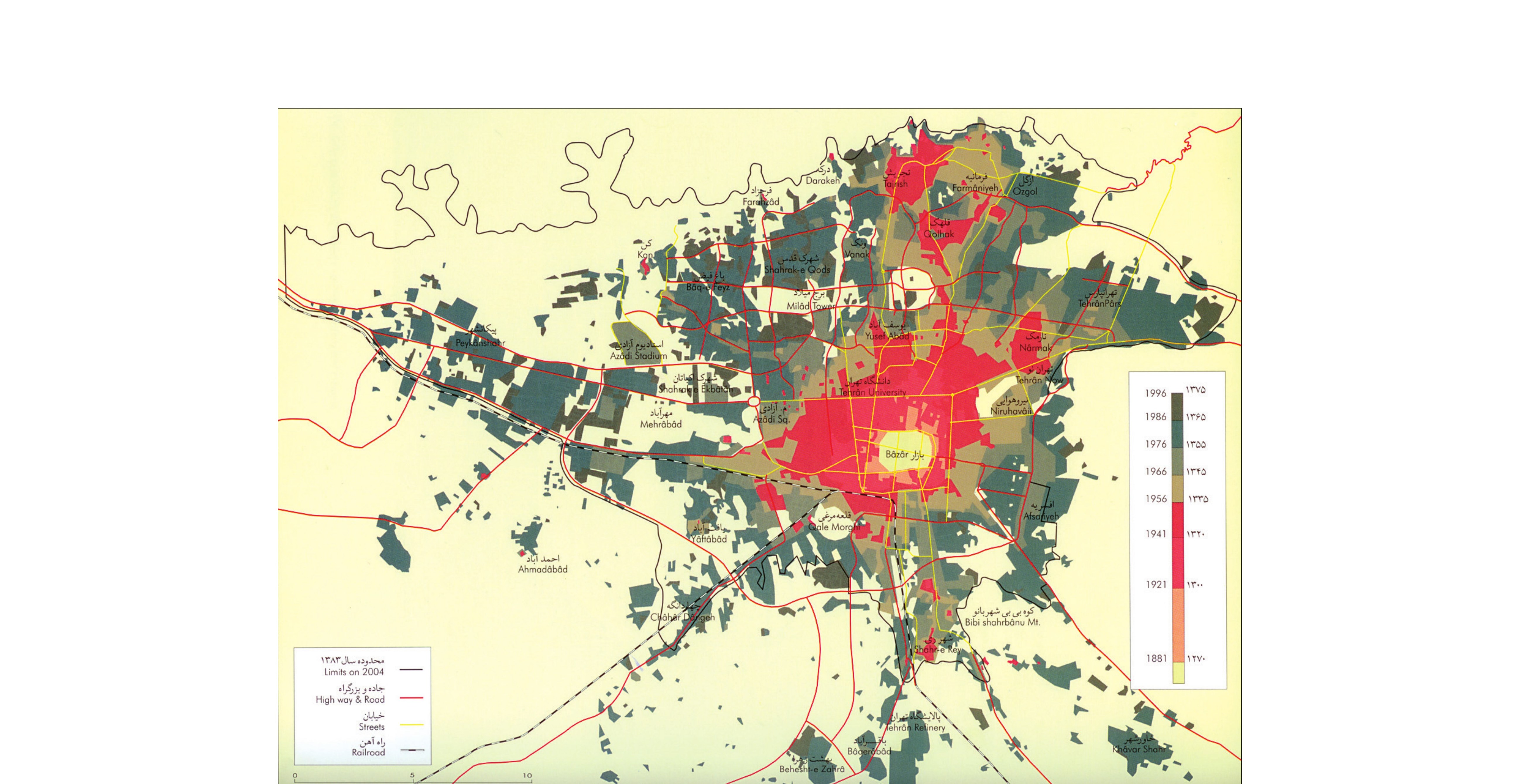
Physical growth of Tehran from the Qajar period

Interview with Akbar Taghizadeh Asl

Before Pardisan, which was a very large project, you were one of the pioneers of restoration and conservation in our country -- in Tabriz and other places. Please provide an introduction to your professional experiences and long career over the past thirty years.

My collaboration with the Cultural Heritage Organization commenced in 1373 [1994], and in the years prior, I was engaged in various construction projects, the recounting of which would become a seventy-man Masnavi and would probably be of no use to this interview. However, regarding conservation, I have experienced the restoration and revival of individual buildings, complexes, and ultimately the Tabriz Bazaar as a type of historic fabric during my tenure at the Cultural Heritage Organization, and I have had the good fortune of being able to accomplish something in this process.

Let me explain the difference between the restoration and revival of individual buildings and even complexes that were in the Organization's custody, and historic fabric whose owners are ordinary people who even live within it. These two types of phenomena have different processes in planning and execution. In a historic building, a single family lives, but in a fabric, an entire city lives. These people have different interests, varying social abilities and capacities, past conflicts with one another... If you want to intervene in the fabric, you must bring them to a consensus, which shapes the planning and methodology. Of course, there is also a strong positive point, which is shared interests, and if you can bring them to believe in this, then the work gets going and they can even forget their previous disputes and quarrels.

How did the restoration happen in Tabriz -- which may be the largest contiguous roofed area to have been restored in the world -- while it did not happen in Tehran? Or, for example, in Isfahan, the fabric in Jolfa was restored and turned out well, while in other neighborhoods of the same city, the government and the Urban Improvement Company spent a great deal of money, time, and effort, yet it did not work and turned into a decorative shell.

Probably many factors must be involved. The first is collective will, which must take shape at an actionable scale. Second, sometimes the interests of certain people lie in disorder. For instance, when your first priority is conservation, revival is the best protective umbrella. A building is both preserved and also serves its appropriate function. This is a win-win game. The building is restored. The building owner benefits from it. The law is enforced. The city benefits. The cultural community has its win. The tourism sector has its win. Everyone wins. Except one group -- the disruptors of the scene -- who want to demolish this fabric and, in this chaos, do their own business by obtaining density allowances and building new structures. They have an entirely different definition of winning. They create disorder for their own profit, because their win does not lie in the survival of the fabric; they are not residents of the fabric at all, or never have been. They want to quickly create disorder, demolish, build, and profit. They do not think about the rest of the community, the country, the future of this land, or even their own lives in the true and sweet sense.

On the other hand, in the win-win game, where all stakeholder groups benefit, the game reaches an equilibrium. This game is the best game in all arenas.

Third, many people think restoration is an expensive process.

Is it not?

No, restoration is absolutely and by far cheaper than new construction. When a building exists, repairing it is much cheaper than building one from scratch. The existing building is existing wealth. Some say, "We went and repaired such-and-such a building and it turned out more expensive than building a new one." Well, do you know what makes it expensive? The building's decorations: plasterwork, tilework, woodwork... which would naturally make new buildings equally expensive if they incorporated similar ornamentation. Do not doubt it at all -- repair is cheaper.

The next issue is that urban society lacks this information; it does not have a suitable model before it. We had this in Tabriz. Everyone became enthusiastic when one or two examples of caravanserais and timchehs were restored and everyone could see them. When these places are restored, the sense of security among bazaar shop owners increases. Customers also feel a greater sense of safety, because the place where they are present is secure. Therefore, the annual transaction volume of the shop goes up, because its customers increase. So the annual income of that person also rises. The goodwill value of the shops goes up.

Well then, who benefits? Everyone. On the margins of these shops, there are second- and third-tier trades -- for example, in the carpet bazaar, some places have rug menders. Suddenly, the rug mender's shop increases from sixty million to one hundred million in value.

Who buys from him? Another carpet dealer...

Yes, exactly. It means an upgrade in the quality of trades in the bazaar. Now, another thing also happens. Generally, goodwill values go up because a safe and more beautiful environment has been created. I witnessed this phenomenon in the Tabriz Bazaar with my own eyes. Such a competition for bazaar restoration began that we could no longer keep up with introducing workers and restorers to the bazaar owners. We had to create a waiting list.

Another difficulty is that during the restoration period, the shopkeeper cannot shut down his business. If he closes, he might lose customers. We learned in Tabriz that both we could do our work and they could continue their business. That is, the restorer must employ a method in his work -- for instance, separating the arch and ceiling space -- so that no harm comes to the bazaar merchants doing their business below.

What is your opinion of the new work in the Tehran Bazaar? These new brick ceilings and decorative elements that are being applied in a very cookie-cutter fashion to the walls and ceilings?

I have not been to the Tehran Bazaar in a long time. Some structural specialists are worried about earthquakes in the Tehran Bazaar and believe that the same lightweight previous ceilings can be renewed in a way that allows light in and nothing collapses onto people's heads during an earthquake. First of all, the Tehran Bazaar precinct is registered as a national heritage site, and this requires serious oversight.

Do you think the Heritage Organization is still active?

No, I know that the Heritage Organization has many problems. Especially in the area of headquarters administration. In the provinces, experts are still present and enthusiastic, but the managerial section of Heritage has weakened, and these people are not specialists in this domain to understand the depth of the issues. If you are merely an archaeologist, or anthropologist, or architect, that is not sufficient. An individual with comprehensive knowledge is needed, and since this sensitivity does not exist in the managers, they cannot expect it from their subordinates either.

So how do we set this will in motion?

In the Tabriz Bazaar, in 1374 [1995], we sat down with several bazaar merchants and conducted a damage assessment. Then we made several serious decisions as strategy and approach. The first was that we -- the government -- should not intervene directly in the people's affairs, but rather entrust their work to their own hands. We would only provide careful oversight. We had other tasks that were the government's duty -- namely, providing new utility networks: water distribution, gas distribution, telecommunications, surface water drainage, electricity, and so on. We even said a central heating and cooling system for the bazaar, so that a bazaar merchant would not bring a barrel of oil -- essentially a bomb -- into the bazaar every day. We also designed central heating systems for ten bazaars in Tabriz. Then we entrusted everything to the executive agencies. For telecommunications, for example, we arrived at a wireless system, although I was no longer there and now more advanced systems have emerged.

Now let us come to Tehran. Currently, not a single reputable consulting engineering firm is working in old Tehran. In Tehran, it seems that whoever has wanted to work for the bazaar has gone to his own office and drawn up plans. Very good plans, too. But they have not sat down with the bazaar merchant, to feel his pain and think on his behalf.

If you will permit, let us move to the discussion of fabrics. Why did your work not advance in Isfahan?

Look, in the Pardisan Project, we had 125,000 square meters of restoration work underway -- meaning between 70 and 120 units of historic buildings.

(He searches through his papers): 43 houses, 14 caravanserais, 7 historic bathhouses, 2 historic thrones, 3 gardens, one castle, one hotel, and one ice house in a 253,000-square-meter precinct. If this work had been completed, it would have provided approximately 2,200 accommodation units, and in all of these buildings, which were to become lodging, tourism, and hospitality complexes, there would have been 3,700 restaurant seats -- meaning nearly 8,000 people per day whom we could have accommodated.

Well, surely they thought: we do not have any tourists, so what do we need these for?

Why do we not have them? Why do you think tourists must necessarily come from abroad? The continuity of Iran's future life lies in domestic tourism. We have ethnic diversity and these people must get to know each other. Does knowledge of one another come about except through travel and visits? Fundamentally, we must progress from domestic tourism to international tourism. In Iran, we do not have a single person who knows how to treat a tourist. We must first learn how to treat domestic tourists, then reach international ones.

If the Pardisan Project had been realized, it would have become a foundation and infrastructure for cultural tourism, which is the most important type of tourism and which, incidentally, is aligned with the country's current policies. Those who engage in cultural tourism are the cultural elites of their own countries. They are the elites of their nations. I read somewhere that there are approximately seventy million cultural tourists worldwide annually, and most of them are interested in visiting Iran as well.

How many of them actually come? Maybe a million?

No, far fewer, perhaps fifty thousand or thereabouts. Unfortunately, we do not have reliable statistics to rely on!

Well, what should be done?

That is the job of the Cultural Heritage Organization, to prepare the groundwork. In Tabriz, we did what was needed: restoration took place and the bazaar was inscribed as a World Heritage Site. Its name went on the airwaves. The shopkeeper who once spent two or three million tomans on bazaar restoration now earns two or three million tomans per day.

So you are saying that it is Heritage that must do these things, not the municipality.

Yes, the duty of Heritage, as stated in the founding law of the Cultural Heritage Organization, is that decisions made regarding registered historic buildings must be carried out under the oversight and supervision of Heritage.

But Heritage has no budget!

Does Heritage need to spend money? It is fundamentally wrong to decide to restore the bazaar with government money. The bazaar merchant fundamentally does not trust the government. Not now -- he has never trusted it enough to hand over his money for restoration work to be done on his behalf. When the government comes to the bazaar, he looks at it askance. The bazaar merchant's problem is not money. He has money. He lacks other things that you must give him. And those are a horizon and a vision. A view toward the future. Then there are things that we understood in Tabriz through damage assessments. They said: if we make repairs, the government will then tax us more. We went to the Tax Director General, who was a fine man, and asked him: where do you get the money you give us? He said: from the bazaar, the merchants... We said: well, if these people themselves come and make these expenditures, what then? He said: let them spend it themselves and fix up the bazaar. We said: then tell your assessors to levy modest and lenient taxes from them for a few years on account of bazaar safety and beautification. He said: agreed, and exempted them from income tax for several years.

Or, for instance, the bazaar merchants complained that the municipality, the Commerce Bureau, and others were interfering in their affairs. Negotiations were held with the municipality. We said: you operate based on the Municipal Law -- you issue permits and collect fees. But according to the Heritage Law, whose date of ratification postdates the Municipal Law, this task has been delegated to us. So, allow us to issue permits for restoration, and we will also send everyone to settle their fees with you first. The mayor agreed and gave the permissions to Heritage.

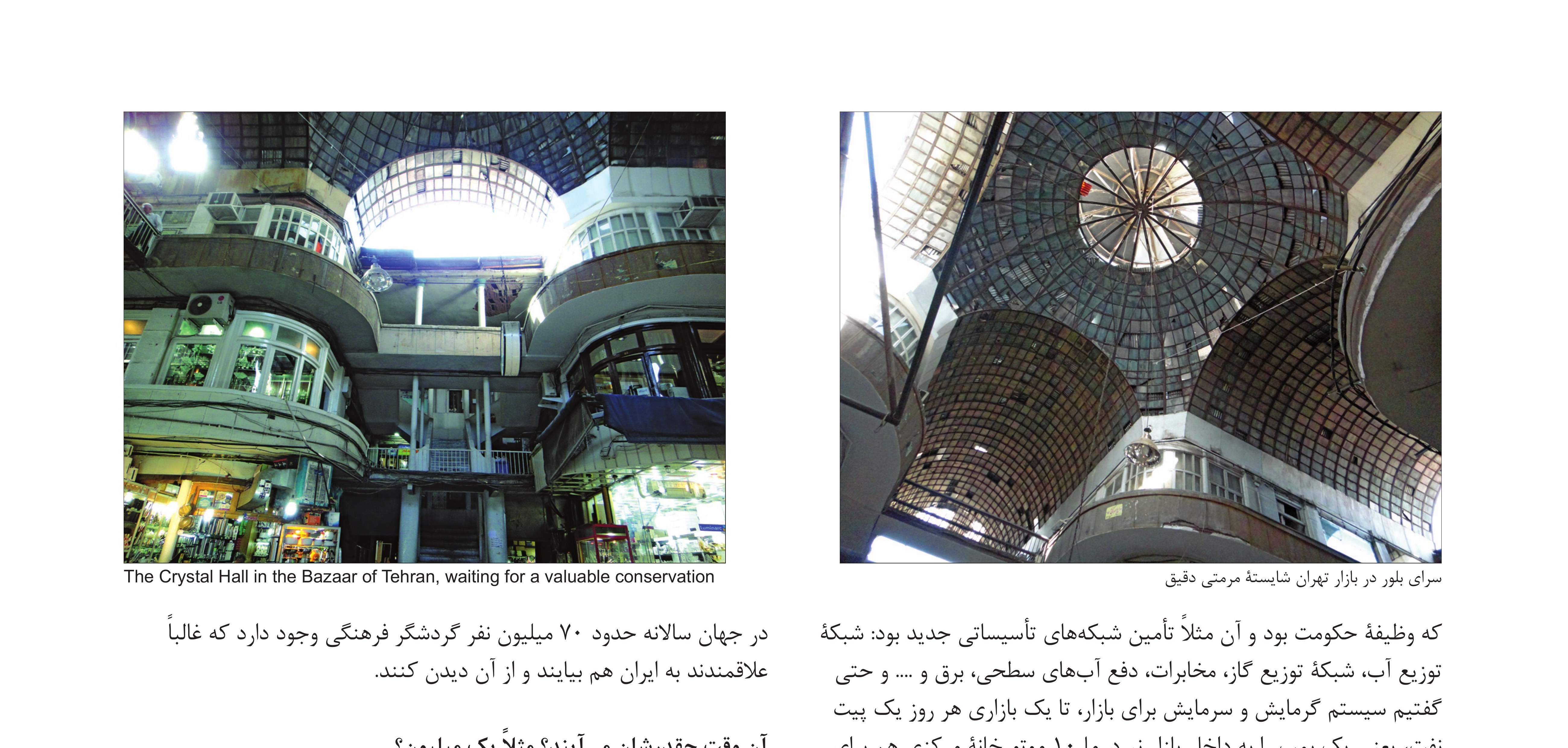
The Crystal Hall in the Bazaar of Tehran, waiting for a valuable conservation

There is currently a great deal of conflict between the municipality and Heritage.

Well, these must be resolved. Why should we not be able to resolve our problems with the municipality or the Tax Authority? We certainly can, and it is better not to postpone today's work until tomorrow.

Let us move to a few more questions. Recently in Tehran, some historic buildings are being removed from the list of Heritage-registered properties, so they can be demolished. What should be done? Why does Heritage -- which is itself the custodian -- do this?

I believe that the Court of Administrative Justice, which issues these rulings, has not yet realized what kind of blow it is dealing to the body of the homeland. It has not realized that the path to our endurance lies in these things, and the foremost aspect of this matter -- what has kept the Iranian nation standing -- is culture. From the Achaemenid era to the present... Look around you: what remains of Assyria and Urartu? But the Iranian element endures. Why? The primary secret is cultural commonality, and its roots lie in history. For instance, Nowruz. All governments in all eras spent generously to bring society to a consensus. Nowruz is one of these. Historic buildings are one of these. It is utterly inconceivable that someone would dislike Naqsh-e Jahan Square.

Now come and eliminate these things one by one. The government must be told to compensate the property owner's lost profits. These people do not think about fundamental imperatives such as the survival of cultural Iran. They must be asked: do you understand what you are doing by issuing these rulings?

In your view, are we lacking anything in terms of legislation in this area?

No, if you read the founding charter of the Cultural Heritage Organization, which was written after the Revolution, it states that opinions regarding registered properties are exclusively within the purview of the Cultural Heritage Organization. How is it then possible for such things to happen?

Then why does this happen?

I do not know where they derive the basis for these rulings. My belief is that with these measures, they are undermining the essential imperatives of the homeland's survival.

Perhaps economics speaks first here. Like the story of Shemiran's gardens, where four to five hundred hectares were sawed down and replaced with five-, eight-, and fifteen-story towers and buildings.

Friends would say to me: what is this insistence on preserving these gardens? What sin have the "honorable owners" of these gardens (meaning the original landowners!) committed by planting trees in them? Now the neighboring plot, which is barren, is worth billions because it can be built upon! While this garden must remain remote from development and neglected.

Rest assured that it will not be very long -- perhaps twenty years, to which we too will bear witness -- before we reach a suitable level of social growth and awareness, and all historic buildings will become so valuable that you cannot even imagine it. Do you know that behind the registration office for historic buildings in England and France, there is now a queue? That is, building owners are lining up to have their buildings registered. Why? Because the moment a property is inscribed on the National Heritage List, it becomes more expensive.

Let me make a comparison. Compare properties that have the "heritage tag" with those that do not. In the deed of ownership, the property's pedigree is recorded -- that is, its values are enumerated and documented. The same applies to the registration of a property on the country's list of historical monuments. Not all buildings have the chance to be registered, because there is no value in them that can be enumerated. Therefore, a building with cultural, artistic, and historical value should command a higher price by virtue of its values. The exact same thing happens with historic buildings.

Now, for this transitional period, we must think of something.

Well, a new law should compensate and secure the property owner's lost profits. For instance, he wants to change the land use. Well, the fees for change of use should not be charged, or the business that he establishes there should be exempt from fees, and for a certain number of years after opening, taxes should not be collected from him. These are not difficult things to do. We support him and he preserves his property. This law must be passed, to support owners of historic buildings... Of course, the Tehran City Council has already taken some steps and passed resolutions regarding assistance to the private sector in the preservation of old fabrics and the creation of...

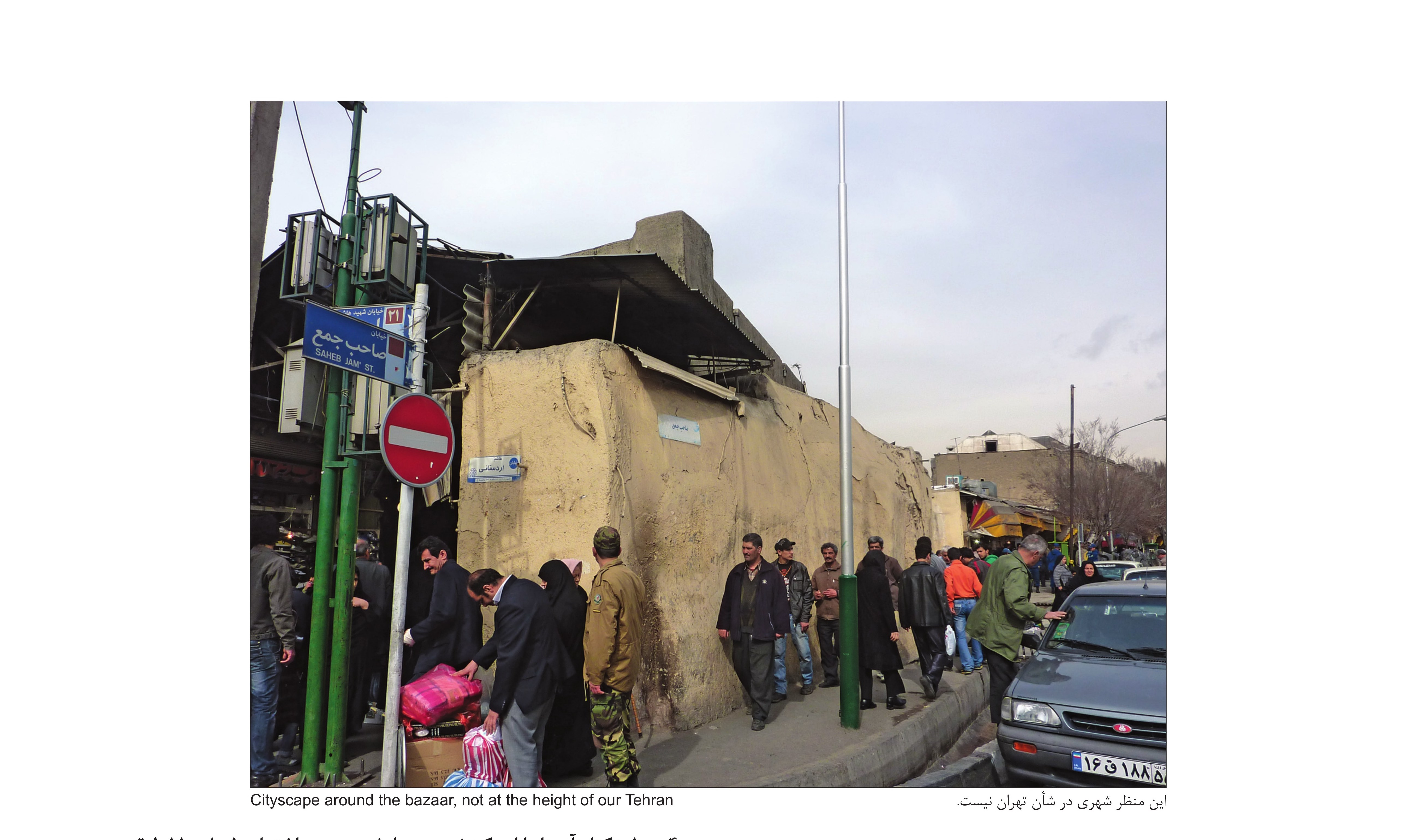
Cityscape around the bazaar, not at the height of our Tehran

...sports and cultural facilities, but practically no budget has been allocated for this purpose, and the municipality is neither attentive nor active. Of course, there has been absolutely no public communication about these small steps. If low-interest banking facilities are provided for owners of historic buildings, if they are exempted from taxes, is that attractive or not? Then he naturally preserves his building. Assistance must be provided to him.

[At this point, Engineer Adel Farhangi, a veteran Heritage expert, also entered the discussion.]

Farhangi: The municipality has not yet evaluated and analyzed its financial system based on the give-and-take of different districts, and it does not have a proper plan for its expenditures either. For example, how much revenue do you derive from the bazaar district? Do you derive the same revenue from Sangalaj or Oudlajan? Then you must see on what basis these revenues should be distributed. So the bazaar that generates this much revenue should also benefit more. In our society, there is no transparency. In that case, the various sectors will demand their rights in proportion to their contribution. Unfortunately, this does not happen in our society, and people are not economically literate.

Second, whatever holds value for the city, everyone must bear its costs, and at the same time everyone should benefit from it. One example is the city of Ferrara in Italy, where they took a city block that contained nine parcels. They could build four stories. They saw that one was an empty lot, one was a valuable building, one was entirely a registered monument. They said: the municipality will not... So they thought among themselves, used initiative, and through design managed both to provide parking for all of them, preserve the historic buildings, and modernize the block. Unfortunately, our professional community has not yet arrived at this kind of thinking and collaboration.

Yes, of course the municipality has also stifled creativity and initiative. The general atmosphere of society does not look favorably upon architecture and beautiful work either.

Farhangi: Yes, of course consultants are also defined as for-profit entities. And then our young people are also partly to blame. If we want quality work, we must make the effort. Methods for funding each project will certainly be found. I would sometimes say in municipal meetings: you must collect the costs of your work from consumers at various scales across the city. This is true not only for historic fabric but for the entire city. The issue of integrated urban management arises here. Of course, these require more precise planning and better oversight... Here the managers change every day...

In our macro economy, something called oil has happened that has blinded our eyes and does not allow us to think otherwise. In the municipality, density-selling has happened. So you are selling oxygen. Everyone -- from the municipality and the tower-builder to me, the consumer -- is participating in a race to make this city uninhabitable.

Farhangi: The Abbas Abad hills themselves. Instead of keeping that area green, they have built a large number of buildings. There is practically no land left...

Do you ultimately think that one day a proper management will put these things in order?

Certainly, Iranian civilization is meant to endure. God willing, in urban management and organizational management, we will be able to plan and be path-breakers. Provided, of course, that we do not squander all our opportunities and everything is not destroyed in the interim.

Farhangi: For this, in any case, people are needed who have strong determination and power and who can manage this process.

* Akbar Taghizadeh Asl, born in 1327 [1948], is a graduate of the Faculty of Architecture at Shahid Beheshti University. He has served as a member of the Board of Directors and President of the Construction Engineering Organization of East Azerbaijan Province, as well as the National Construction Engineering Council. At the Cultural Heritage Organization of East Azerbaijan, he served as complex manager and in the national Pardisan Project, which pertains to the revival of historic buildings after restoration and their conversion into intra-urban and extra-urban lodging and hospitality complexes. He has taught at the architecture faculties of Tabriz University and the Islamic Art University of Tabriz and is currently the executive director of the Saba-Pardisan Project, which oversees the restoration and revival of the Ameri Complex in Kashan, the Masoudieh Historical Complex in Tehran, and the Vakil Caravanserai in Kerman.

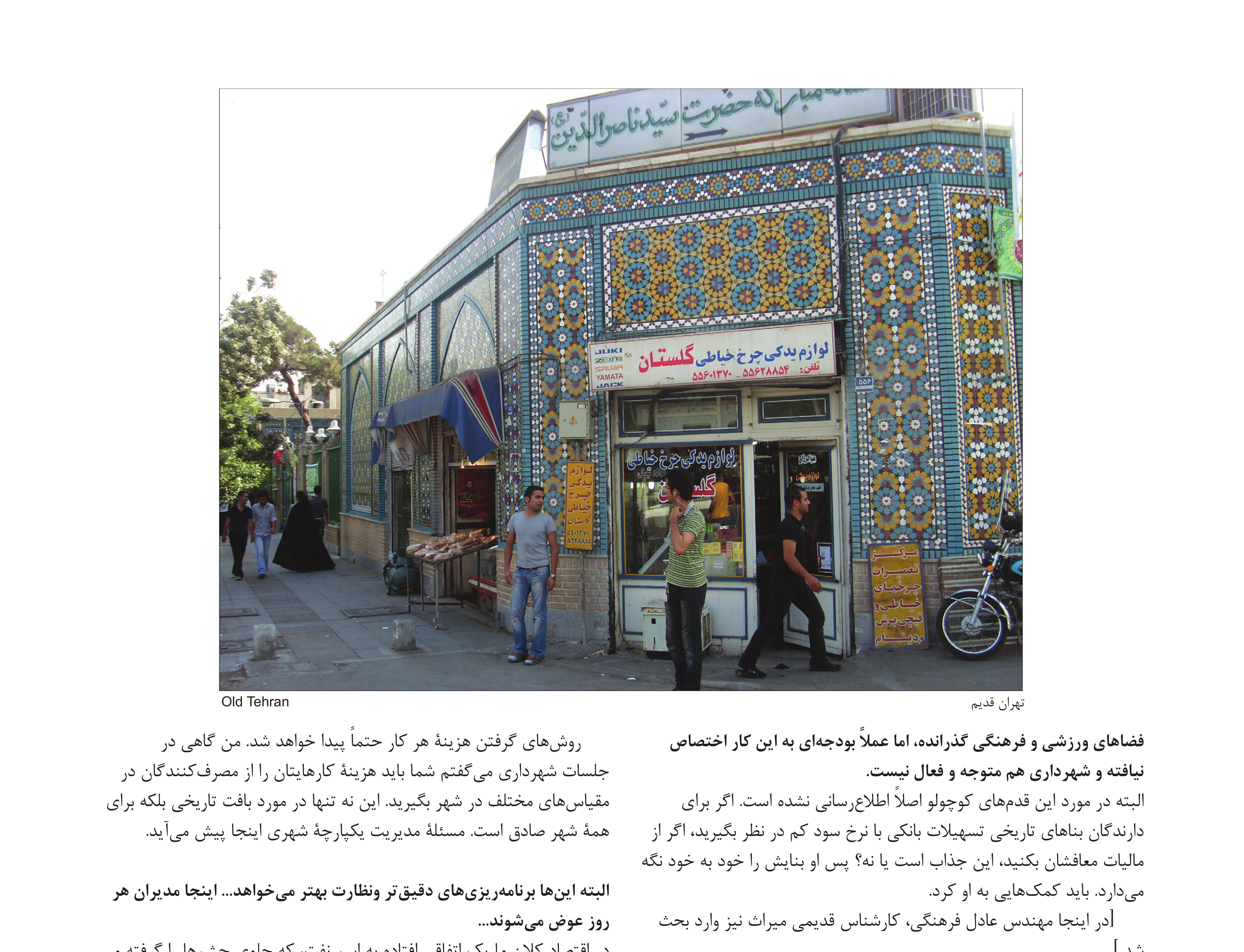
Old Tehran

Interview with Mohammadreza Khoshfekari

Mr. Mohammadreza Khoshfekari, you are one of the most prolific and active engineers engaged in restoration and improvement work within Tehran's historic fabric. The most important sites of historic Tehran are currently being renovated under your supervision. Please provide an introduction to your work.

My work in Tehran began in 1381 [2002] with the restoration of the Ein al-Dowleh building in District 4, outside the boundaries of historic Tehran. It was a Qajar-era building. Then came the restoration of individual historic buildings in District 12, during the tenure of Mr. Zafarghandi. In fact, due to my prior collaboration with Engineer Razavi in Isfahan, I began as senior consultant for District 12, working with the collection of buildings that the Tehran municipality had purchased in that district, starting with six or seven buildings such as the Fakhr al-Dowleh building -- now the House of the Maddah -- Hammam-e Navvab, the Dabir al-Molk residence, and several other buildings.

Then the discussion of Moravi Alley (Koucheh-ye Moravi) arose, which in my view was an urban case. This axis was designed by Isfahan Housing Builders Company, and they also carried out the work, but I played an effective role in it. The prevailing view there was that this axis should be fully covered -- like a bazaar. The merchants wanted this. I resisted, and ultimately I was commissioned to exercise senior oversight of this project. During our weekly sessions, the idea of the arcades was also mine, because certain sections had already been covered, and we decided to continue the same approach.

Moravi Alley, beyond its commercial role and the sale of cosmetics, also contains an old school called Moravi School and other historic buildings. Was this work approached as a historic axis? That is, the form that Moravi Alley took -- its materials, design, and type of work -- was it in harmony with the historic form and role of this axis? And was it worthy of those buildings?

In the Moravi axis, we identified the places that had been defined as neighborhood centers -- for instance, the mosque, the cistern, and so on -- and what was around the neighborhood core at the crossroads, which we took as the primary nucleus, so that if we wanted to plan for any expansion and extension of the work, it would proceed from this point. We then took the existing tendencies and conditions as our baseline assumption. Then we finalized the arcade plan, because the existing conditions imposed certain constraints upon us.

It is interesting to see how you finalized these arcades. How did this innovation come about?

Well, in Moravi Alley we have two levels of commerce, one below and one above. On the first floor, the entrances to the upper sections had created some arcades and overhangs that had already taken shape; these had been allocated as commercial centers and were developing. We thought we would optimize this existing phenomenon so it could proceed along the same trajectory, with a specialized team overseeing it. Now, you might have opinions about the arches...

No, I wanted to understand the rationale, and now I see that your thinking was practical. Since there was already a tendency in the location, you continued it and thought toward a practical development. But what was the design basis? Did you have prior studies or did you adopt a model from somewhere?

No, Isfahan Housing Builders, based on its studies of the existing conditions, had concluded that the existing arcades had to be accepted. They had developed an understanding of it, and the colleagues' view was that perhaps the phenomenon could be contained. But my thinking was that expansion was likely, and with the conditions we were creating and the improvements we were making, this development would certainly accelerate. In truth, the design of Moravi Alley was not a restoration approach; it was an improvement approach.

That is absolutely right! In truth, you did not look at it with a historical eye. You simply wanted to make it better.

Yes, the fabric here was being completely destroyed. We tried to at least stabilize the situation. All the buildings were also repaired. All the utilities were placed in channels within Moravi Alley. The same channel system was also created in the bazaar.

In any case, the optimization of Moravi Alley created potential in the area. We proposed a pedestrian axis. We could have proposed a pedestrian ring -- a pedestrian zone within Old Arg and the bazaar area, from Arg Square, Davar, Sour-e Esrafil, coming down from Nasserkhosrow. These pedestrian routes are also envisioned in the district's detailed plan, and other routes existed as well. If we look at it from an urban perspective, Sabzeh Meydan is the busiest spot. From the beginning of Golubandak Crossroads to Sirus Crossroads, we set this as our first priority. We said if we have this ring, we would place a concentration center here -- that is, Sabzeh Meydan would become the main node, the next priority after Moravi Alley.

We consulted historical documents and drew a model from those plans, trying to build these arcades based on the arcades that had existed before. Of course, the most recent arcades at Sabzeh Meydan were neither brick nor arched. However, in the time of Amir Kabir, there were arched vaults here. In the late Qajar period, the arches became flat, and only during the Reza Shah era did the arcades have no arches at all. Of course, conditions had also changed greatly. The existing situation was completely chaotic. Construction had occurred on upper floors, and there was the problem of the gold bazaar too.

Since 1388 [2009], three years of this work have been underway. Of course, some work here happens simultaneously -- like the pedestrianization of Davar and Sour-e Esrafil streets and part of Nasserkhosrow, although these, like 15 Khordad Street, happen in two phases. First a vehicular ring remains, then it becomes fully pedestrian.

Who prepared these plans?

The Sabzeh Meydan improvement plan and the pedestrian ring idea were ours. But the paving plans were done by Tarh-o-Ta'avon Company, which are consulting engineers. The plans for Davar, Sour-e Esrafil, and Nasserkhosrow streets were prepared by Baft-e Shahr (Urban Fabric) consultants. We ourselves carried out all the facade work on the southern side of 15 Khordad Street.

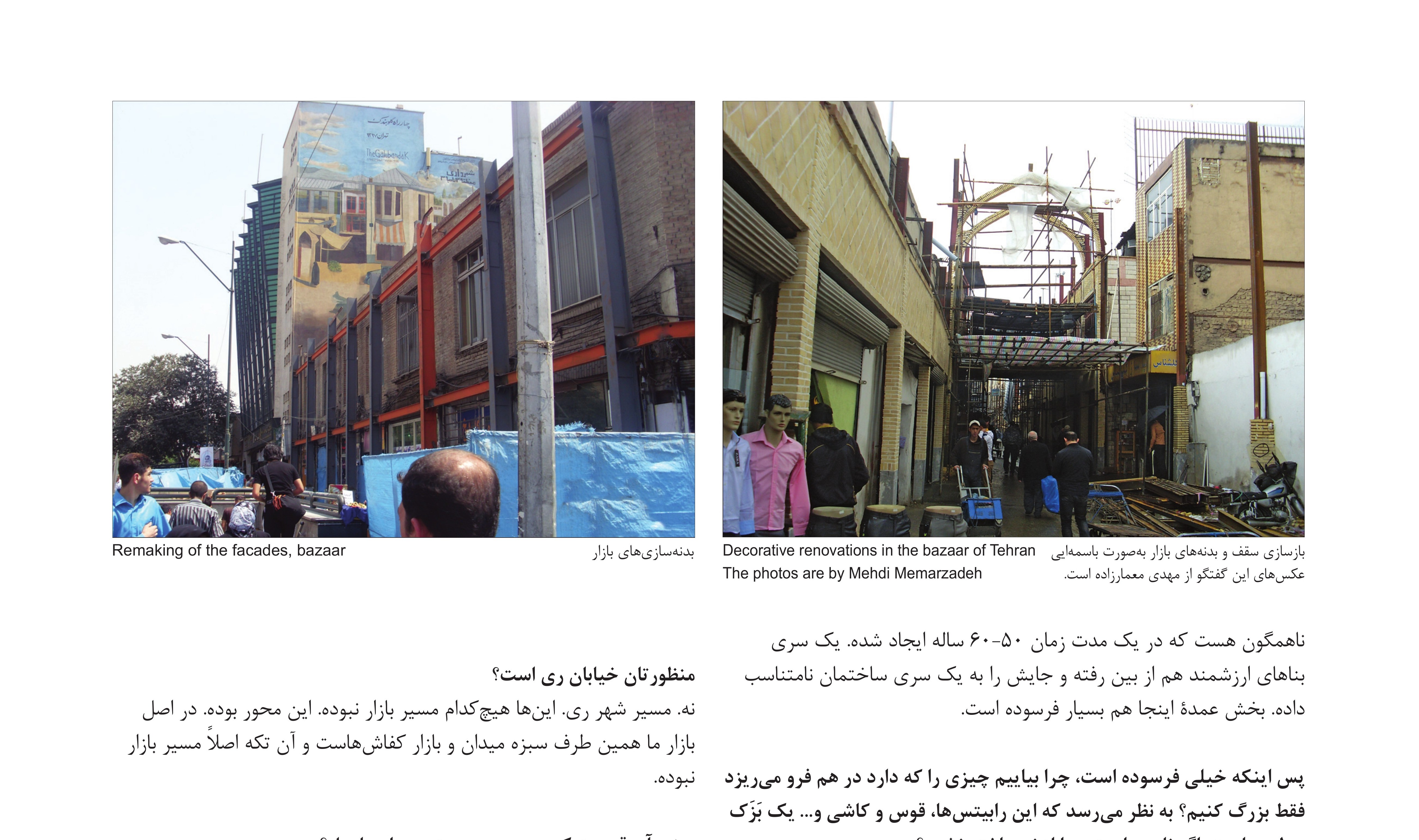
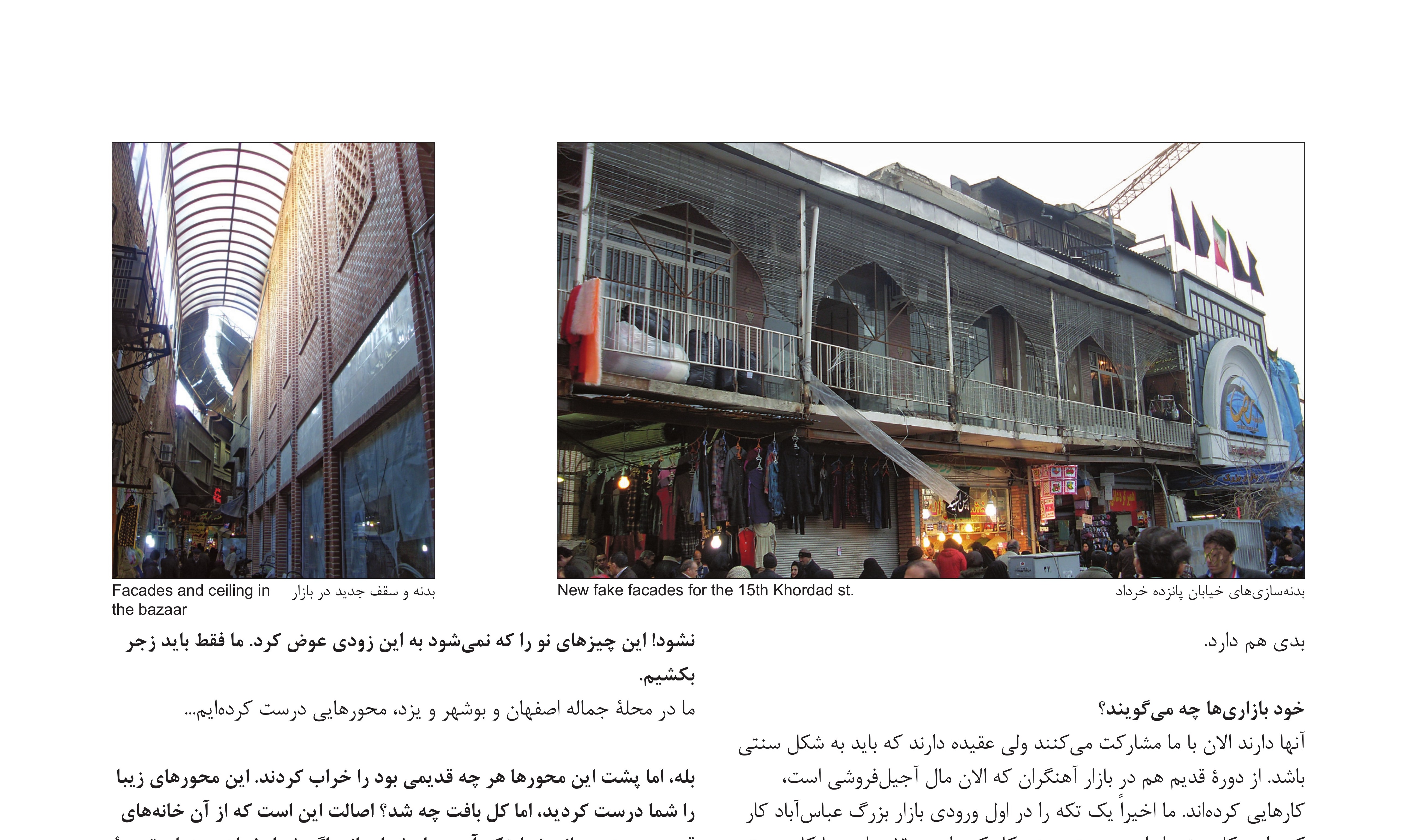
What is the story of this facade work being done with wire lath (rabitz)?

This is a shell along 15 Khordad Street, from Golubandak Crossroads to the Nasserkhosrow route, with a single skyline. From the entrance of Imam Khomeini Mosque to the end of the project at Sirus Crossroads, the skyline is defined at several different levels.

So you decided to create a facade treatment for this area, which of course does not mean the actual improvement of these buildings, but rather something like a set decoration?

Yes, it is a shell. What is the purpose of a shell? Look, there is nothing we can do. Imagine there is a series of buildings here

Commentaires

Aucun commentaire. Soyez le premier à partager vos réflexions.