Contemporary Architecture

The Works of Farokh Ghahremanpour

Majid Ghamami·Photos: Ataollah Amidvar, Ataollah Ziaei, Aligholi Ziaei·Memar 01 — The Inaugural Issue

If we do not consider architecture a "special subject" that is the preoccupation of "special people," and its mission solely "innovation" (at any cost and in any manner), and if — in addition to the grand, important, and unique buildings that are built from time to time — we also consider all the small and large, important and unimportant buildings that are constructed and that form the reality of our cities and neighborhoods, alleys and streets, and the main stage of our lives, to fall within the domain of architectural concern, then we can say that the chaos that today afflicts the face of our cities and living environment is an important architectural problem.

This chaos results from a combination of multiple factors: the speed of transformation, our superficial and hasty approach to the achievements of the advanced West, and the effective and influential presence of social strata who, in the course of this rapid change and transformation, have suddenly come into wealth and have imposed a caricature of aristocracy, luxury, and superficial ostentation upon the architecture of cities through an unhealthy competition.

Yet despite the dominance and influence of this destructive assault, we believe a healthy current still exists in the field of architecture — one that has stood firm against this onslaught. Memar Magazine intends, in solidarity with this healthy current and in support of this architecture — which is the product of cultivated taste, serious thought, and skill born of sustained practice — to introduce to the public, against the backdrop of vapid, irresponsible, and trend-following architecture, the works of architects who through years of labor and effort have achieved technical and artistic maturity and built buildings that are serious, sound, and beautiful.

In this issue, we shall introduce the works of Farokh Ghahremanpour. Born in 1320 SH (1941) in Tehran, he graduated in architecture from the Faculty of Fine Arts at the University of Tehran in 1346 SH (1967). Over his thirty-year professional career in architecture, Ghahremanpour has designed and built numerous houses and residential apartments as well as several public buildings, either as an independent architect or as a member and associate of Parsaz Consulting Engineers.

Here we present one example of Ghahremanpour's completed works — a private-sector office building — and two public buildings under construction within the framework of Parsaz Consulting Engineers.

◆ ◆ ◆
Characteristics of Ghahremanpour’s Works

Creating a pleasant and delightful environment through a measured and harmonious composition of volumes, while maintaining simplicity and avoiding clutter, disorder, and the use of incongruous elements; providing natural light for all spaces of the building; maintaining a geometric order upon which the building's structure rests while allowing freedom and variety in volumes; economy in the use and precision in the selection of materials with serious attention to construction details; and responsiveness to functional needs — these constitute the fundamental pillars of Ghahremanpour's architecture.

He believes that since an architectural work is enduring (even in cases where a building's lifespan is short, it lasts at least 20 to 30 years), it must remain appealing and acceptable throughout its life, and for this reason he considers blind and hasty imitation of passing fashions to be wrong. He strongly criticizes the practice that has become common in recent years, whereby some prepare "plans" for a building while others "paste" a "facade" onto it, and says that architecture is not facade-making. Interior space and exterior facade must be the product of a thoughtfully composed and coherent combination of volumes that are integrated to respond to the building's needs.

A glance at Ghahremanpour's recent works reveals his increasing tendency to use soft and curved surfaces and volumes, as opposed to the orthogonal surfaces and volumes that in his earlier works were combined at 45-degree angles — a tendency that perhaps speaks of a flexibility and suppleness born of the passage of time.

Second-prize winning design sketch for the Headquarters of the Iranian Association of Consulting Engineers
Second-prize winning design for the Headquarters of the Iranian Association of Consulting Engineers
◆ ◆ ◆
Office Building in Tehran
01

Office Building in Tehran

Project Data

Client: Farhang Ghasempour

Architect: Farokh Ghahremanpour

Mechanical & Electrical: Kolaberg and Sarmad Engineers

Structure: Fariborz Vakili

Construction Dates: 1365, 1367, 1373 SH (1986, 1988, 1994)

Photographs: Ataollah Ziaei

Ghahremanpour's office building differs fundamentally from neighboring buildings in its area in that the designer has attended not only to the building's interior spaces but also to its exterior appearance and its relationship with the surrounding environment. The building is situated at the entrance to an alley on a plot of approximately 550 square meters. Rising five stories above ground with two basement levels, it has a total built area of approximately 2,200 square meters, of which about 60 percent is office space and the remainder residential. The building has three distinct facades, with 7 steps from the main courtyard level and fully separated pedestrian and vehicular routes.

"The serious challenges of this project lay in confronting the severe constraints of the site on one hand and the opportunities arising from its location on the other, in addition to the views of the Alborz Mountains to the north — issues that had to be resolved during the design process."

— Farokh Ghahremanpour

The design is based on a modular geometric grid of two 20 × 20 meter squares, with 4 large circular columns placed at 14-meter intervals at the four vertices of this square. Through the combination of varying heights and the division of the square into sub-squares and diagonals, and the transformation of each square into semicircular and triangular surfaces, diverse natural light enters the building while also contributing to the beauty and variety of the facade.

◆ ◆ ◆
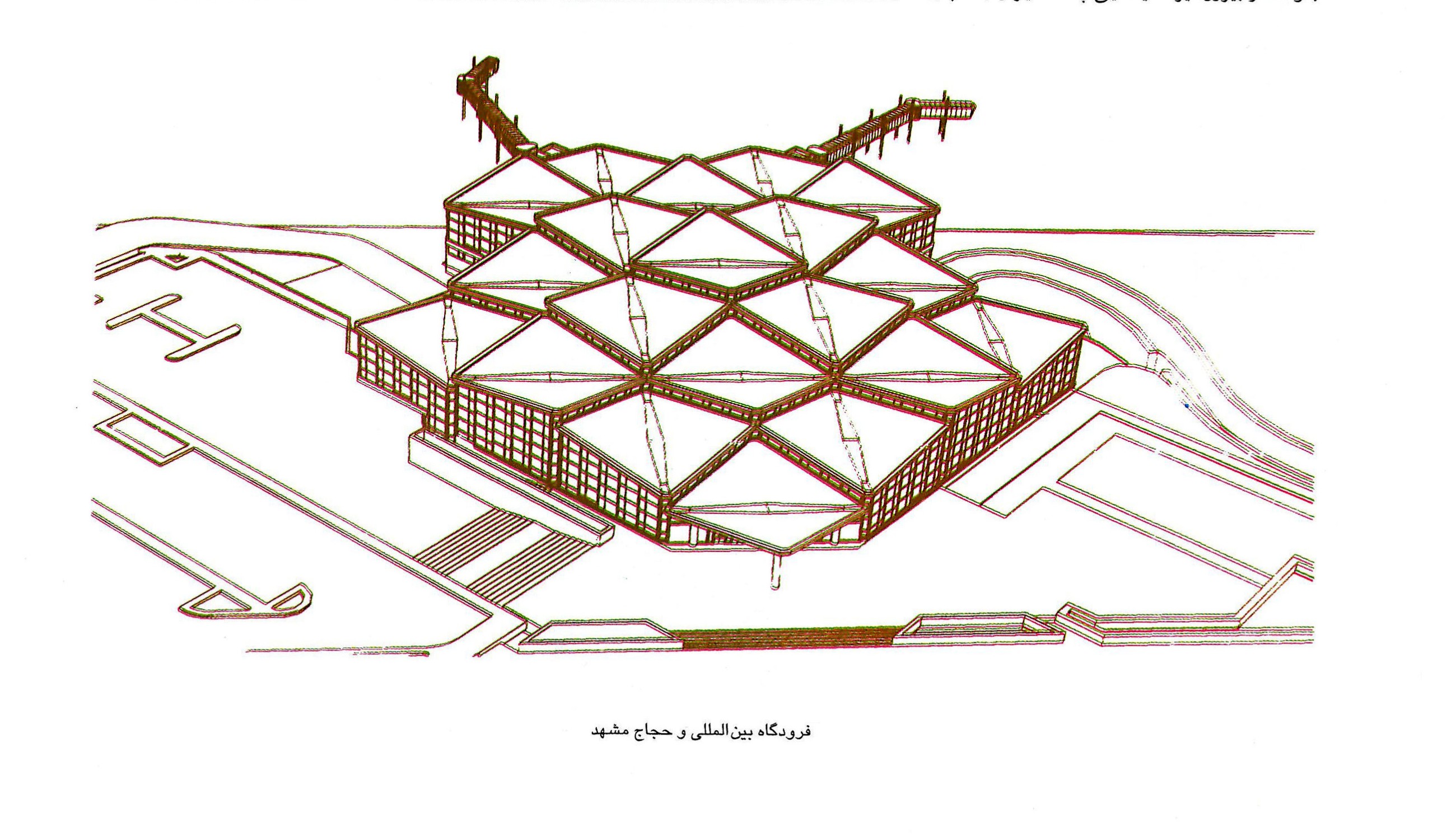
Mashhad International and Hajj Terminal
02

Mashhad International and Hajj Terminal

Project Data

Client: Civil Aviation Organization, Iran Airports Company

Consultant: Parsaz Consulting Engineers

Architecture: Farokh Ghahremanpour, Sirus Bolouri

Structure: Mohammadreza Ghodousizadeh

Mechanical: Mohammadreza Ghodousibadi

Electrical: Jahangir Solhjou

Contractor: Azar Mashhad Company (construction), Control Volt Company (services)

Construction Start: 1371 SH (1992)

The design of the Mashhad International and Hajj Terminal was commissioned in Bahman 1366 SH (February 1988) by the client to the consultant, in response to the limited capacity of Mashhad Airport in providing necessary services for the growing number of direct international flights as well as Hajj pilgrimage flights. This terminal, with an annual passenger capacity of 1.8 million, comprises a total built area of approximately 18,000 square meters. Located within the grounds of Mashhad Airport at an approximate distance of 1,200 meters from the existing passenger terminal, approximately 50 percent of construction work and 40 percent of services installation had been completed at the time of writing.

The principal design challenge of this building, given the terminal's need for a vast and unified space to freely and flexibly accommodate various activities, was the search for an appropriate method of covering it — in a manner that would respond to the building's diverse needs while making the interior as pleasant as possible, and at the same time allowing the terminal building to present a striking, attractive, and appropriately dignified exterior.

The entire terminal space is covered by placing together a modular roofing system: each roof unit rests on 4 large circular columns at 14-meter intervals. An ancient pattern from Iranian and Islamic architecture has also been employed. The combination of varying heights and the transformation of each square module into semi-pyramidal triangular surfaces pointing upward provides diverse natural light to the terminal interior while also contributing to the beauty and variety of the building's profile. The undulating roofline and the provision of air bridges for aircraft boarding are among the terminal's other notable features.

◆ ◆ ◆
Mehrabad Airport Terminals 1 & 2 Expansion
03

Mehrabad Airport Terminals 1 & 2 Expansion

Project Data

Client: Mehrabad International Airport, Shahed Trading Company

Consultant: Parsaz Consulting Engineers

Architecture: Farokh Ghahremanpour, Sirus Bolouri

Structure: Fariborz Vakili

Mechanical: Mohammadreza Ghodousizadeh

Electrical: Masoud Mokhlesi

Contractor & Construction Management: Asman Afarin Construction Company

Construction Start: Bahman 1375 SH (February 1997)

Photographs: Aligholi Ziaei

The expansion plan for Mehrabad Airport Terminals 1 and 2 in Tehran was referred to Parsaz Consulting Engineers in Dey 1375 SH (January 1997), in view of the ever-increasing number of flights, the inadequacy of existing airport facilities, and the extended timeline required for the commissioning of Imam Khomeini International Airport.

This project, currently under construction, has two parts. The first part, presented here, is the expansion on the entrance and parking side, intended to create a transit hall, flight waiting lounges, and a number of shops, with an approximate area of 3,500 square meters. The second part is the expansion on the runway side, creating a transit hall and flight waiting lounges with the capability to use air bridges, with an approximate area of 4,500 square meters.

The complex under discussion comprises a hall atop the existing Terminal 2 building and connected to it, approximately 85 meters long and 21 to 25 meters wide, and a smaller building connected to Terminal 1, allocated to storage, cold rooms, and other ancillary spaces of the restaurant. The road serving the airport's administrative buildings passes between these two sections. On the first floor, using a corridor and mezzanine inside the hall, the kitchen and restaurant — placed in a free form at the right corner of the main hall — are connected to one another. In effect, by this arrangement, the buildings of Terminals 1 and 2 have also been connected to each other.

The interior height of the building is approximately 7 meters in the waiting hall section and approximately 10 meters in the restaurant section. A circular staircase freely connects the ground level to the restaurant. The greater height of the building in the restaurant section and its circular ceiling have made the junction of the two buildings distinctive and prominent in both form and elevation. A continuous skylight has been installed at the junction of the existing Terminal 1 roof with the new expansion, approximately 2.5 meters wide, running the entire length of the hall, allowing the interior spaces to benefit from natural light.

◆ ◆ ◆
Memar Magazine
Iranian Bimonthly on Architecture and Urban Design · Issue 01 · Summer 1377 / July 1998

Related in Architecture Database