Except the pioneers, who with more audacity have put the existing formulas and principles accepted by all, on debate and paved the way towards the future, can the other group be the real evidence of a historical era? Can cultural success be accomplished without generating new thoughts and can these thoughts be obtained without stepping on to the unraveled path? Did the pioneer movement exist in each historical era and in each field of art? The recognition of that is difficult. To recognize that, one cannot make use of old standards and written views. Flair, evidential understanding and future viewing are necessary. Predictions are not always there in the art of future viewing, instead, the objective and the project are. Before his death the famous critic Bruno Zevi, wrote: “We succeeded after campaigning for nearly half a century. At last we are free and we have destroyed the perspective”. He, from 1945 with the book TOWARDS AN ORGANIC ARCHITECTURE gave the glad tidings of the occurrence of a movement, free from geometrical limitations and perspective atmosphere. In the book HISTORY OF MODERN ARCHITECTURE (1953) he presented an attractive diagram under the heading of “How would the new style be”. In this diagram, important periods of history of architecture are shown in two main groups. On top, those according to Zevi’s point of view come under the range of wisdom like Greece, Rome, Romanesque, Renaissance, Neoclassicism and Rationalism are described. At the bottom, a variety of styles, which fall under the jurisdiction of wisdom and fantasy, are also shown: Bizantine, Gothic, Baroque and Floreal (Art Nouveau). This curve shows the alternate motion during the lapse of time from wisdom to fantasy and vice versa. The diagram ends at a point, which belongs to the future and there is nothing inscribed on it. From Zevi’s diagram, it is presumed that the future architecture has forcibly been placed in the realm of fantasy or based on styles far from wisdom.
That which we really are witnessing today is the certainty or the result of the foresight of a group of architects of which Zevi is the advance guard in the field of criticism and the theory of architecture. The movement of the advance guard regarding which I will talk later, although has taken shape during the 80’s, in spite of the presence of young talents in recent years, it is considered to be the most important phenomenon of the century. The works of architects like Eisenman, Tschumi, Gehri, Koolhaas, Coop Himmelblau and Hadid have left such a deep impact on today’s architecture that one cannot talk about a new style, rather than a new architecture.
Radicalism is the characteristic of each advance guard in art. The new mediocre founders, to begin with, are compelled to strongly oppose the current style in order to acquire the required energy to take distance from the period in which they live. For this reason, the pioneers of modern designing stood in opposition with the historical styles of the 19th century. The only recent criticism showed that the claims of the anti modern history were basically historical and belonged to the cycle of transformation of several thousand years of architecture. Severance from history is not the problem because the creative power spring from memories and eventually from history. The truth is that the pioneers linked to the history connected to their own period broke away and in exchange referred to a different history. Renaissance negated the Gothic era and the middle Ages but returned to the classic period of Greece and Rome. Modernist fled from eclecticism and the current styles of the 19th century, but got the inspiration from the primary arts, architecture and the art of the Far East, industrial architecture and the classic constructions. Although, today’s advance guard moves away from the recent modernism and post modernism to the position of designs but owes the basic facts of his aesthetics to the reflection of modernism of the first half of the 20th century in the art of personification, and is indebted to the post modern thinking for his beliefs. Although the monuments which we have in mind, can be compared to the many designs of the 20th century like suprematism, cubism and futurism as far as aesthetic is concerned. But expressionism of the second and third decades of the 20th century is closer to the morale and apprehension of today’s advance guard. From 1910 to 1925, architects like Mendelsohn and Poelzig proceeded to welcome the special current aesthetic, leaving behind functionalism, revolted against stereotype methods, endeavored in the infusion of sentiments and shaping the volume of the construction with the help of free motions and plastic.
Important movements, though limited, took place to get rid of the bonds of rationalism between 1950 and 1960, and to reminding of those is related to our arguments. Le Corbusier, was the pioneer of this movement who continuously broke his mould and moved away from mannerism. The Ronchamp Church is the creation of aesthetic values of expressionism and return towards the cooperation of the Middle Ages. During the 60’s in Germany, a campaign for the revival of expressionism took place. Architects like Hans Sharon and Gottfreid Bohem, designed monuments that are considered to be the father of Frank Gehri works. Two Scandinavian architects, Jorn Utzon and Eero Saarinen also with the Sidney Opera and TWA airport were giving tidings of the birth of the new expressionism. Michelucci with the Church of the Sun Highway, offended the anti thesis architecture of Italian rationalism which even escaped unhurt from the fascist era. Anyway, none of those works could make use of the new aesthetics of architects like Eisenman, Gehri and Hadid with sincerity and intensity.
Our remark was regarding the flight of the current advance guard from the rules of recent modernism. The second flight of the advance guard is aviding of “construction” in the contractual. It is for this reason that the basis of the aesthetics of the current advance guard should mostly be sought in painting and modern sculpture rather than architecture. The proportionate increase in the volume of construction has caused any type of “building” look worthless and insignificant. In the midst of thousands of ideas and new solutions, the main problem, before looking into the quality of the message, is to draw one’s attention. Undoubtedly today attraction is in line with approval, truly speaking, the progressive architecture has chosen an immoderate path. Efforts to incite the feeling of praise by way of creating a shock against works like Gogenheim Museum in Bilbao, the work of Frank Gehri with such a striking aesthetic and “self resort” criticism becomes helpless. Because of the exaggerated proportions and opposition to the existing rules, the most important of which is logic of construction and following the superficial law of gravitation and also because of the dramatic statement, the aforesaid work can be named as a kind of a new expressionism. Bruno Zevi, in his recent article continuously referred to this point that the expressionism situation, which was removed from the scene of modern architecture during the 30’s by the international designers, has again forced its head out from under the earth.
But now, expressionism has acquired a new and only isolated value and the new tendency has emptied expressionism of its ideological, moral and human contents. The advance guard architecture has come into being in intellectual conditions and consequently inclined to isolation. The intellectual branch of this group where Eisenman enjoys the top position utilizes the ultra human principle like mathematics and science and a kind of theoretic machine, which produces a form independent of the direct interference of the designer. In the new process of designing, the designer known as the creator of ideas and forms of architecture has also been kept out of the scene and replaced by the guidelines. The recent problem is utilization of controlled form replaced by controlled process. Architecture is in need of a new explanatory instrument and designing in the sense of composition, which places the decision of selecting shapes and the manner of arranging them at the disposal of the designer. At the most it ends up in the aesthetic of moderate rationalism. Keeping aside the method of formation is in other sense keeping aside the designer as a decision maker and a selector of shapes. That shape is exciting which looks accidental and incidental and for this reason the designer simulates the process of Big Bang in designing and becomes the commencer of a kind of creation of a geometrical process in the space which, after passing through certain stages creates a new atmosphere by blending and transformation and an (initial shape), an atmosphere that even the architect did not think of before the final transformation. It is here that architecture comes closer to painting. In modern painting, the work takes shape in the process of its formation transparency but architecture, before it’s recent era, was significant in granting reality to the imagination. Thus, the modern architecture departed from imagination to reality but painting and sculpture from reality to new imagination. Architecture from the point of view of influence and dramatic expression would like to upgrade itself to the levels of music and painting. Discarding typology of any kind like door, windows, ceiling and all the other elements are eliminated so that the perception of architecture, not from the point of view of virtuosity but by way of appreciating the shape to take its form. This is a process from one imagination to another.
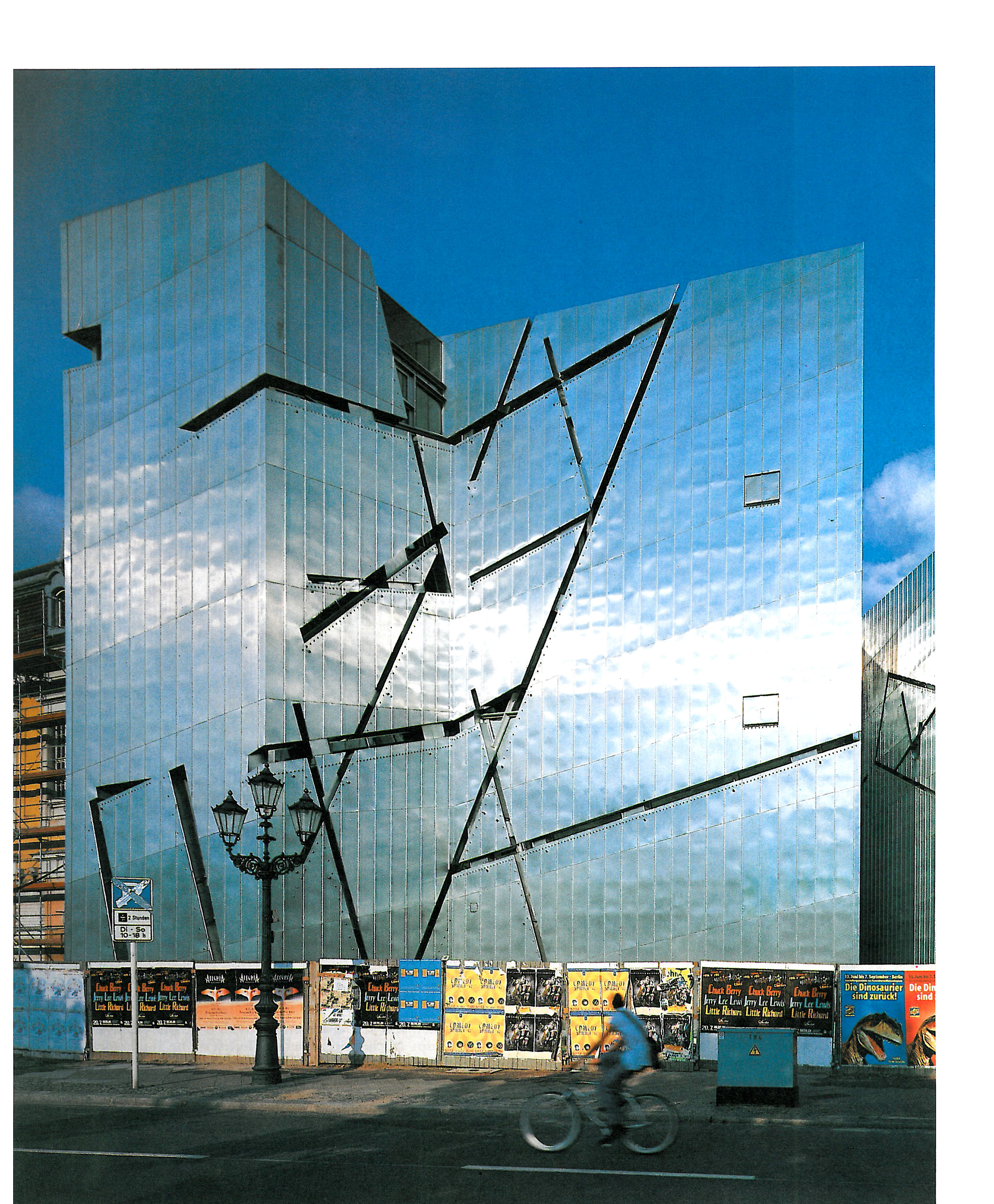
In the other branch the advance guard has been influenced lesser from the compiled views and more from the personal feelings. The most fundamental significance of architecture meaning, the logic of construction and adherence to the rules of resistance have been kept aside. Frank Gehri, Zaha Hadid and Coop Himmelblau, created a work in a new mould with the renewed plan of the obsolete slogan “art for art” by exploiting the latest current technology and proceeded to negate the technology in lieu of the (source of idea) which apparently defies the laws of gravitation. Volumes of constructions like (Chagal) figures are hanging in the space. Confrontation with the laws and with the existing principles changes in to the very basic foundation of designing. Work in lieu of protest has gone one step further (from past works) than the (work in lieu of criticism) and rebellion, the only moral and theoretical capital adopted from expressionism, revives another history. Revolt takes place against assumptions, town planning and the context of the construction that holds the work in the interior. The advance guard, seeks the Genius Loci (the soul of place) connection in contrast and not in harmony, a methodological and verbal contrast that ends in the destruction of the construction in lieu of boxes or rectangular cubes one inside another. The construction turns into a negative personality of the appearance of the city and acquires its strength from its individuality. This new architecture, which is so pivotal and personal, offers original spaces making use of, savage creativity (from the point of view of impertinence and innovation) similar to a modern painting explaining the momentary mental condition of the artist. Projects strong look unfinished and crude. (Incomplete) aesthetic against polished and completed ones, making use of the cuts, bends and broken shapes for inciting the excitement of the viewer. Aesthetic, which is against the renaissance ideology, seems, can be added or deducted without damaging the artistic contents of the work. The problem again is finding a solution for a problem namely, architecture. Now, not the construction, but the architectural projects have gained importance as the main and intellectual objective of the designer. Project is a tool for investigating the different and new possibilities of creating architectural atmosphere. The new atmosphere is nothing but a romantic understanding from today’s knowledge, which has taken artistic shape. Problems like lack of certainty, caos theory, heterogenity and complexity and hermenotics, which have placed the previous beliefs in doubt, convert into values. Architecture is continually the reflection of reality, but an idealized truth that has acquired a mythological value. Practically, the designers find refuge in a perfect world of abstract geometrical forms because in utopian understanding, less attention is paid to the real and touched requirements. Organization of space on the basis of operation has given its place to organization of space according the current human needs, an understanding that the advance guard architect considers to be its prophet. The architect with interference in the very purpose of the construction not only changes the space but also the meaning of the place. In the recent Berlin Museum, works of Libeskind and Bilbao, work of Gehri, changed the place of a museum. The museum has changed from a neutral capsule with a non eye catching aesthetic to a dramatic work, whose duty was to beautify the artistic work leaving a deep impact in understanding the presentation.
In this objective i.e. creating impact and excitement, experienced observers like Libeskind and Gehri who have come into agreement, insist that the legality of each created form should be proved by pure theoretical arguments. It is strange that at the end of the second millennium, a group of architects having so many differences because of the methodology of clashes came closer to each other in the final production. It is here that the superiority of the mould on the contents and the process becomes evident. The world of detached forms, crude and expressionist designs, exaggerated proportions, complicated multi-centered perspectives, deformed volumes, formation of tall pointed volumes, unimaginable curves and whatever completed in negation to the classic forms, is wise and lawful and create a new identity. This identity is the end of second path that always existed in the history of architecture and has continued from the Gothic era till today. If today, we talk about the new expressionism from the point of view of invention of “ism” is nothing new, but to bring up a history where less attention was paid to most of the modernist tendency in particular international designs in the second half of 1930. In the present stage we have to pay more attention not only to the signs of the future, but look for the traces past art in the works of prominent current designers.



