Hossein Sheykh Zeineddin leads Bavand Consulting Engineers. The four projects gathered here all come out of a single investigation: how the elements and parts of a design can expand, transform or dissolve during the design process — without any insistence on holding one of them fixed — until, finally, they produce a new body that is like none of them, though the shadow of all of them can still be recognised in it.
The experience is not yet complete, nor has it settled into a reliable method; its advantage is that it opens many possibilities in the mind of the designer — possibilities which sometimes carry the outcome far beyond what he had expected.
In all four designs, traces of the architectural tradition can be seen — but not as visible, copied quotations from the past. These are foundational concepts for change. In each project, one element of the architectural language of the past — the garden wall and dove-tower in the Esfahan cultural centre, the koushk in the Maskan Bank Club, and the bridge in the embassy scheme — has been chosen and then combined with other bodily and non-bodily factors, and has grown in the combination and moved forward, gradually losing its dominance, only to arrive at a new combination in a fresh balance. This result should not be regarded as finished; in another design, that very final combination may well be taken as a point of departure.
The four projects presented in this issue of Memar have been selected because each of them recounts a particular process in the architectural language, rather than charting the designer’s architectural trajectory through his professional career.
In earlier works, two ways of reaching a present-day architectural language while keeping an eye on the heritage of past civilisation had been tried. The first was the use of explicit, symbolic elements of the valuable architecture of the past and the fusion of that with contemporary functions and requirements. The second was the drawing upon hidden expressions and concepts and their reinterpretation in a contemporary idiom. In both experiments, the visible and the hidden elements remained more or less unchanged to the end of the work. In this new experiment, however, elements taken from historical architecture are released into a free process, so that they develop in step with the evolving design — to the point where nothing of them remains but a shadow.
These designs mark the beginning of a period in which the architectural language no longer confines itself to a single, pure idea; rather, from the very start, many factors and elements are combined with one another in a more complex process. To put it differently: the language of traditional architecture alone, the problem of identity alone, simplicity and function alone, or natural and environmental conditions, aesthetics and philosophical expression — none of these is raised in isolation; in these projects, all of these factors enter into the shaping of the architectural language from the very beginning of the design.
The Club of Maskan Bank, Tehran
The building is to be constructed in the middle of a pleasant garden and, therefore, is designed in a compact form to minimize the area under construction.
The architectural design is in the form of a cubic Koushk (classic garden house), splitted through its radius where an atrium has emerged and in a centrifugal process half of the cube has given way to a modern half circle, accommodating auditorium and spacious halls. Here, a coherent body has been fragmented into classic and modern elements, then combined to create a new version.
The half circle volume is connected to the cube and protruding atrium by contrasting an instable element against a very stable one. Playing with volumes and planes has completed the total combination of the building.
Private House, Tehran
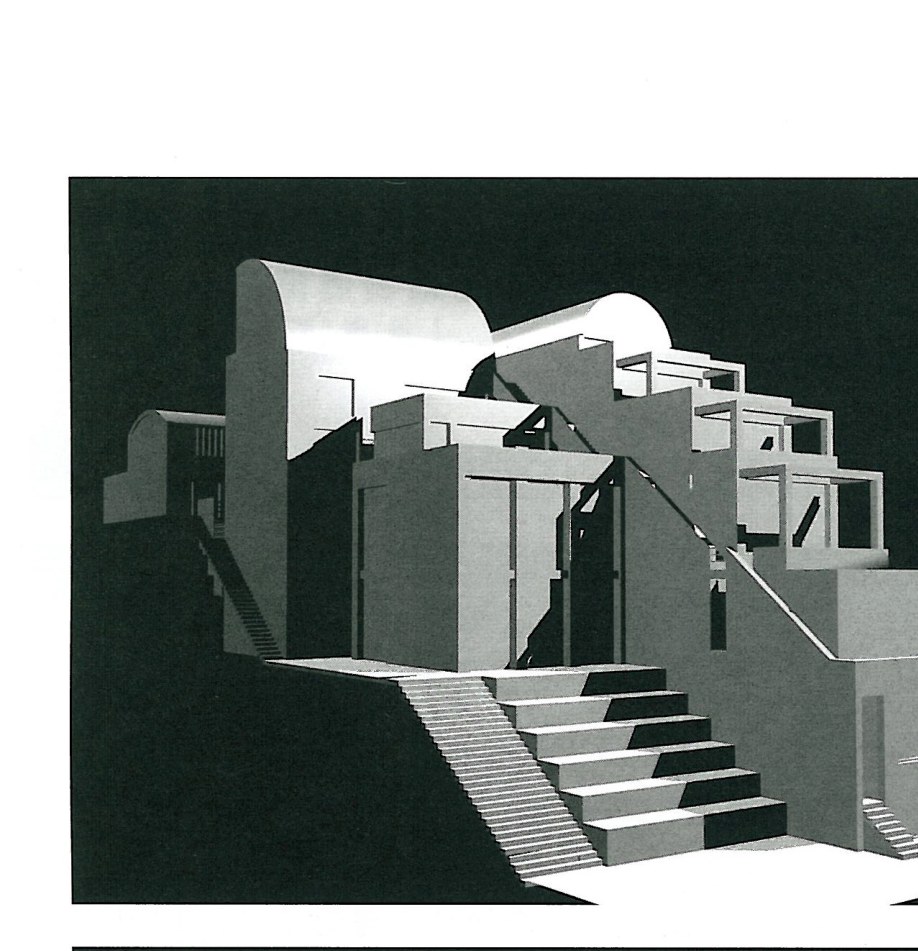
Sharp slope of the site and the pleasant view over surrounding landscape are two significant features in giving form to the spatial structure of the building.
Architectural elements and spaces of the interior are arranged in a style to facilitate decending from upper levels to lower levels, but gradual ascending from the yard level to the street level in the exterior is swift, creating various volumes.
An outdoor stairway passing through the building and its open space toward the lowest border of the site is a distinguished element in this building.
I. R. Iran Embassy, Tokyo, Japan
Diplomatic buildings possess specific characteristics which distinguish them from conventional office buildings. The most significant characteristics are: symbolic aspect which reflects the political and cultural mission of the guest country in the host country; ceremonial functions of a foreign mission and finally, security considerations of the building. Symbolic characteristic is expressed by the architectural vocabulary and language, arising from the original cultural and interpreted in a way that is integrated with the context and the architectural trends in the host country. Ceremonial function adds to the dignity of the building; and the safety is obtained by accurate site selection, observing security considerations as well as equipping the building as an intelligent one. Since the design process is in the schematic and conceptual phase, some differences might be perceptible between the 3D drawings and the plans.
Architectural Concepts
In designing the I.R. Iran’s Embassy in Tokyo, the prime consideration was conformity with the context and the environs, while using some concepts of the Iranian traditional architecture in two different approaches:
First, using implicit and refined concepts oriented to the context in the exterior volume and facade of the building.
Second, with explicit explained and symbolic functional concepts envolved as a new function in the interior spaces.
The bridge, as the symbol of connection and relationship, with some references to the traditional Iranian bridges, namely Khajo bridge in Esfahan. By departing the two side planes from the main volume of the building and creating transparent spaces in between, the concept of bridge is stressed further. The rhythm and sequence of these openings makes a sense of unity and coherence, while interior spaces benefit from direct natural light.
Evan (verandah), is created by designing a garden on a portion of the second floor’s ceremonial lobby roof. The verandah has a pergola making a combination of light and shade, dancing on the facade.
Central Courtyard, is a focal point of the building. It is divided into outdoor and indoor sections by a glass plane covering the facade and the roof. The design of the courtyard is based on the rotation of two axes and the combination of traditional and modern geometry’s.
Holy Defence Museum and Cultural Center in Esfahan
The monumental concept of the building necessitates a sustainable quality. In spite of various functions the building would accommodate according to different events, the physical form is expressed in a grandeur, respectable and firm landmark, resembling the heroic defence and noble militants. The complex is to be built in the eastern side of the famous garden “Qadir” in Esfahan. The main volumes of the building are in the forms of a fortification and a fort — the former a symbol of strenght and defining element of the garden’s eastern border, and the latter resembling both the defensive character of the war and renown towers in Esfahan.



